
Clock Reasoning Cheat Sheet
31 Oct 2026
Quick answer
A quick revision cheat sheet on clock problems for SSC, Banking, Railway and state exams. It covers the degrees moved by the hour and minute hands, the formula for the angle between the two hands, how often the hands coincide, point opposite or form a right angle, and the common gaining-time idea, with worked examples.
Clock Reasoning Cheat Sheet
Quick Revision
A clock is a circle of 360° divided into 12 hours and 60 minutes. Clock problems come down to how fast each hand moves and the angle between them.
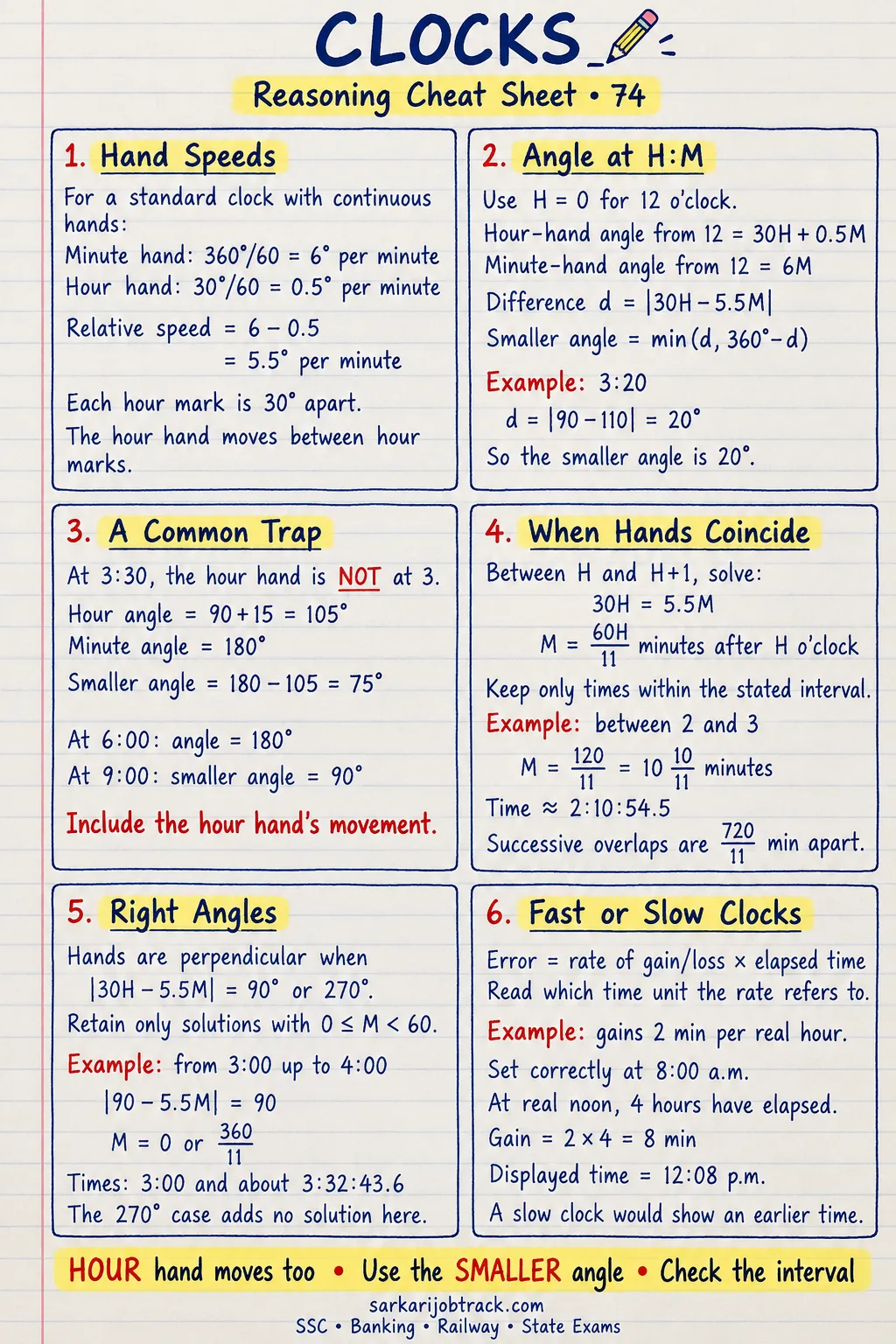
1. How Fast Each Hand Moves
| Hand | In 60 minutes | Per minute |
|---|---|---|
| Minute hand | 360° | 6° |
| Hour hand | 30° | 0.5° |
- Each hour mark is
360 / 12 = 30°apart. - Each minute mark is
360 / 60 = 6°apart.
2. Angle Between the Hands
For a time of H hours and M minutes:
Angle = | 30H − 5.5M |If the result is more than 180°, subtract it from 360° to get the smaller angle.
Example
At 3:40:
= | 30×3 − 5.5×40 |
= | 90 − 220 |
= 130°
3. Special Positions
| Position | How often in 12 hours |
|---|---|
| Hands coincide (0° apart) | 11 times |
| Hands point opposite (180°) | 11 times |
| Hands at a right angle (90°) | 22 times |
The hands coincide every 65 5/11 minutes, not every 60 minutes, because the hour hand also moves.
4. The Gaining Idea
In 60 minutes the minute hand gains 55 minute-spaces over the hour hand (the minute hand covers 60, the hour hand 5). This is why the hands meet a little after each hour, not exactly on it.
5. Exam Quick Tips
- Use
Angle = |30H − 5.5M|; if over 180°, take360 − angle. - The hands coincide 11 times, not 12, in 12 hours.
- A right angle happens 22 times in 12 hours.
- Remember the speeds: minute hand 6°/min, hour hand 0.5°/min.
Keep revising with the rest of the Reasoning section:
How this was made: Drafted with AI assistance; spot-checked by the editor on 31 October 2026.