
Decision Making Cheat Sheet
31 Oct 2026
Quick answer
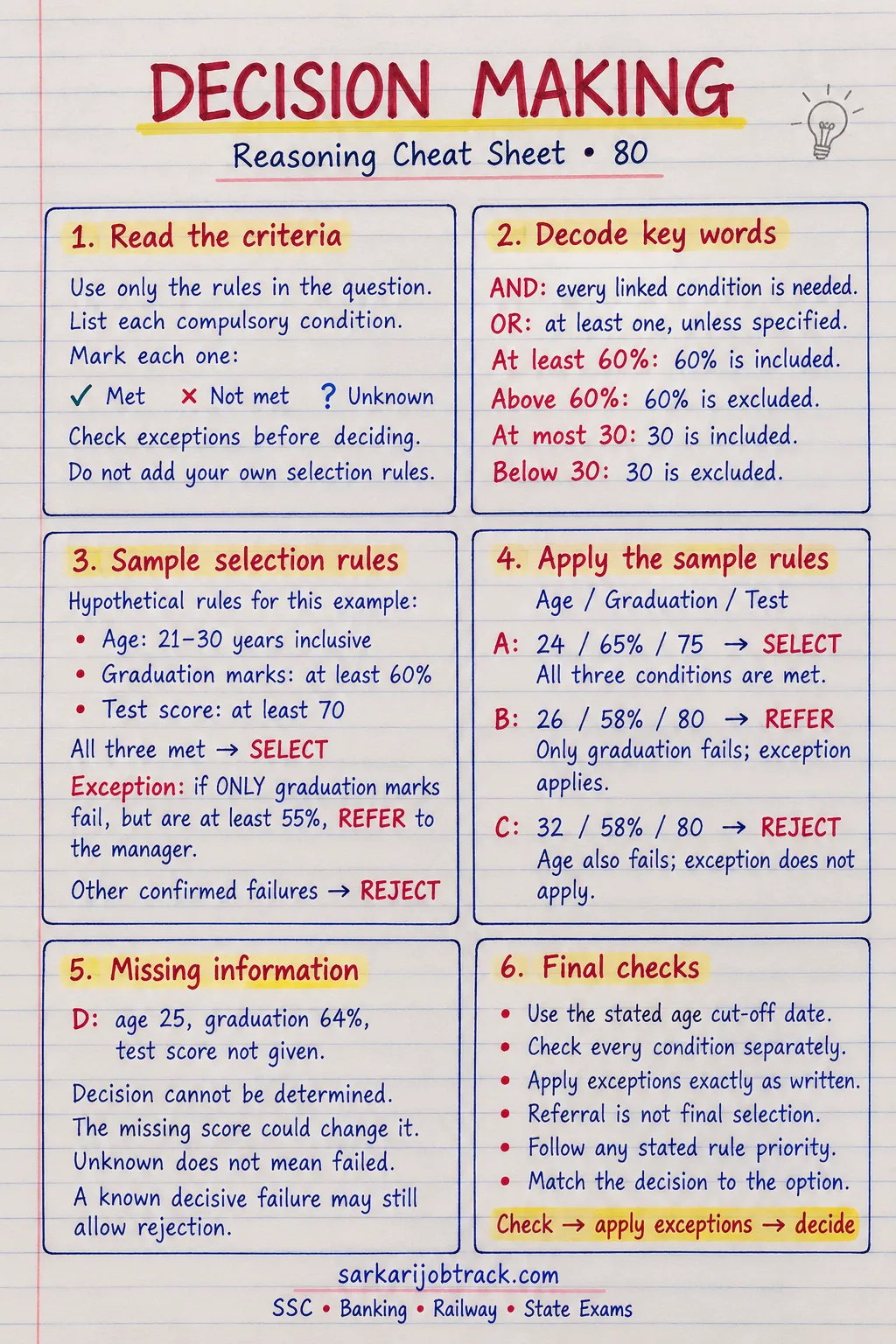
A quick revision cheat sheet on decision making for SSC, Banking, Railway and state exams. It covers how these questions give eligibility conditions and a candidate's data, the standard outcomes, how to apply each condition and its exceptions, and the common traps, with a worked example to revise quickly before the exam.
Decision Making Cheat Sheet
Quick Revision
In a decision making question you are given a set of conditions (eligibility rules) and the data of one or more candidates. You apply the rules and choose the correct outcome.
1. The Standard Outcomes
The candidate is selected
The candidate is not selected
The case is referred to a higher authority
The data given is inadequate to decide
2. How to Apply the Conditions
- List every condition as a separate checkbox.
- Tick each one against the candidate's data.
- If all main conditions are met → selected.
- If one main condition fails and no exception applies → not selected.
3. Exceptions and Referrals
Many sets include an exception clause — "if a candidate meets all conditions except X, the case is referred to the (named officer)". Always read the exception after the main conditions, and refer the case only when the clause says so.
4. Worked Example
Conditions: A candidate must (i) be at least 21, and (ii) hold a degree. Exception: if (ii) is not met but the candidate has 5 years' experience, refer to the Director.
- Candidate: 24 years old, no degree, 6 years' experience → the exception applies → refer to the Director.
5. Exam Quick Tips
- Check conditions one at a time; a single unmet main condition usually means not selected.
- Apply an exception clause exactly as worded — it often triggers a referral, not a selection.
- Choose "data inadequate" only when a needed fact is genuinely missing.
Keep revising with the rest of the Reasoning section:
How this was made: Drafted with AI assistance; spot-checked by the editor on 31 October 2026.