
Inequalities Reasoning Cheat Sheet
31 Oct 2026
Quick answer
A quick revision cheat sheet on reasoning inequalities for SSC, Banking, Railway and state exams. It covers the inequality symbols, how to combine relations into a chain, when a conclusion is definitely true, the coded-inequality type, and the either-or case that trips up most candidates, with clear examples.
Inequalities Reasoning Cheat Sheet
Quick Revision
Inequality questions give relations between variables (like A > B ≥ C) and ask which conclusions must be true. The skill is to combine the relations correctly and know when a conclusion is certain.
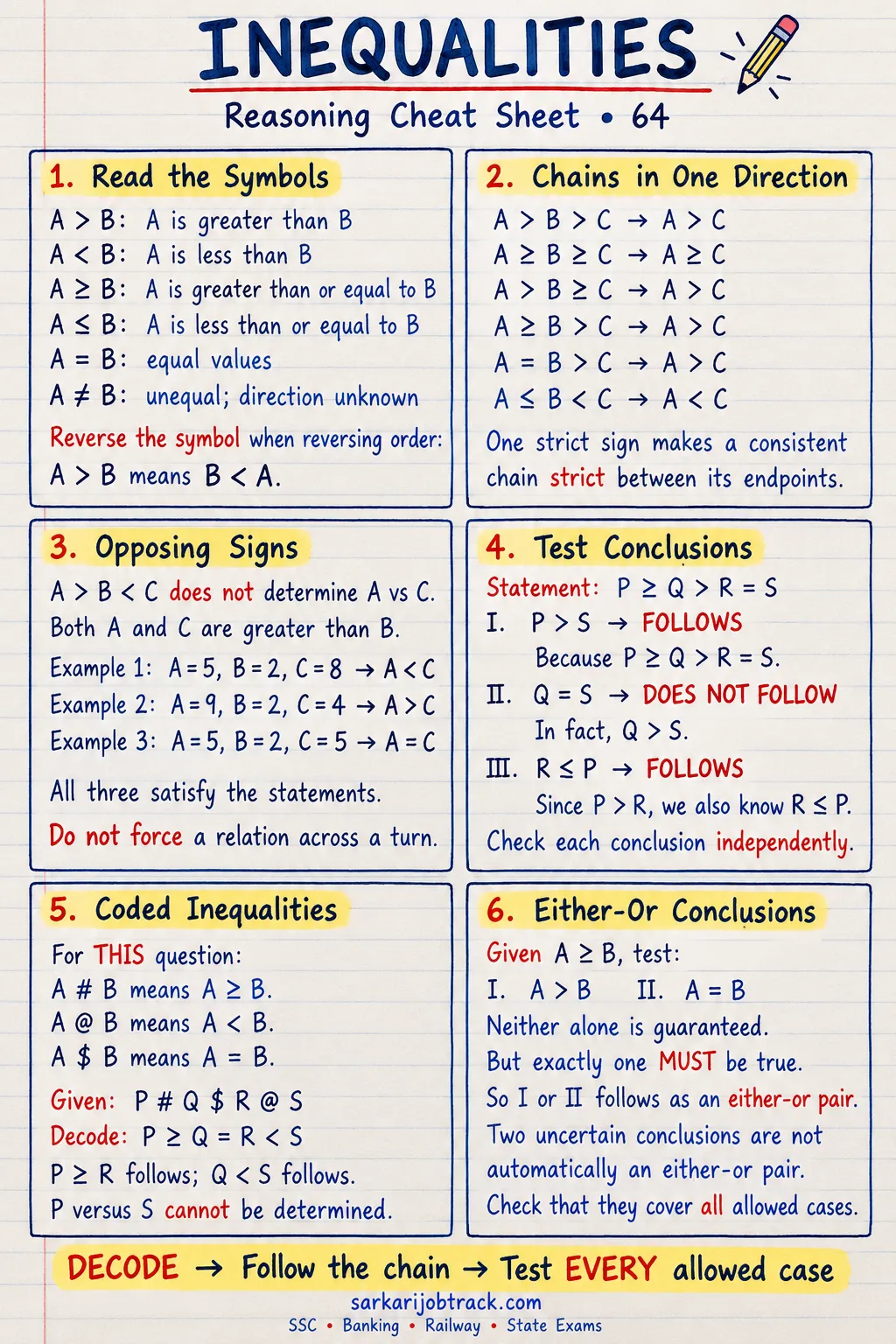
1. The Symbols
| Symbol | Meaning |
|---|---|
| A > B | A is greater than B |
| A < B | A is less than B |
| A ≥ B | A is greater than or equal to B |
| A ≤ B | A is less than or equal to B |
| A = B | A equals B |
| A ≠ B | A is not equal to B |
2. Combining Relations
A conclusion between the two ends of a chain is certain only if every link points the same way.
| Chain | Valid conclusion |
|---|---|
| A > B > C | A > C |
| A > B ≥ C | A > C |
| A ≥ B > C | A > C |
| A ≥ B ≥ C | A ≥ C |
If the links change direction (for example A > B < C), no relation between A and C can be fixed.
3. Coded Inequalities
Some questions replace the symbols with codes (for example "@" means ≥). First decode every symbol, rewrite the statements with real signs, and only then test the conclusions.
4. The Either–Or Case
When a single conclusion is not certain but two conclusions together cover every possibility, the answer is "either … or".
This happens when the two conclusions are complementary on the same pair of variables — for example A ≥ B splits into A > B or A = B. If neither alone is always true but one of them must be, the answer is either A > B or A = B.
5. Exam Quick Tips
- A conclusion across a chain is sure only when all signs agree in direction.
- A single
>anywhere makes the end relation strict (>), not≥. - For coded questions, rewrite with real symbols first.
- Spot the either-or case: two complementary conclusions on the same pair.
Keep revising with the rest of the Reasoning section:
How this was made: Drafted with AI assistance; spot-checked by the editor on 31 October 2026.