
Simplification: A Lesson on BODMAS, 'of' and Fast Approximation
Learn to simplify a long numerical expression in the right order using BODMAS, handle 'of' and brackets correctly, combine fractions and percentages, and use approximation to answer "find the approximate value" questions quickly. Worked step by step in the exam's simplification and approximation styles, with the squares and roots worth memorising and the mistakes to avoid.
By the end of this lesson you will be able to take a long expression such as "12 + 6 ÷ 2 × 3 − 4" and simplify it in the correct order without second-guessing, handle of, brackets, fractions and percentages together, and round sensibly to answer an "approximate value" question in seconds.
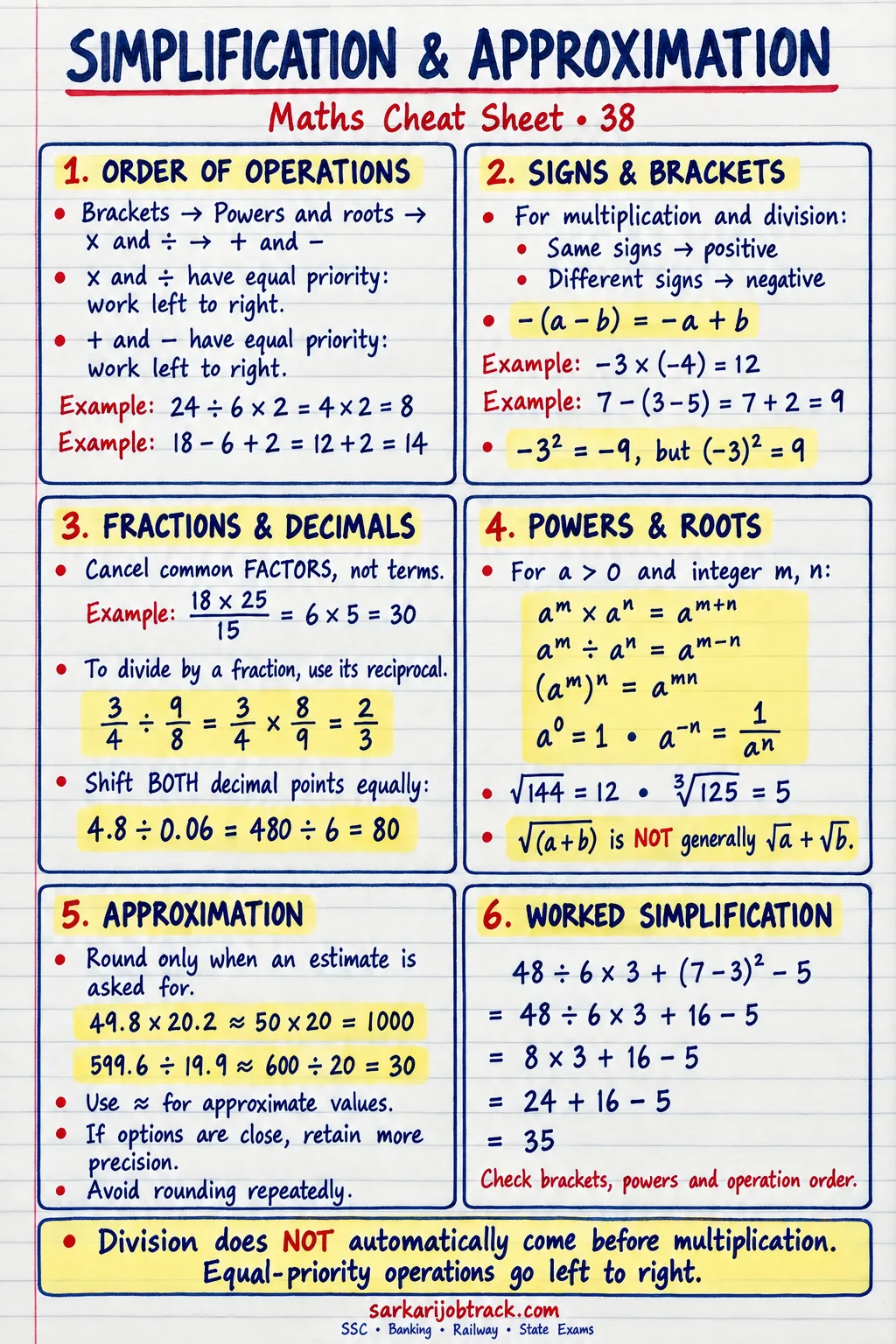
Already confident? Skip to practice: Simplification quiz
Before this: simplification mixes whole numbers, fractions and percentages, so you must be able to add and subtract fractions first. If that feels shaky, read the Fractions and Decimals lesson before this one.
The order: BODMAS
An expression with several operations has exactly one correct answer, and the order is fixed by BODMAS:
| Letter | Operation | Note |
|---|---|---|
| B | Brackets | Innermost first: ( ) then { } then [ ] |
| O | Order (powers and roots) | Squares, cubes, square roots |
| D | Division | Division and multiplication rank equally |
| M | Multiplication | — do them left to right |
| A | Addition | Addition and subtraction rank equally |
| S | Subtraction | — do them left to right |
The one point everyone gets wrong: division and multiplication are equal in rank, and so are addition and subtraction. When two equal operations sit side by side, you work left to right — not all multiplication before all division.
Worked example. Simplify 12 + 6 ÷ 2 × 3 − 4.
- Division and multiplication first, left to right: 6 ÷ 2 = 3, then 3 × 3 = 9.
- Now addition and subtraction, left to right: 12 + 9 − 4 = 17.
A common wrong answer is 9, from doing 2 × 3 = 6 first, which turns the middle into 6 ÷ 6 = 1 and gives 12 + 1 − 4. Equal operations go left to right, so the division comes first here.
Brackets and 'of'
Brackets are opened from the inside out. Simplify 5 × (8 − 3) + 12 ÷ 4.
- Bracket first: 8 − 3 = 5.
- Then 5 × 5 = 25 and 12 ÷ 4 = 3.
- Add: 25 + 3 = 28.
'of' means multiply, and it is worked before an ordinary division (the convention most exams state). So in ½ of 60 + 20% of 150:
- ½ of 60 = 30; 20% of 150 = 30.
- 30 + 30 = 60.
Fractions and percentages together
Simplification questions usually mix fractions and percentages, so convert to one form and work with BODMAS.
Worked example. Simplify 2/3 + 3/4 − 1/6.
- The LCM of 3, 4 and 6 is 12.
- 2/3 = 8/12, 3/4 = 9/12, 1/6 = 2/12.
- 8/12 + 9/12 − 2/12 = 15/12 = 5/4 = 1.25.
Percentage as a fraction. A percentage is quicker as its fraction: 25% = 1/4, 20% = 1/5, 12.5% = 1/8, 16⅔% = 1/6. So 12.5% of 320 = 320 ÷ 8 = 40, with no long multiplication.
Approximation: the "find the approximate value" question
Many questions ask for the approximate value, and the options are far apart, so you round each number to something easy and compute. Do not calculate exactly — that wastes time the question is not testing.
Worked example. Find the approximate value of 49.8 × 20.1.
- Round: 49.8 ≈ 50, 20.1 ≈ 20.
- 50 × 20 = 1000. (The exact value is 1000.98, so 1000 is the right choice.)
Worked example. Approximate 1199 ÷ 24.05.
- Round: 1199 ≈ 1200, 24.05 ≈ 24.
- 1200 ÷ 24 = 50. (Exact is about 49.9, so 50 is right.)
The skill is rounding each number to the nearest easy figure before operating, and trusting that the far-apart options absorb the small error.
Squares and roots worth memorising
Simplification speeds up enormously if these are instant recall.
- Squares 1–15: 1, 4, 9, 16, 25, 36, 49, 64, 81, 100, 121, 144, 169, 196, 225.
- Squares 16–20: 256, 289, 324, 361, 400.
- Cubes 1–10: 1, 8, 27, 64, 125, 216, 343, 512, 729, 1000.
So a root question is just recognition: √196 = 14, √324 = 18, ∛343 = 7.
Worked example. Simplify √(144) + 3³ − √(81).
- √144 = 12, 3³ = 27, √81 = 9.
- 12 + 27 − 9 = 30.
Common mistakes to avoid
- Doing multiplication before division by habit — they rank equally; go left to right. 8 ÷ 2 × 4 is (8 ÷ 2) × 4 = 16, not 8 ÷ 8 = 1.
- Treating subtraction as higher than addition — they are equal; 10 − 4 + 2 = 8, not 10 − 6 = 4.
- Calculating an approximation exactly — if the question says "approximate", round first; exact working loses time.
- Forgetting 'of' before division — ½ of 10 ÷ 5 is (½ × 10) ÷ 5 = 1, when the convention of working of first is stated.
Quick revision table
| Step | Rule |
|---|---|
| 1 | Brackets, innermost first |
| 2 | Orders — powers and roots |
| 3 | Division and multiplication, equal rank, left to right |
| 4 | Addition and subtraction, equal rank, left to right |
| 'of' | means ×, worked before an ordinary division |
| % | use the fraction: 25% = ¼, 20% = ⅕, 12.5% = ⅛ |
| Approximate | round each number first, then operate |
Keep this and the simplification cheat sheet for revision. Simplification underlies every other arithmetic topic, so follow it with Percentage, where the fraction-of-a-percentage shortcut is used throughout.
How this was made: Drafted with AI assistance; every formula and worked figure recomputed independently.