
Active and Passive Voice Cheat Sheet
2 Nov 2026
Quick answer
A quick English grammar revision sheet on changing the voice — the three steps from active to passive, the form of the verb in each tense, and how to handle questions, imperatives and modals — with examples and the common errors, for fast SSC, Banking and Railway revision.
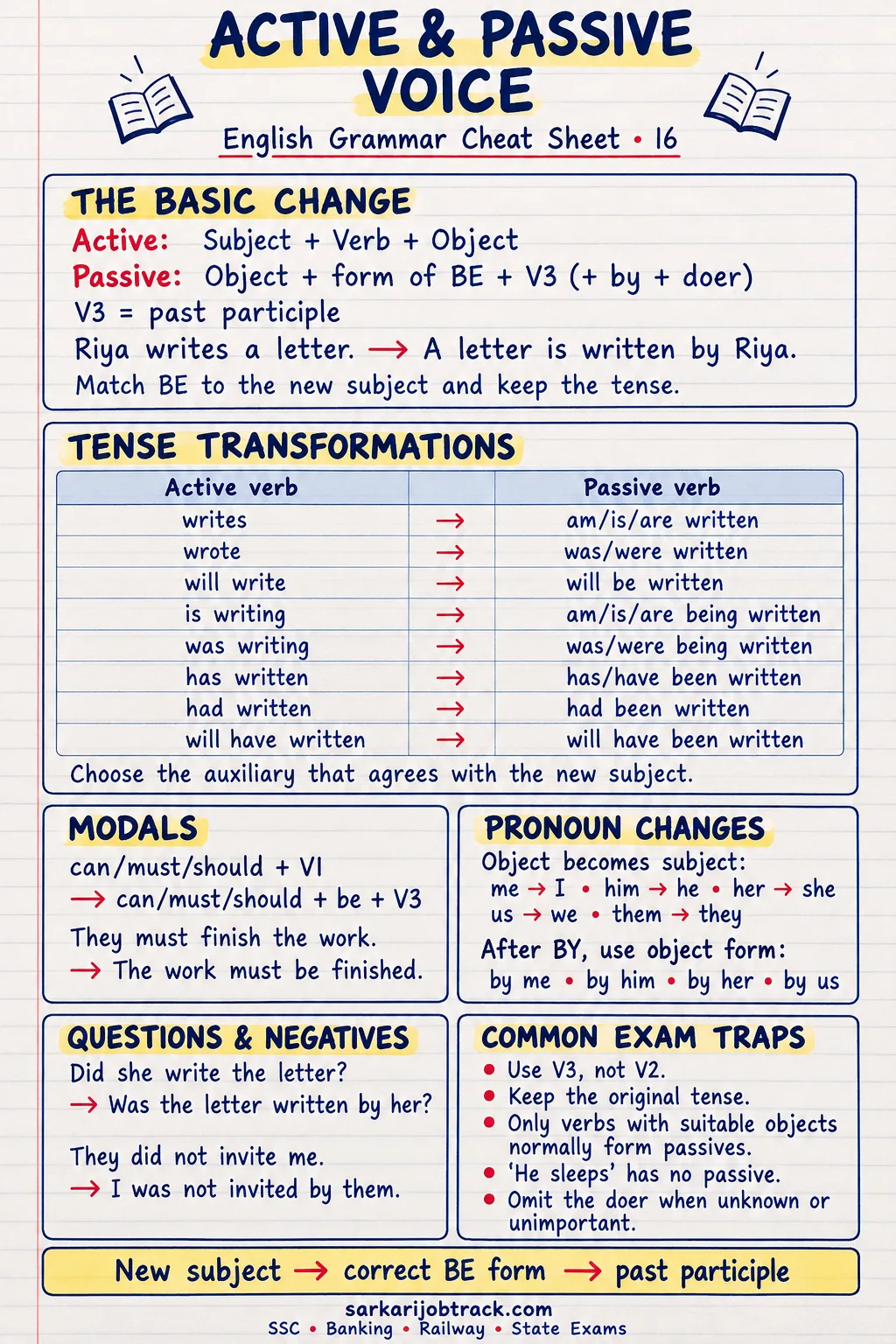
To change active to passive, the object becomes the subject, the verb becomes a form of be + past participle (keeping the tense), and the old subject moves to a by phrase.
The three steps
- Object → subject. "The gardener waters the plants" → "The plants …"
- Verb → be + past participle, same tense. "waters" → "are watered".
- Subject → by phrase. "… by the gardener."
Result: The plants are watered by the gardener.
The verb form by tense
| Tense | Active | Passive (be + V3) |
|---|---|---|
| Simple present | writes | is written |
| Present continuous | is writing | is being written |
| Present perfect | has written | has been written |
| Simple past | wrote | was written |
| Past continuous | was writing | was being written |
| Past perfect | had written | had been written |
| Simple future | will write | will be written |
| Modal | can write | can be written |
Special sentence types
- Questions: keep the question form. "Did he write it?" → "Was it written by him?"
- Imperatives: use Let … be …. "Open the door." → "Let the door be opened."
- No object, no passive: an intransitive verb (sleep, arrive) has no object, so it cannot be made passive.
Common errors
- Forgetting to change the verb to be + past participle (the third form), e.g. writing "are water" for "are watered".
- Changing the tense — the passive keeps the active tense; only the form of be carries it.
Revise the full method in the Active and Passive Voice lesson, then practise these questions or browse more English revision sheets.
How this was made: Drafted with AI assistance; every fact checked against the source it cites.