
Active and Passive Voice: A Beginner's Lesson on Changing the Voice
Learn how to change a sentence from the active voice to the passive and back — moving the object to the front, turning the verb into a form of be plus the past participle, and keeping the tense — and how to handle each tense, questions, imperatives and modals, through worked examples in the change-the-voice style.
By the end of this lesson you will be able to take an active sentence, find its object, and rebuild it in the passive with the right form of the verb, and do the same change in reverse, so that you can answer "Change into the passive voice: The gardener waters the plants" with confidence.
Already confident? Skip to practice: Active and Passive Voice quiz
Before this: the passive form of a verb is built from the tense of the active verb, so you must be able to name a tense first. If that feels shaky, read the Tenses lesson before this one.
What "active" and "passive" mean
The two voices say the same thing, but they put a different word in the subject's place.
- Active: the subject does the action. "The gardener waters the plants." (The gardener is the doer.)
- Passive: the subject has the action done to it. "The plants are watered by the gardener." (The plants are now the subject, and the gardener is pushed to the end.)
The exam question gives you a sentence in one voice and asks for the correct version in the other. Nothing about the meaning changes; only the shape of the sentence changes. The whole task is a set of fixed, mechanical steps, and once you know them the answer is never a matter of opinion.
The three changes
Every active-to-passive change is the same three moves. Learn them as one unit.
| Step | What you do | Example |
|---|---|---|
| 1. Swap subject and object | The object of the active verb becomes the subject of the passive sentence. | the plants moves to the front |
| 2. Rebuild the verb | The verb becomes a form of be + the past participle (the third form: watered, written, done). The form of be carries the same tense as the active verb. | waters → are watered |
| 3. Add the agent | The old subject becomes the agent, placed after by at the end. | by the gardener |
So "The gardener waters the plants" becomes "The plants are watered by the gardener."
Two things decide the verb form. First, the tense never changes: a simple past active gives a simple past passive, a present perfect gives a present perfect, and so on. Second, the number of the new subject — singular or plural — decides whether be is is/was or are/were. In "The plants are watered", plants is plural, so be is are.
A verb must have an object before it can go into the passive. A verb with no object (sleep, arrive, laugh) has no passive, because there is nothing to move to the front.
The passive of each tense
The past participle stays the same throughout; only the form of be changes with the tense. Here is one verb, build, as a model.
| Tense | Active | Passive (singular / plural be) |
|---|---|---|
| Simple present | builds | is / are built |
| Present continuous | is / are building | is / are being built |
| Present perfect | has / have built | has / have been built |
| Simple past | built | was / were built |
| Past continuous | was / were building | was / were being built |
| Past perfect | had built | had been built |
| Simple future | will build | will be built |
| Future perfect | will have built | will have been built |
Match the active tense to its row, keep the past participle (built), and choose is/was or are/were by the number of the new subject.
The perfect continuous forms (has been building, had been building) and the future continuous (will be building) are almost never put into the passive, and the exam does not ask for them. If you meet one, leave the sentence in the active.
When the "by" phrase is dropped
The agent after by is left out when it adds nothing — when the doer is unknown, obvious, or an indefinite word such as somebody, someone, people, they or one.
- "Someone has broken the lock." → "The lock has been broken." (We do not know who, so by someone is dropped.)
- "They grow tea in Assam." → "Tea is grown in Assam." (They names nobody in particular.)
- "One cannot change the past." → "The past cannot be changed."
Keep the by phrase only when it names a definite, useful doer: "The plants are watered by the gardener."
A pronoun agent changes form. The agent takes the object form: I → by me, he → by him, she → by her, we → by us, they → by them.
Questions in the passive
A question stays a question. Keep the helping verb in front of the subject.
- Yes/no question: "Did she write the report?" → "Was the report written by her?"
- *A wh- word that is the object: "What did he say?" → "What was said* by him?"
- *A who that is the doer: who becomes by whom, and the sentence keeps its question order. "Who painted this picture?" → "By whom was* this picture painted?"
Imperatives (commands) in the passive
A command has no subject, so it takes a special pattern: Let + the object + be + the past participle.
- "Close the window." → "Let the window be closed."
- A negative command adds not: "Do not waste water." → "Let water not be wasted." (Some papers also accept "Water should not be wasted.")
Modals in the passive
A modal (can, could, may, must, should, will, would) keeps its own form and is simply followed by be + the past participle.
- "You can solve this puzzle." → "This puzzle can be solved by you."
- "The soldiers must defend the fort." → "The fort must be defended by the soldiers."
Changing passive back to active
The reverse change undoes the same three moves: the agent after by becomes the subject, the be + past participle becomes an ordinary verb in the same tense, and the old subject becomes the object.
- "The report was signed by the manager." → "The manager signed the report." (Simple past passive → simple past active.)
- "A song is being sung by the choir." → "The choir is singing a song." (Present continuous both ways.)
The tense is your anchor both ways: find it first, and it tells you which active or passive form to build.
Worked examples
Example 1: Simple present
Question: Change into the passive voice: The gardener waters the plants.
- Find the object of the active verb waters: the plants. Move it to the front as the new subject.
- The active tense is simple present, so the passive is is/are + past participle. Plants is plural, so use are; the past participle of water is watered: are watered.
- The old subject the gardener becomes the agent: by the gardener.
Answer: "The plants are watered by the gardener."
The principle: object to the front, verb to be + past participle in the same tense, old subject into a by phrase. The number of the new subject fixes is or are.
Example 2: Simple past
Question: Change into the passive voice: The flood damaged the crops.
- The object is the crops; it becomes the subject.
- The tell is the tense. Damaged is simple past, so the passive keeps the simple past: was/were + past participle. Crops is plural → were; the past participle is damaged: were damaged.
- The old subject becomes the agent: by the flood.
Answer: "The crops were damaged by the flood."
The principle: the tense never changes in the passive. A simple past active becomes was/were + past participle, not is/are and not has/have been.
Example 3: Present continuous
Question: Change into the passive voice: The tailor is stitching my shirt.
- The object is my shirt; it becomes the subject.
- Is stitching is present continuous, whose passive is is/are being + past participle. Shirt is singular → is being; the past participle is stitched: is being stitched.
- Add the agent: by the tailor.
Answer: "My shirt is being stitched by the tailor."
The principle: a continuous tense keeps being in the passive — is/are being done, was/were being done. Dropping being turns it into the wrong tense.
Example 4: Changing passive back to active
Question: Change into the active voice: The winners have been chosen by the judges.
- The agent after by is the judges; it becomes the subject.
- Have been chosen is the present perfect passive, so the active keeps the present perfect: has/have + past participle. The subject the judges is plural → have chosen.
- Your turn: what is the object, and what does the whole active sentence read?
Check: the old subject the winners becomes the object, so the sentence is "The judges have chosen the winners."
The principle: to go back to the active, make the by agent the subject and keep the same tense. Has/have been + past participle is present perfect, so the active is has/have + past participle.
Example 5: An imperative
Question: Change into the passive voice: Shut the gate.
- A command has no subject, so it takes the pattern Let + object + be + past participle.
- The object is the gate. The past participle of shut is shut.
- Your turn: fit the object and the verb into the Let … be … pattern.
Check: "Let the gate be shut."
The principle: an imperative becomes Let + the object + be + the past participle. A negative command adds not: Let … not be ….
Example 6: A question
Question: Change into the passive voice: Who painted this picture?
- The object is this picture; it becomes the subject.
- The doer is who, so it becomes by whom, and the sentence must stay a question with the helping verb before the subject.
- The tense is simple past, so the verb is was + past participle: was painted.
- Your turn: put by whom, the helping verb, the subject and the verb in question order.
Check: "By whom was this picture painted?"
The principle: a question stays a question. A who that names the doer becomes by whom, and the helping verb keeps its place in front of the subject.
Example 7: Your turn
Question: Change the voice of each sentence. Cover the table below, write your answers, then check.
- The children are flying kites. (to passive)
- A thief stole her purse. (to passive)
- The volunteers will clean the park. (to passive)
- Someone has switched off the fan. (to passive)
- Post this letter. (to passive)
- The nurse must check the patient. (to passive)
- The cake was baked by my aunt. (to active)
- The streets are being decorated by the workers. (to active)
| Sentence | Answer | Why |
|---|---|---|
| 1 | Kites are being flown by the children. | Present continuous → is/are being + past participle. |
| 2 | Her purse was stolen by a thief. | Simple past → was/were + past participle. |
| 3 | The park will be cleaned by the volunteers. | Simple future → will be + past participle. |
| 4 | The fan has been switched off. | Present perfect → has/have been; someone is dropped. |
| 5 | Let this letter be posted. | A command → Let + object + be + past participle. |
| 6 | The patient must be checked by the nurse. | A modal keeps its form + be + past participle. |
| 7 | My aunt baked the cake. | The by agent becomes the subject; simple past stays. |
| 8 | The workers are decorating the streets. | Is/are being + past participle is present continuous. |
The principle: find the tense first, move the object to the front (or the agent, going the other way), and rebuild the verb in that same tense.
A quick checklist
Before you choose, run through four questions:
- Find the object of the active verb. It becomes the subject of the passive sentence. (Going the other way, the by agent becomes the subject.)
- Name the tense. It must be the same in both voices.
- Build the verb: the matching form of be + the past participle. Choose is/was or are/were by the number of the new subject.
- Handle the agent: add by + the old subject, and drop it if the doer is unknown or indefinite.
Common mistakes
- Losing the tense. "The thief was caught", not "is caught", for a simple past. Match the tense before anything else.
- Forgetting the past participle. After be, use the third form: written (not wrote), done (not did), taken (not took). "It was written", never "It was wrote".
- *Dropping being or been. A continuous passive needs being (is being built); a perfect passive needs been (has been built*). Leaving them out changes the tense.
- Agreement with the new subject. The verb agrees with the word now in front: "The letters were posted" (plural), "The letter was posted" (singular).
- Wrong agent pronoun. The agent takes the object form: by me, by him, by them — never by I or by he.
- *Keeping a useless by phrase. Drop the agent when it is somebody, people, they or one*: "My purse has been stolen", not "has been stolen by somebody".
Practise and go next
Practise now: Active and Passive Voice quiz
Next: the other topic that builds straight on the tenses is Direct and Indirect Speech, where a past reporting verb shifts the tense back. After that, Error Spotting and Sentence Improvement ask you to catch a wrong passive or verb form inside a longer sentence.
Active and Passive Voice at a glance
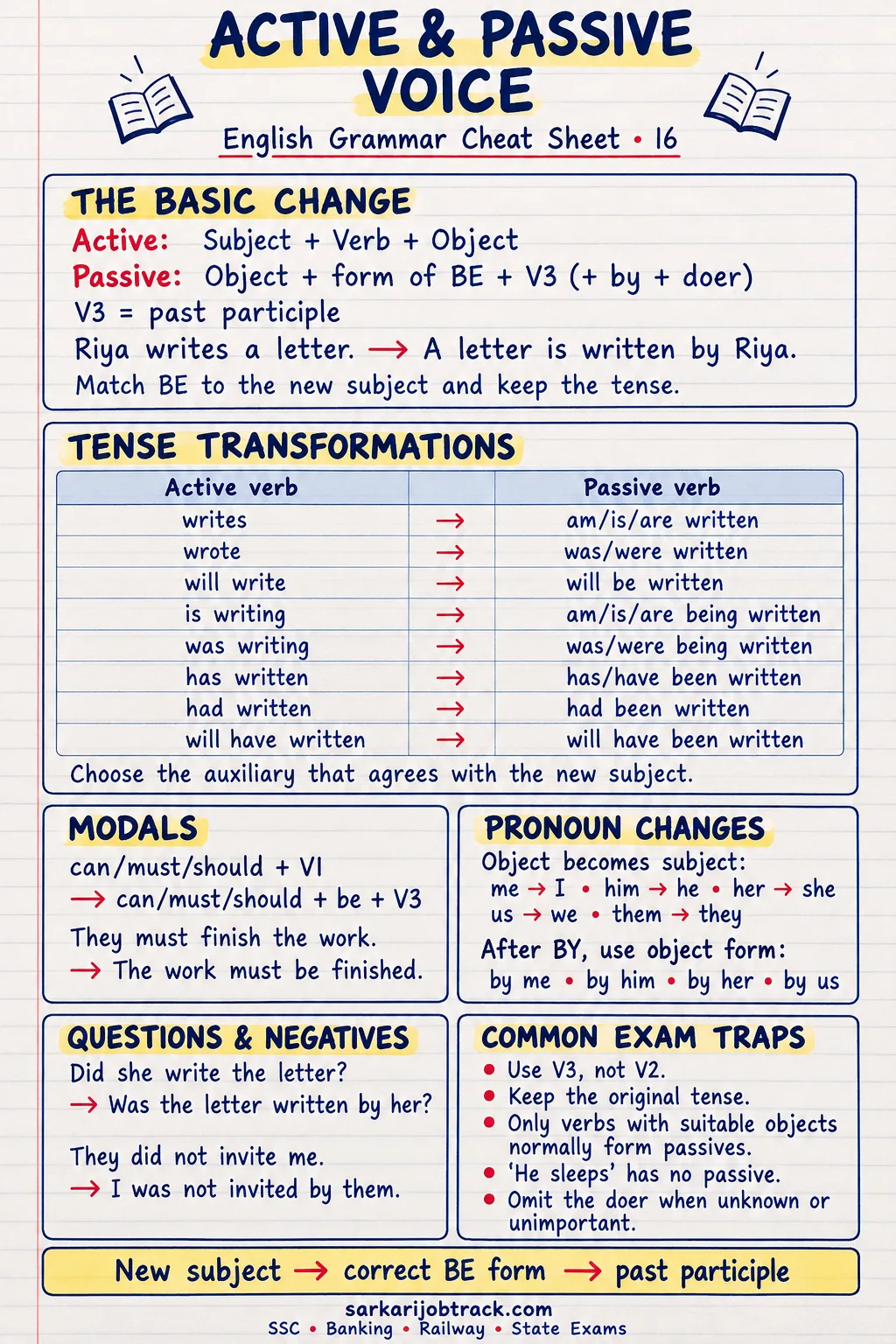
Quick revision — the whole method on one screen. The revision image at the top of this lesson sets out the same points.
The passive of each tense (model verb build; the past participle built never changes):
| Tense | Active | Passive |
|---|---|---|
| Simple present | builds | is / are built |
| Present continuous | is / are building | is / are being built |
| Present perfect | has / have built | has / have been built |
| Simple past | built | was / were built |
| Past continuous | was / were building | was / were being built |
| Past perfect | had built | had been built |
| Simple future | will build | will be built |
| Future perfect | will have built | will have been built |
| Modal (can, must, should …) | must build | must be built |
The perfect continuous forms and the future continuous are not normally used in the passive.
The steps:
- Make the object of the active verb the new subject.
- Rebuild the verb as the matching form of be + the past participle, keeping the same tense; choose is/was or are/were by the number of the new subject.
- Put the old subject into a by phrase, and drop it when the doer is unknown or indefinite.
- For a question, keep the question order (who → by whom); for a command, use Let … be …; for a modal, use the modal + be + past participle.
How this was made: Drafted with AI assistance; spot-checked by the editor on 28 October 2026.