
Arithmetic Progression Cheat Sheet
31 Oct 2026
Quick answer
A quick revision cheat sheet on arithmetic progression (AP) for SSC, Banking, Railway and state exams. It covers the nth-term formula, the sum of the first n terms in both forms, the arithmetic mean, and the standard shortcuts, with worked examples to revise quickly before the exam.
Arithmetic Progression Cheat Sheet
Quick Revision
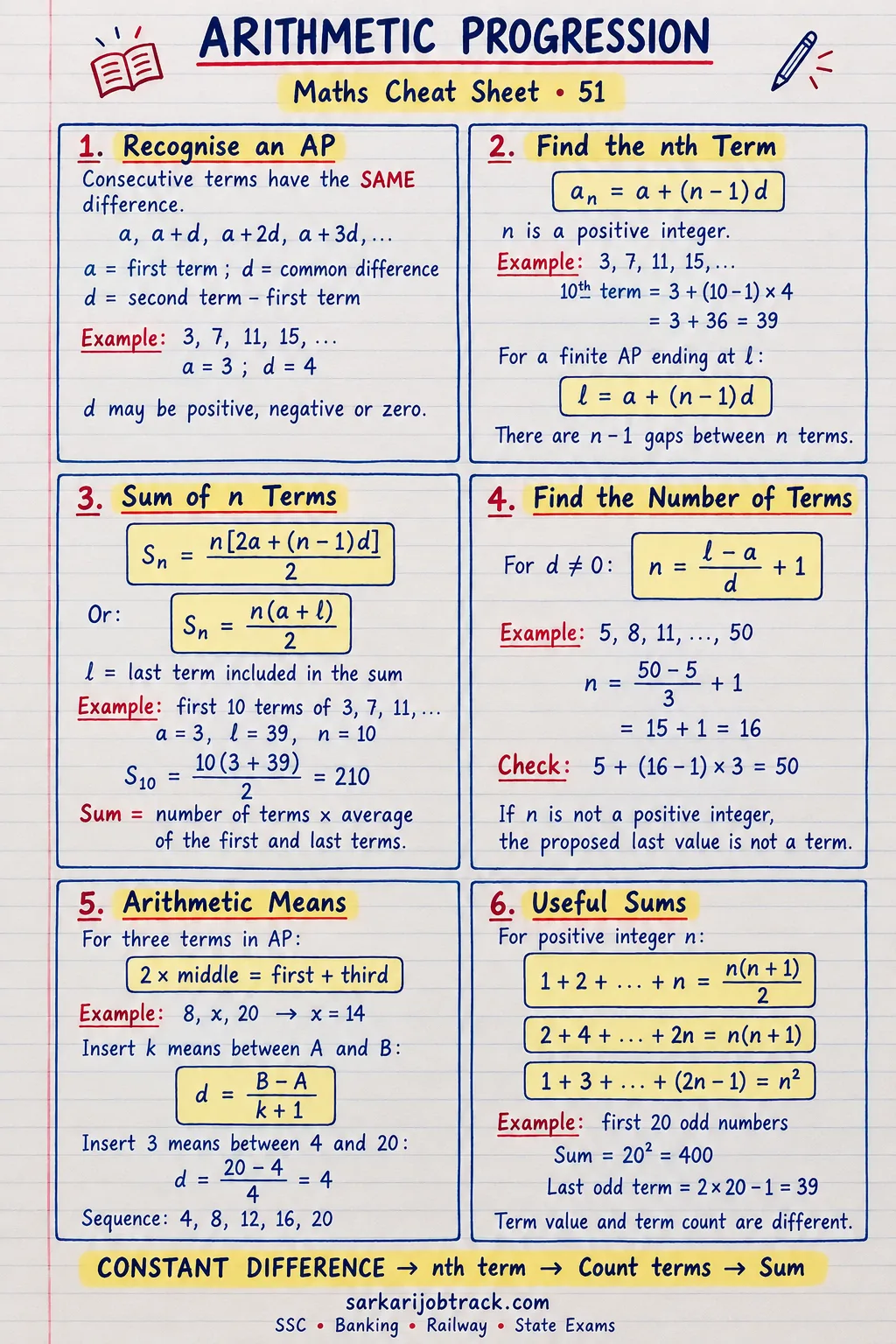
An arithmetic progression (AP) is a sequence in which each term differs from the one before it by a fixed number, the common difference d. With first term a, the terms are a, a + d, a + 2d, a + 3d, ….
1. The nth Term
aₙ = a + (n − 1)dHere a is the first term, d the common difference and n the term number.
2. Sum of the First n Terms
Sₙ = n/2 × [2a + (n − 1)d]
Sₙ = n/2 × (a + l)        (l = last term)
Use the first form when you know a and d; use the second when you already know the last term l.
3. Arithmetic Mean
The arithmetic mean of two numbers a and b is their average:
AM = (a + b) / 2If three numbers are in AP, the middle one is the AM of the other two.
4. Worked Example
For the AP 3, 7, 11, 15, … the first term is a = 3 and d = 4.
10th term  = 3 + (10 − 1) × 4 = 3 + 36 = 39
Sum of 10  = 10/2 × [2 × 3 + 9 × 4] = 5 × 42 = 210
5. Exam Quick Tips
- The common difference is later term − earlier term; it can be negative.
- Three numbers in AP are best written as
a − d, a, a + d— their sum is3a. - To count the terms:
n = (l − a)/d + 1. - The sum formula needs only two of
a,d,landn.
Keep revising with the rest of the Maths section:
How this was made: Drafted with AI assistance; spot-checked by the editor on 31 October 2026.