
Average Cheat Sheet
31 Oct 2026
Quick answer
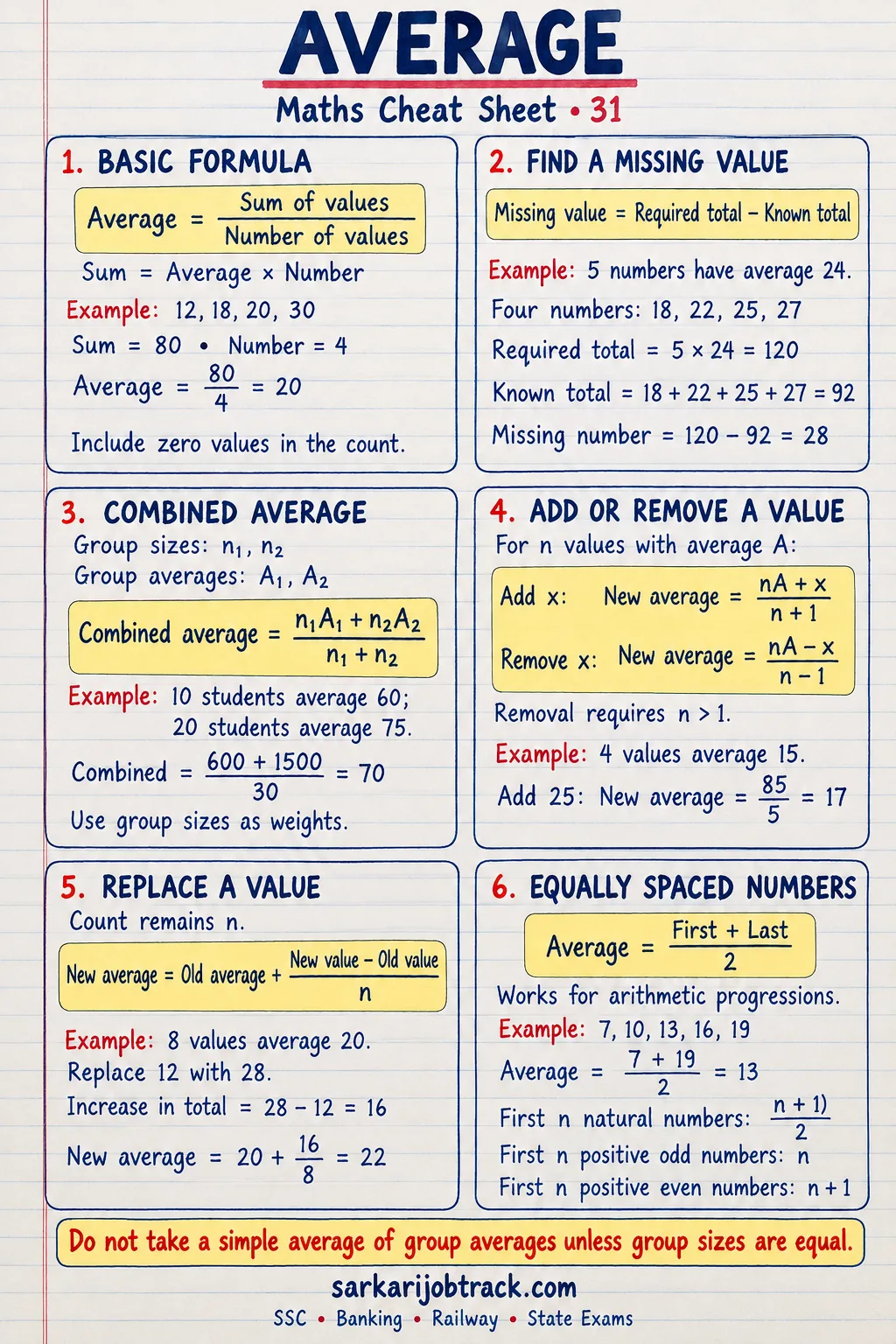
A quick revision cheat sheet on averages for SSC, Banking, Railway and state exams. It covers the basic average formula, the averages of the first n natural, even, odd, square and cube numbers, weighted average, average speed, and the shortcut for a change in average when an item is added, removed or replaced.
Average Cheat Sheet
Quick Revision
The average (arithmetic mean) of a set of values is their sum divided by how many there are.
Ready to practise? Take the Average quiz
1. Basic Formulas
| Quantity | Formula |
|---|---|
| Average | Sum of values ÷ Number of values |
| Sum of values | Average × Number of values |
| Number of values | Sum of values ÷ Average |
2. Averages of Standard Series
| Series | Average |
|---|---|
| First n natural numbers (1…n) | (n + 1) / 2 |
| First n even numbers (2…2n) | n + 1 |
| First n odd numbers (1…2n−1) | n |
| Consecutive numbers | (first + last) / 2 |
| Squares of first n natural numbers | (n + 1)(2n + 1) / 6 |
| Cubes of first n natural numbers | n(n + 1)² / 4 |
3. Weighted Average
When groups of different sizes are combined:
Weighted Average = (n₁a₁ + n₂a₂ + …) / (n₁ + n₂ + …)where each group has n members and average a.
Example
30 students average 60 marks and 20 students average 70 marks.
= (30×60 + 20×70) / (30 + 20)
= (1800 + 1400) / 50
= 64 marks
4. Change in Average (Replace or Add)
Replacement. If replacing one person changes the average of n people by d:
New value − Old value = n × dExample
The average weight of 8 people rises by 2.5 kg when a new person replaces one of 65 kg.
Rise in total = 8 × 2.5 = 20 kg
New person's weight = 65 + 20 = 85 kg
New member added. If n people with average A are joined by one more and the average becomes A + d:
New member's value = A + (n + 1) × d(Use a negative d when the average falls.)
5. Average Speed (quick note)
For equal distances covered at speeds x and y:
Average speed = 2xy / (x + y)This is not the simple average of the two speeds. More in the Time, Speed and Distance sheet.
6. Exam Quick Tips
- Average always lies between the smallest and largest value.
- For the first n natural numbers, the average is simply
(n + 1)/2. - Use the change in total method for add/remove/replace problems.
- For two equal-distance speeds, use
2xy/(x+y), never(x+y)/2.
Keep revising with the rest of the Maths section:
How this was made: Drafted with AI assistance; spot-checked by the editor on 31 October 2026.