
Conditional Statements Cheat Sheet
31 Oct 2026
Quick answer
A quick revision cheat sheet on conditional statements for SSC, Banking, Railway and state exams. It covers the if-then form, the converse, inverse and contrapositive, which of these are logically equivalent, necessary and sufficient conditions, and the common traps, with a worked example to revise quickly before the exam.
Conditional Statements Cheat Sheet
Quick Revision
A conditional statement has the form "If P, then Q". From it you can build three related statements — and only one of them always has the same truth as the original.
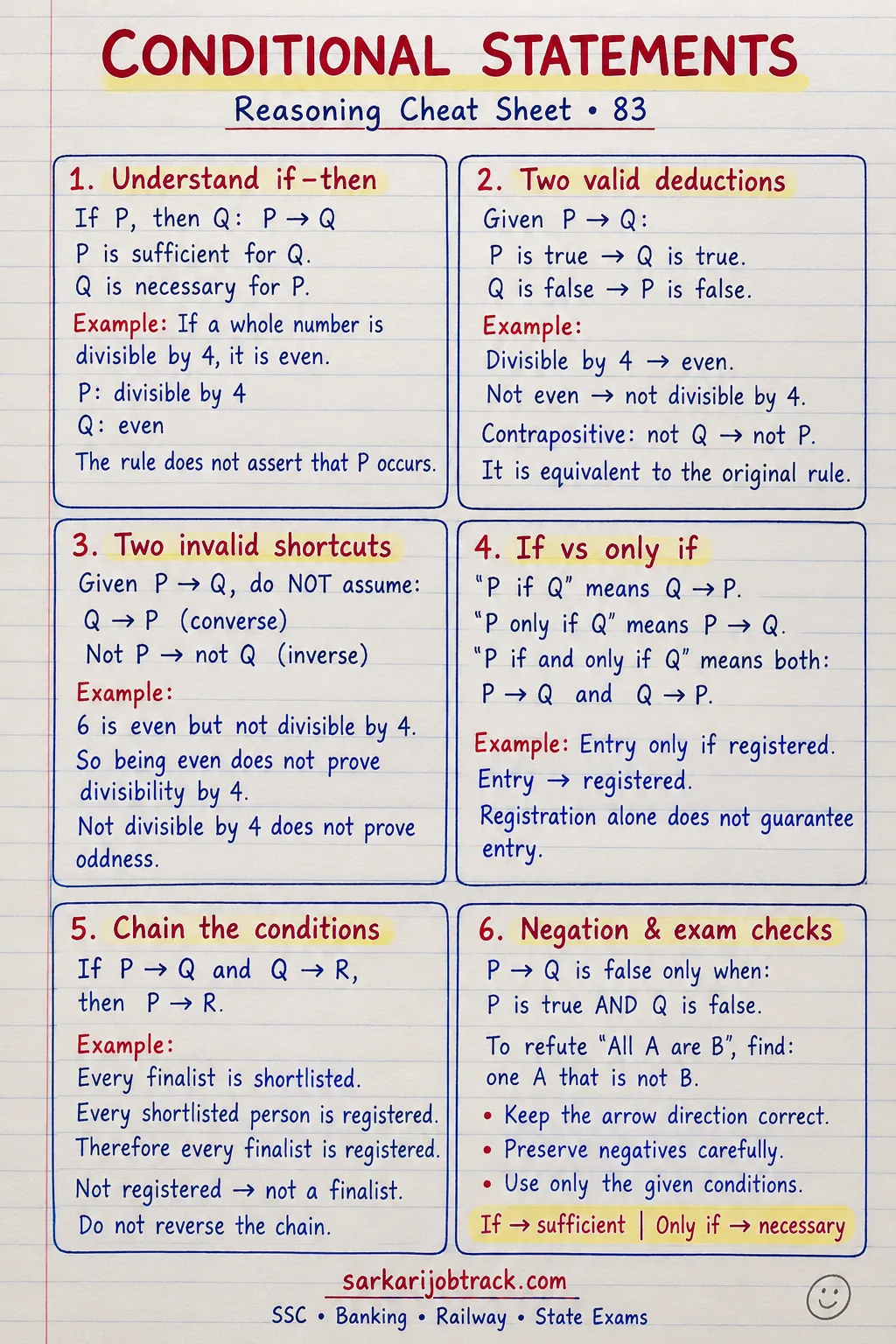
1. The Four Forms
Statement       : If P, then Q
Converse        : If Q, then P
Inverse         : If not P, then not Q
Contrapositive  : If not Q, then not P
2. What Is Equivalent
- The contrapositive is always logically equivalent to the statement — if one is true, so is the other.
- The converse and the inverse are not equivalent to the statement (though they are equivalent to each other).
3. Necessary and Sufficient
In "If P, then Q":
- P is sufficient for Q — P alone guarantees Q.
- Q is necessary for P — P cannot happen without Q.
4. Worked Example
Statement: "If it rains, the match is cancelled."
Contrapositive : If the match is not cancelled, it did not rain.  (true — same meaning)
Converse       : If the match is cancelled, it rained.            (not guaranteed)
The match might be cancelled for another reason, so the converse need not hold.
5. Exam Quick Tips
- To test a conditional, use its contrapositive — it is always safe.
- "P only if Q" means If P, then Q, not the reverse.
- Do not assume the converse is true; that is the most common trap.
Keep revising with the rest of the Reasoning section:
How this was made: Drafted with AI assistance; spot-checked by the editor on 31 October 2026.