
Statement and Arguments Cheat Sheet
31 Oct 2026
Quick answer
A quick revision cheat sheet on statement and arguments for SSC, Banking, Railway and state exams. It covers what makes an argument strong or weak, the tests you apply to each argument, the standard answer choices, and the common traps, with a worked example to revise quickly before the exam.
Statement and Arguments Cheat Sheet
Quick Revision
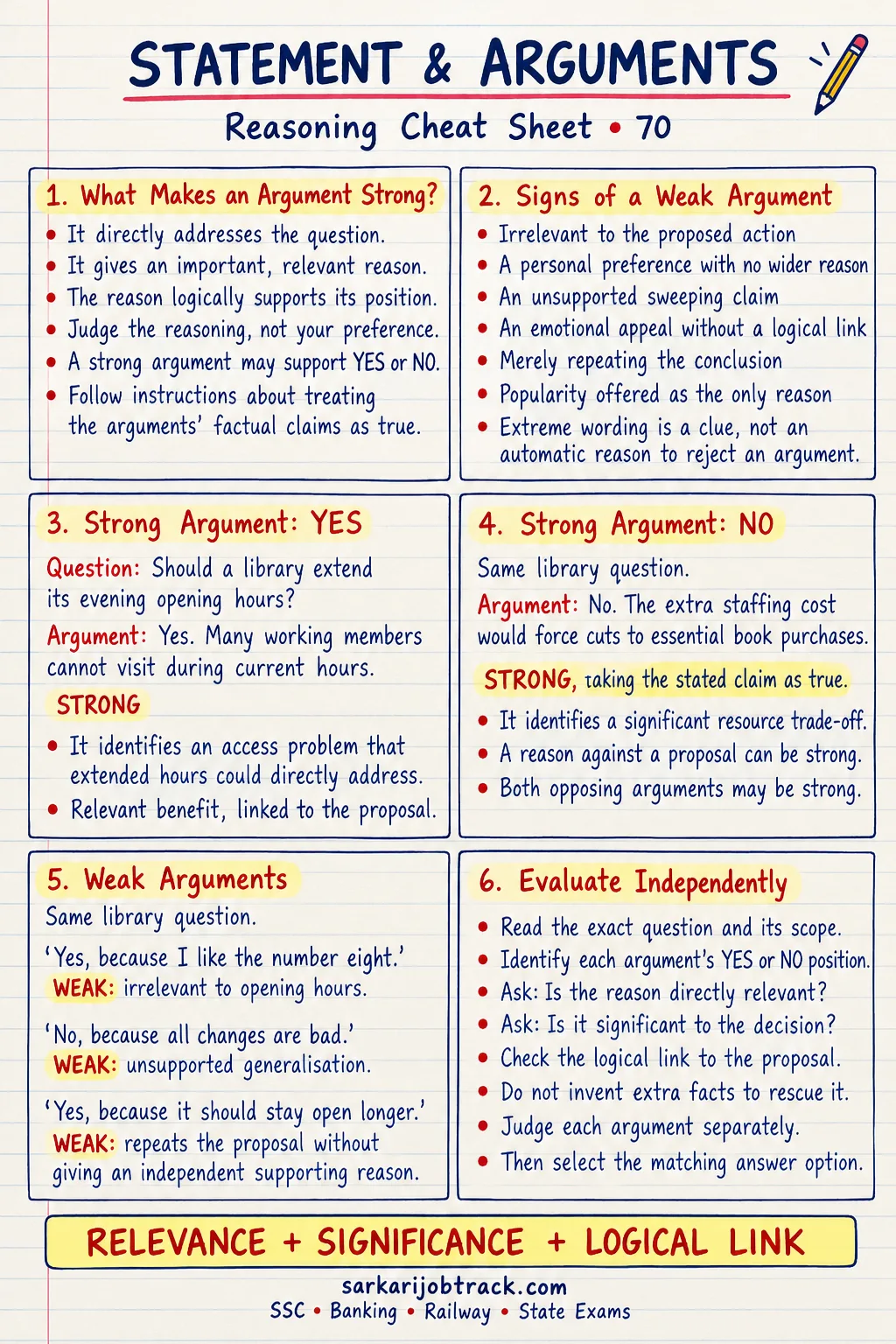
In a statement and arguments question you are given a statement — usually a proposal or a question of policy — followed by two or more arguments. You must decide which arguments are strong and which are weak.
1. A Strong Argument
A strong argument is:
- Directly related to the statement, not to a side issue;
- Practical and sensible in the real world;
- Aimed at the core of the question, with real weight either way.
2. A Weak Argument
An argument is weak if it is:
- Unrelated or only loosely connected to the statement;
- Trivial or minor compared with the issue;
- Ambiguous, or merely restates the statement;
- Based only on an assumption or a personal feeling.
3. The Answer Choices
Only argument I is strong
Only argument II is strong
Either I or II is strong
Neither is strong
Both are strong
4. Worked Example
Statement: Should cycling be encouraged in big cities?
- I. Yes, it cuts pollution and traffic. → Strong (directly addresses a real benefit).
- II. No, cycles were used long ago. → Weak (irrelevant and trivial).
So only argument I is strong.
5. Exam Quick Tips
- Judge each argument on its own merit, not by whether you agree with the statement.
- A "yes/no" that simply repeats the statement is weak.
- An argument that merely raises fear or a vague possibility is usually weak.
Keep revising with the rest of the Reasoning section:
How this was made: Drafted with AI assistance; spot-checked by the editor on 31 October 2026.