
Data Interpretation Cheat Sheet
31 Oct 2026
Quick answer
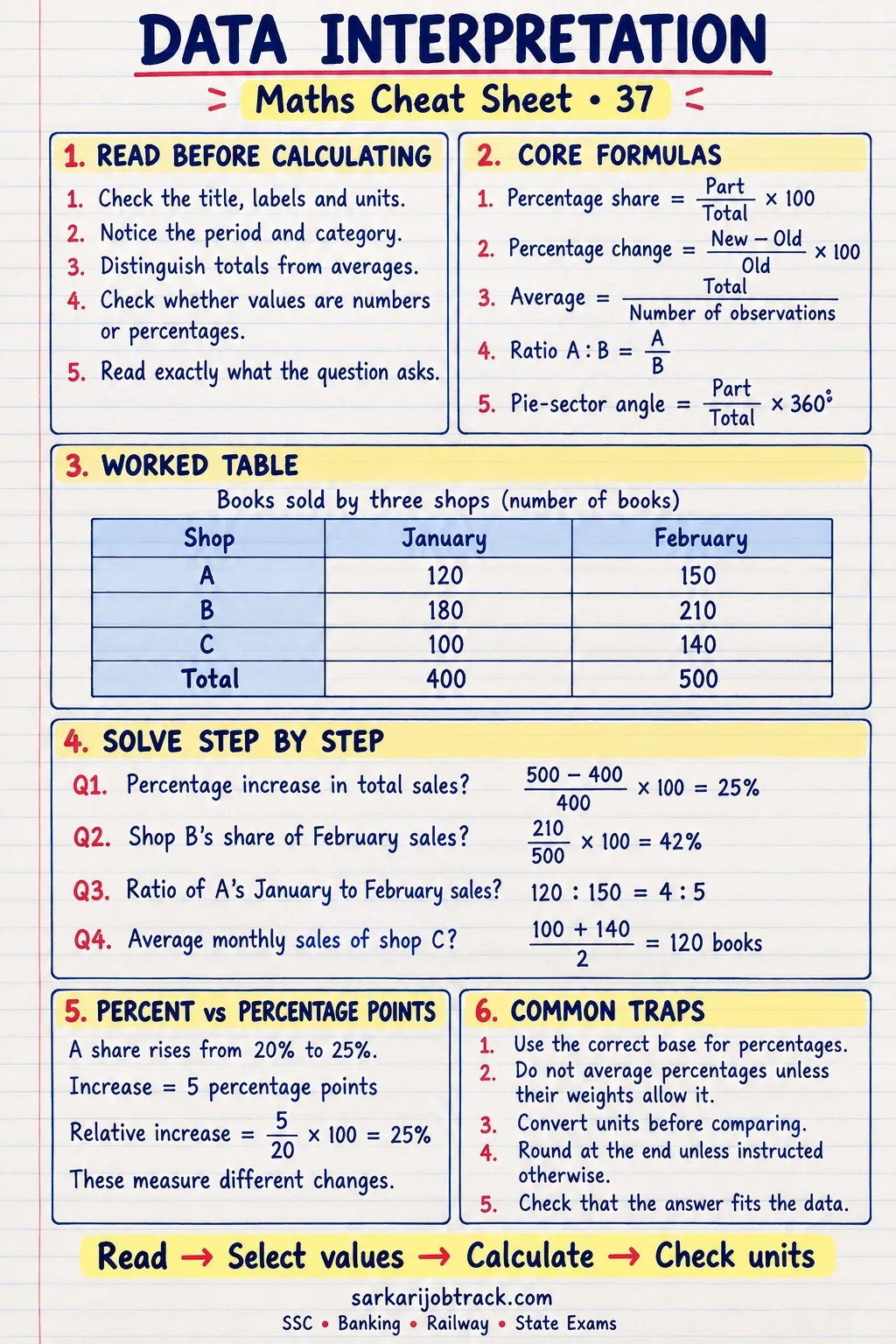
A quick revision cheat sheet on data interpretation for SSC, Banking, Railway and state exams. It covers the common DI formats — tables, bar graphs, line graphs, pie charts and caselets — the pie-chart angle and percentage formulas, and the core calculations of percentage change, ratio and average used to answer DI questions quickly.
Data Interpretation Cheat Sheet
Quick Revision
Data interpretation (DI) gives you information in a table or chart and asks questions about it. The maths is simple — percentages, ratios and averages — so the skill is reading the data correctly and calculating fast.
Ready to practise? Take the Data Interpretation quiz
1. Common DI Formats
| Format | What it shows |
|---|---|
| Table | Exact values in rows and columns |
| Bar graph | Values compared as bars |
| Line graph | A trend over time |
| Pie chart | Parts of a whole, as sectors |
| Caselet | Data written in a paragraph |
2. Pie Charts
A full circle is 360° and represents 100% of the total.
Value of a sector   = (sector angle / 360) × Total
                    = (sector percentage / 100) × Total
Angle of a sector   = (sector value / Total) × 360
Example
In a pie chart of a ₹7200 budget, "Food" is 90°.
Food = (90 / 360) × 7200 = ₹18003. Core Calculations
Percentage of a part  = (part / total) × 100

Percentage change     = (new − old) / old × 100

Average               = sum of values / number of values

Ratio of A to B       = A : B
4. Reading the Data Well
- Read the title, labels and units before you start — note "in thousands", "in %", etc.
- For "by how much more / less", you usually need a difference or a percentage change, not the raw value.
- Carry over the total from one sub-question to the next where it repeats.
- Approximate when the options are far apart.
5. Exam Quick Tips
- A pie-chart sector's share:
(angle / 360) × total— or use its percentage directly. - Percentage change always divides by the old (original) value.
- Watch the units in the chart heading; a wrong unit is the commonest DI error.
- Reuse a computed total across the question's parts instead of recomputing it.
Keep revising with the rest of the Maths section:
How this was made: Drafted with AI assistance; spot-checked by the editor on 31 October 2026.