
Partnership Cheat Sheet
31 Oct 2026
Quick answer
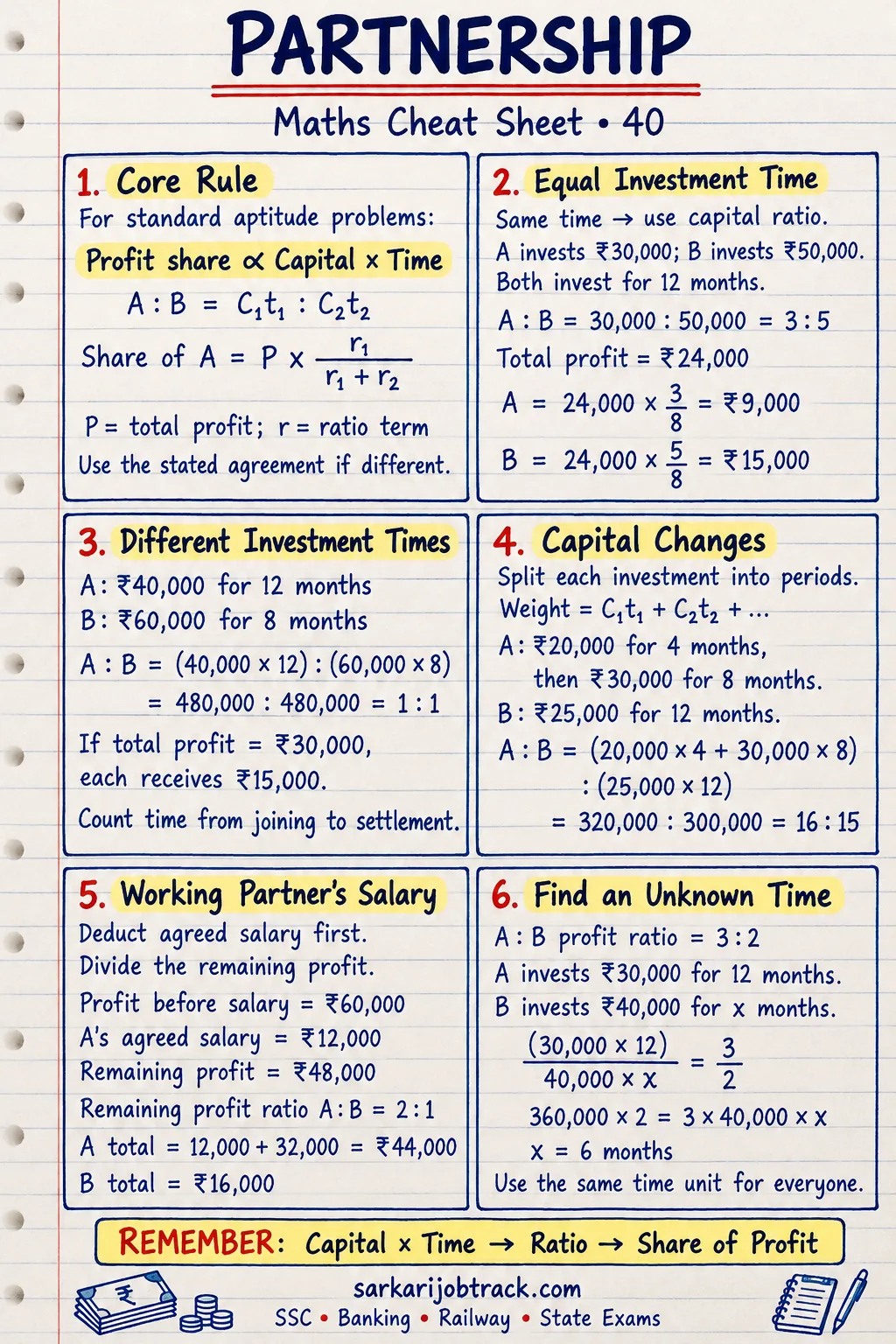
A quick revision cheat sheet on partnership for SSC, Banking, Railway and state exams. It explains how profit is shared between partners, the difference between simple and compound partnership, how to handle capital invested for different periods, and the working-versus-sleeping-partner salary case, with worked examples.
Partnership Cheat Sheet
Quick Revision
In a partnership, two or more people invest money in a business and share the profit (or loss) in the ratio of their capital × time.
Ready to practise? Take the Partnership quiz
1. The Core Rule
Profit is divided in the ratio of each partner's investment × time:
A's share : B's share = (Cₐ × tₐ) : (C_b × t_b)where C is the capital and t is the time for which it was invested.
2. Simple vs Compound Partnership
- Simple partnership — all partners invest for the same time. Profit is shared in the ratio of the capitals alone.
A : B = Cₐ : C_b- Compound partnership — partners invest for different times. Profit is shared in the ratio of capital × time.
A : B = (Cₐ × tₐ) : (C_b × t_b)3. Worked Example (different times)
A invests ₹12,000 for 8 months; B invests ₹9,000 for 10 months.
Ratio = (12000 × 8) : (9000 × 10)
      = 96000 : 90000
      = 16 : 15
So a ₹6200 profit is split as 6200 × 16/31 and 6200 × 15/31 = ₹3200 and ₹3000.
4. Working and Sleeping Partners
- A working partner manages the business; a sleeping partner only invests.
- A working partner may first take a salary or a commission. Deduct that from the profit; share the remaining profit in the capital-time ratio.
Example
Total profit ₹10,000; working partner takes 10% as salary.
Salary = ₹1000; remaining ₹9000 is shared in the investment ratio.5. Exam Quick Tips
- Always share profit in the ratio of capital × time, not capital alone (unless the time is equal).
- If a partner changes their capital mid-year, split it into periods and add the capital × time products.
- Deduct any salary or commission first, then divide the rest.
- Loss is shared in the same ratio as profit.
Keep revising with the rest of the Maths section:
How this was made: Drafted with AI assistance; spot-checked by the editor on 31 October 2026.