
Mathematical Operations Cheat Sheet
2 Nov 2026
Quick answer
A quick reasoning revision sheet for mathematical operations — applying BODMAS after decoding, the symbol-substitution type where the operators are disguised, and the sign-interchange type — with the step-by-step method, a worked example and the common left-to-right slip to avoid, for fast SSC, Banking and Railway revision.
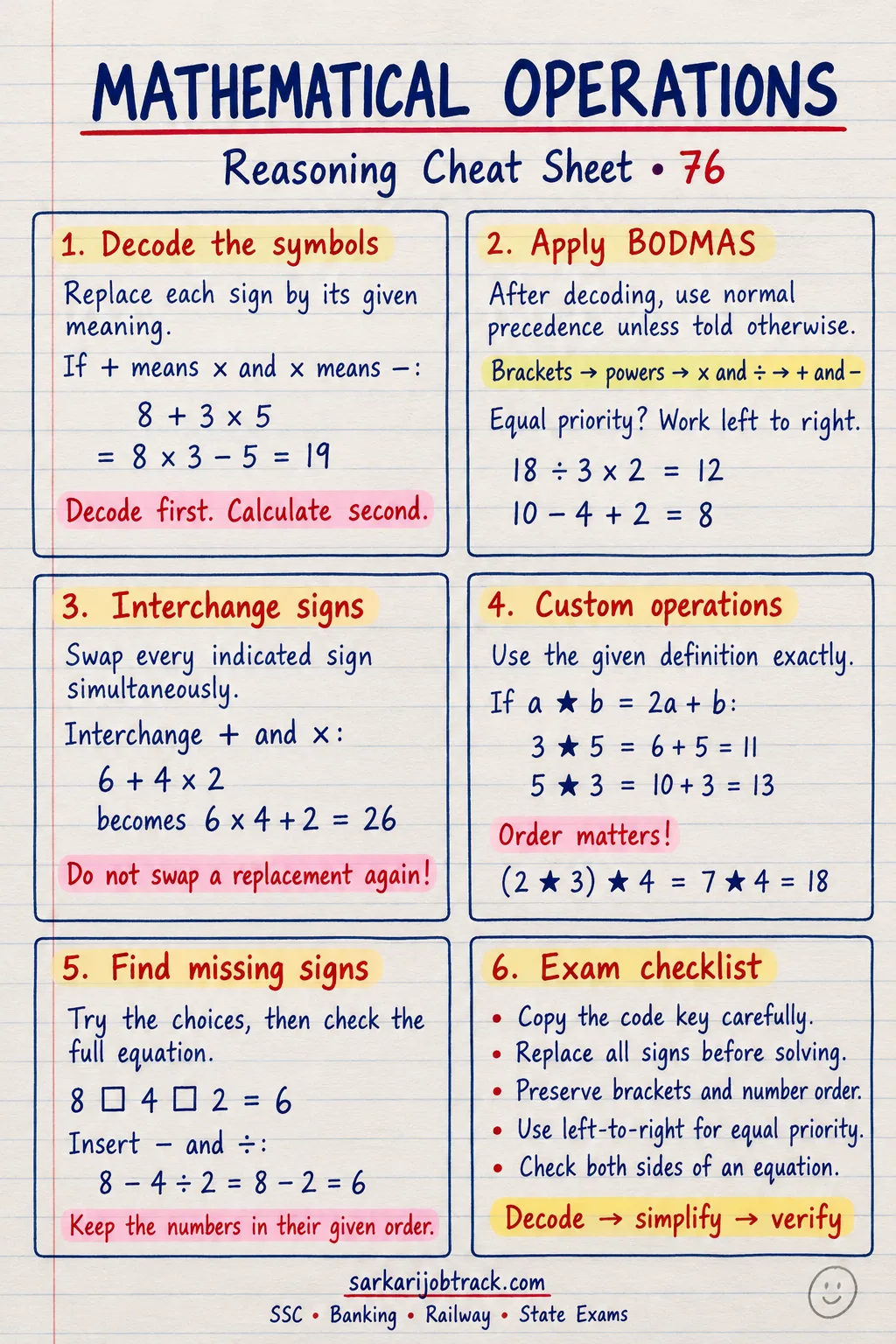
A mathematical operations question hides the real operators behind other symbols (or swaps them), and asks you to evaluate an expression once you decode them. The engine is always BODMAS.
BODMAS, first and last
After you decode the symbols, solve in the order Brackets, Orders, Division and Multiplication (equal, left to right), then Addition and Subtraction (equal, left to right). Division and multiplication are not "before" each other — they go left to right.
The symbol-substitution type
You are told what each symbol means, for example "+ means ×". Replace every symbol with its real meaning, then apply BODMAS.
Worked example. If + means ×, − means +, × means ÷, ÷ means −, find the value of 6 × 2 + 3 − 4 ÷ 2.
- Decode: × → ÷, + → ×, − → +, ÷ → −. The expression becomes 6 ÷ 2 × 3 + 4 − 2.
- BODMAS: 6 ÷ 2 = 3, then 3 × 3 = 9 (left to right).
- Then 9 + 4 − 2 = 11.
The sign-interchange type
You are asked which equation becomes correct after two signs (or two numbers) are swapped. Swap them in each option and test with BODMAS; the one that balances is the answer.
Worked example. Interchanging + and −, is "8 − 4 + 2 = 6" correct?
- After swapping: 8 + 4 − 2 = 10 ≠ 6, so with this swap it is not correct. Test each option this way.
The method
- Write the decoded expression in full before calculating — never evaluate symbol-by-symbol in your head.
- Apply BODMAS strictly, taking ÷ and × left to right.
- For interchange questions, apply the swap to the whole equation, both sides, then check equality.
Quick tips
- The commonest slip is doing × before ÷ by habit; they are equal, so go left to right.
- Re-read which symbol means which — the question often disguises ÷ as − and vice versa to catch a careless swap.
Revise the full method in the Mathematical Operations lesson, then practise these questions or browse more reasoning revision sheets.
How this was made: Drafted with AI assistance; every formula and worked figure recomputed independently; every fact checked against the source it cites.