
Mathematical Operations: BODMAS and the Symbol-Swap Questions
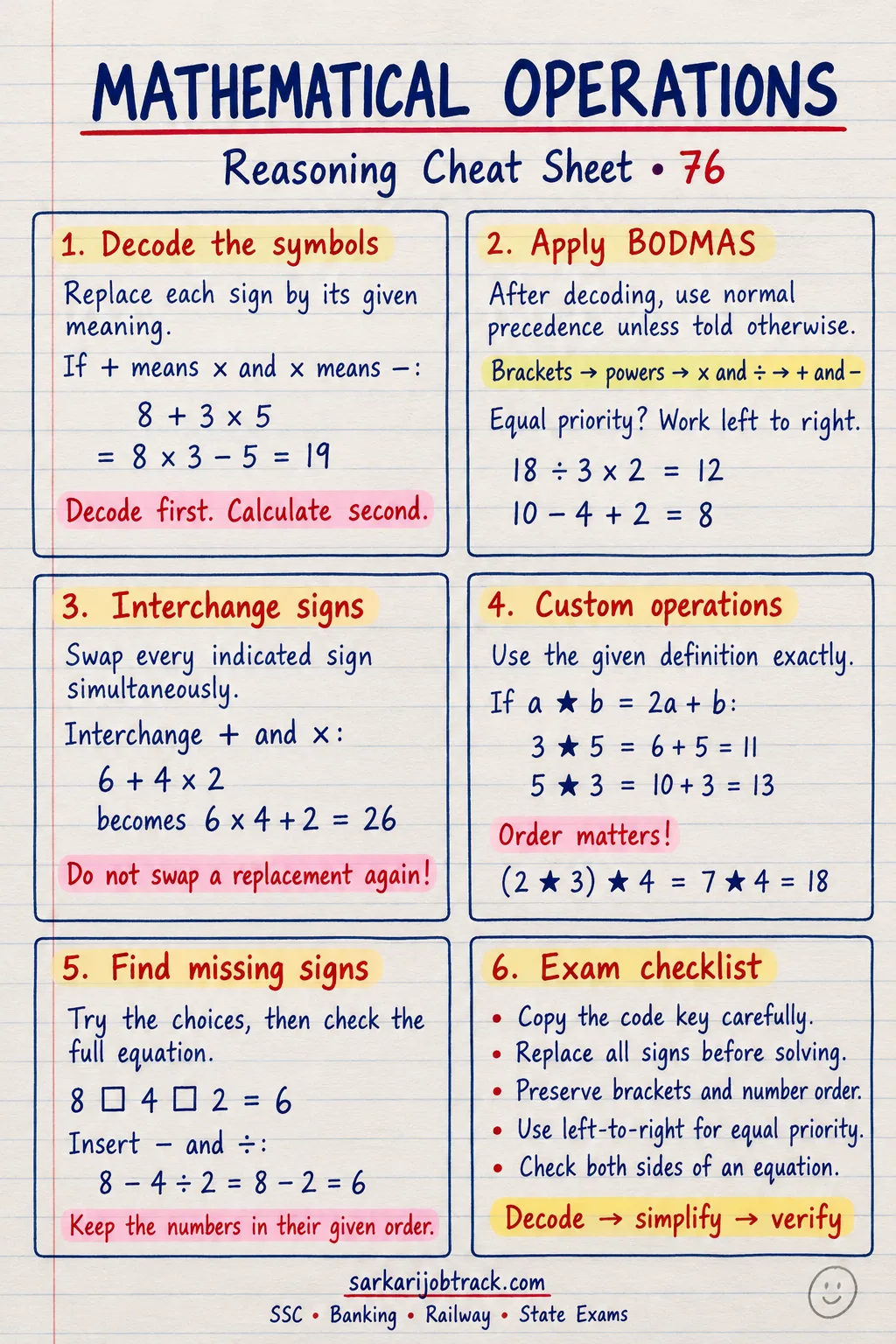
Learn to solve the reasoning "Mathematical Operations" questions — applying BODMAS in the right order, substituting coded symbols or letters for the real operators, interchanging signs or numbers to make an equation true, and picking the one correct equation — through worked examples, a checklist for any question and a revision list.
By the end of this lesson you will be able to read a coded arithmetic line — one where the symbols or numbers have been swapped — turn it back into an ordinary sum, and solve it in the correct order, so that you can answer every style of Mathematical Operations question an exam sets.
Already confident? Skip to practice: Mathematical Operations quiz
Before this: this topic uses no new facts, but it leans on one habit — reading a rule, writing out exactly what it says, and only then computing. That is the same habit the Coding–Decoding lesson builds, where a code is decoded one letter at a time. Here you decode one operator at a time.
What a Mathematical Operations question looks like
This is a reasoning topic, not an arithmetic one. The sums themselves are small; the test is whether you follow the rule and the order of operations exactly. You will meet five shapes of question:
- Symbol substitution. Odd symbols stand in for the real operators: "If
$means×and#means−…". You rewrite the line with the real operators, then solve. - The "if P means ×" style. The same idea, but letters stand in for the operators.
- Sign interchange. You are told to swap two operators — "interchange
+and÷" — and then find the value, or find which equation becomes true. - Number interchange. You swap two numbers everywhere they appear, then find the value or the equation that becomes true.
- Selecting the correct equation. Four equations are given and only one is true under the ordinary rules. You test each.
Every one of them rests on a single skill: BODMAS, applied after any swap. Learn that first.
BODMAS: the order you must compute in
When a line mixes operators, you do not read it left to right. You follow BODMAS (the same order is sometimes written BIDMAS):
- B — Brackets first.
- O / I — Orders (powers and roots), also called Indices.
- D and M — Division and Multiplication, which rank equally, taken left to right.
- A and S — Addition and Subtraction, which rank equally, taken left to right.
The trap in step 3 and step 4 is thinking "multiply before divide" or "add before subtract". They are equal; when only those appear, you simply work from left to right.
Example 1: BODMAS with no brackets
Question: Solve 72 ÷ 8 + 5 × 3 − 4.
- Division and multiplication first: 72 ÷ 8 = 9, and 5 × 3 = 15.
- The line is now 9 + 15 − 4.
- Left to right: 9 + 15 = 24, then 24 − 4 = 20.
The principle: circle the × and ÷ parts and settle them before you touch the + and −. The answer is 20.
Example 2: BODMAS with brackets
Question: Solve 6 × (4 + 2) − 18 ÷ 3.
- Brackets first: 4 + 2 = 6. The line is now 6 × 6 − 18 ÷ 3.
- Then × and ÷: 6 × 6 = 36, and 18 ÷ 3 = 6.
- Then the subtraction: 36 − 6 = 30.
The principle: a bracket jumps the queue, even ahead of multiplication. The answer is 30.
Symbol substitution: rewrite, then BODMAS
Here the real operators are hidden behind other symbols. The method is two clean steps: first rewrite the whole line with the real operators, then solve it by BODMAS. Do not try to do both at once.
Example 3: Substituting symbols
Question: If ◆ means +, ★ means −, ● means ×, and ○ means ÷, find 16 ● 2 ○ 4 ◆ 7 ★ 3.
- Rewrite symbol by symbol:
●→ ×,○→ ÷,◆→ +,★→ −. The line becomes 16 × 2 ÷ 4 + 7 − 3. - Now BODMAS. The × and ÷ rank equally, so go left to right: 16 × 2 = 32, then 32 ÷ 4 = 8.
- The line is now 8 + 7 − 3 = 12.
The principle: the symbols are only a disguise. Once rewritten, it is an ordinary BODMAS sum — and BODMAS still applies. The answer is 12.
Example 4: The "if a letter means an operator" style
Question: If A means ×, B means +, C means ÷, and D means −, find 12 C 4 A 5 B 8 D 2.
- Rewrite:
C→ ÷,A→ ×,B→ +,D→ −. The line becomes 12 ÷ 4 × 5 + 8 − 2. - The ÷ and × first, left to right: 12 ÷ 4 = 3, then 3 × 5 = 15.
- The line is now 15 + 8 − 2 = 21.
The principle: letters work exactly like symbols — rewrite them to real operators and solve. The answer is 21.
Your turn (symbol substitution)
If > means ×, < means +, ^ means −, and ~ means ÷, find 20 ~ 5 > 3 < 6.
Check: rewrite to 20 ÷ 5 × 3 + 6. Then 20 ÷ 5 = 4, 4 × 3 = 12, and 12 + 6 = 18.
Sign interchange: swap the two operators, then solve
Here you are told to trade two operators for each other throughout the line. Rewrite the line with the swap in place, then apply BODMAS to the new line. The swap is symmetric: if you interchange + and −, every + becomes − and every − becomes + — both directions at once, not just one.
Example 5: A single sign swap
Question: If + and − are interchanged, find the value of 30 − 10 + 5.
- Swap both ways: the
−becomes+, the+becomes−. The line becomes 30 + 10 − 5. - Left to right: 30 + 10 = 40, then 40 − 5 = 35.
The principle: the swap replaces the signs before you compute; the untouched value (30 − 10 + 5 = 25) is the wrong answer the question is baiting you with. The answer is 35.
Example 6: Interchanging signs to make an equation true
Some questions give a false equation and ask which interchange of two signs makes it correct.
Question: By interchanging two signs, make this true: 15 − 3 + 6 = 12.
- As written, 15 − 3 + 6 = 18, not 12, so it is false.
- Try interchanging
+and−: the line becomes 15 + 3 − 6. - Check: 15 + 3 = 18, then 18 − 6 = 12. True.
The principle: test the suggested swap, rebuild the left side, and see whether it now equals the right side. Here interchanging + and − works. The answer is 12 (the equation becomes 15 + 3 − 6 = 12).
Number interchange: swap the numbers everywhere, then solve
This time you swap two numbers rather than operators. Replace every appearance of one with the other — and leave any number that merely contains those digits alone (if you swap 2 and 5, the number 25 is not touched, only standalone 2 and 5). Then apply BODMAS.
Example 7: Swapping two numbers
Question: If the numbers 2 and 5 are interchanged, find the value of 5 × 2 + 10 ÷ 5.
- Replace every standalone 2 with 5 and every 5 with 2 (the 10 is left alone): the line becomes 2 × 5 + 10 ÷ 2.
- BODMAS: 2 × 5 = 10, and 10 ÷ 2 = 5.
- The line is now 10 + 5 = 15.
The principle: change the numbers first, write the new line in full, then compute. The answer is 15.
Selecting the correct equation
Here four complete equations are given and exactly one is true under ordinary BODMAS. Work each left side out carefully; the wrong ones are usually "correct" only if you ignore the order of operations.
Example 8: Which equation is true?
Question: Which equation is correct? (a) 9 + 6 ÷ 3 = 5 (b) 7 × 2 − 4 = 10 (c) 15 − 10 ÷ 5 = 1 (d) 4 × 3 + 2 = 20
- (a) 9 + 6 ÷ 3 = 9 + 2 = 11, not 5. False.
- (b) 7 × 2 − 4 = 14 − 4 = 10. True.
- (c) 15 − 10 ÷ 5 = 15 − 2 = 13, not 1. False.
- (d) 4 × 3 + 2 = 12 + 2 = 14, not 20. False.
The principle: the false options tempt you with left-to-right answers (in (a), 9 + 6 = 15, ÷ 3 = 5). BODMAS settles it. The correct equation is 7 × 2 − 4 = 10.
How to attack any Mathematical Operations question
- Read the rule and write it out. List each symbol or letter against the real operator, or note the exact pair being swapped.
- Rewrite the whole line first. Put in the real operators, or carry out the swap, and write the new line in full before you compute anything.
- Then — and only then — apply BODMAS. Brackets, orders, then × and ÷ left to right, then + and − left to right. The order rule does not go away after a substitution.
- Remember × and ÷ rank equally, and + and − rank equally. When only those appear, work left to right; do not promote multiply over divide.
- Make every swap symmetric. "Interchange + and −" changes both, not one.
- Swap numbers everywhere they stand alone, and leave larger numbers that only contain the digit untouched.
- For "make it true" and "which is correct" items, test each option by rebuilding its left side and comparing with the right side.
At a glance: the rules in one place
Everything here reduces to "rewrite, then BODMAS". Keep the order in your head: B, O, D&M (left to right), A&S (left to right).
- BODMAS: Brackets → Orders → Division and Multiplication (equal, left to right) → Addition and Subtraction (equal, left to right).
- Symbol / letter substitution: replace each symbol or letter with its real operator, write the new line, then solve by BODMAS. Example:
●= ×,○= ÷ turns 16 ● 2 ○ 4 into 16 × 2 ÷ 4. - Sign interchange: swap the named pair both ways throughout, then solve. "Interchange + and −" turns 30 − 10 + 5 into 30 + 10 − 5.
- Number interchange: swap the two numbers wherever they stand alone, then solve. "Interchange 2 and 5" turns 5 × 2 into 2 × 5.
- Make the equation true: apply the suggested swap, rebuild the left side, and check it equals the right side.
- Select the correct equation: evaluate each left side by BODMAS; keep the one that matches its right side.
Common mistakes
- Forgetting BODMAS still applies after the swap. The commonest slip: students rewrite the line correctly, then solve it left to right. The × and ÷ still come first.
- Promoting multiplication over division (or addition over subtraction). They rank equally. Only the left-to-right position decides.
- Swapping in one direction only. "Interchange + and −" must change every + and every −.
- Solving the original line by mistake. After a swap you must use the new line; the untouched value is the bait distractor.
- Interchanging the wrong pair. On a "make it true" question, test the pair the option names, not a pair that looks tidy.
- Changing a digit inside a larger number. Interchanging 2 and 5 leaves 25 alone; touch only the standalone 2s and 5s.
Next
The later Reasoning topics are Blood Relations, Direction Sense, Puzzles and Seating Arrangement and Non-Verbal Reasoning. The careful "rewrite, then compute in order" habit you built here is the same one the arithmetic subject leans on whenever a sum mixes operators.
Ready to test this lesson? Take the Mathematical Operations quiz
How this was made: Drafted with AI assistance; every formula and worked figure recomputed independently; spot-checked by the editor on 30 October 2026.