
Surds and Indices Cheat Sheet
31 Oct 2026
Quick answer
A quick revision cheat sheet on surds and indices for SSC, Banking, Railway and state exams. It covers the laws of indices, zero and negative powers, fractional powers, the rules for surds, and how to rationalise a denominator, with worked examples to revise quickly before the exam.
Surds and Indices Cheat Sheet
Quick Revision
Indices are powers, such as a³; surds are roots that cannot be simplified to a whole number, such as √2. The same small set of laws governs both.
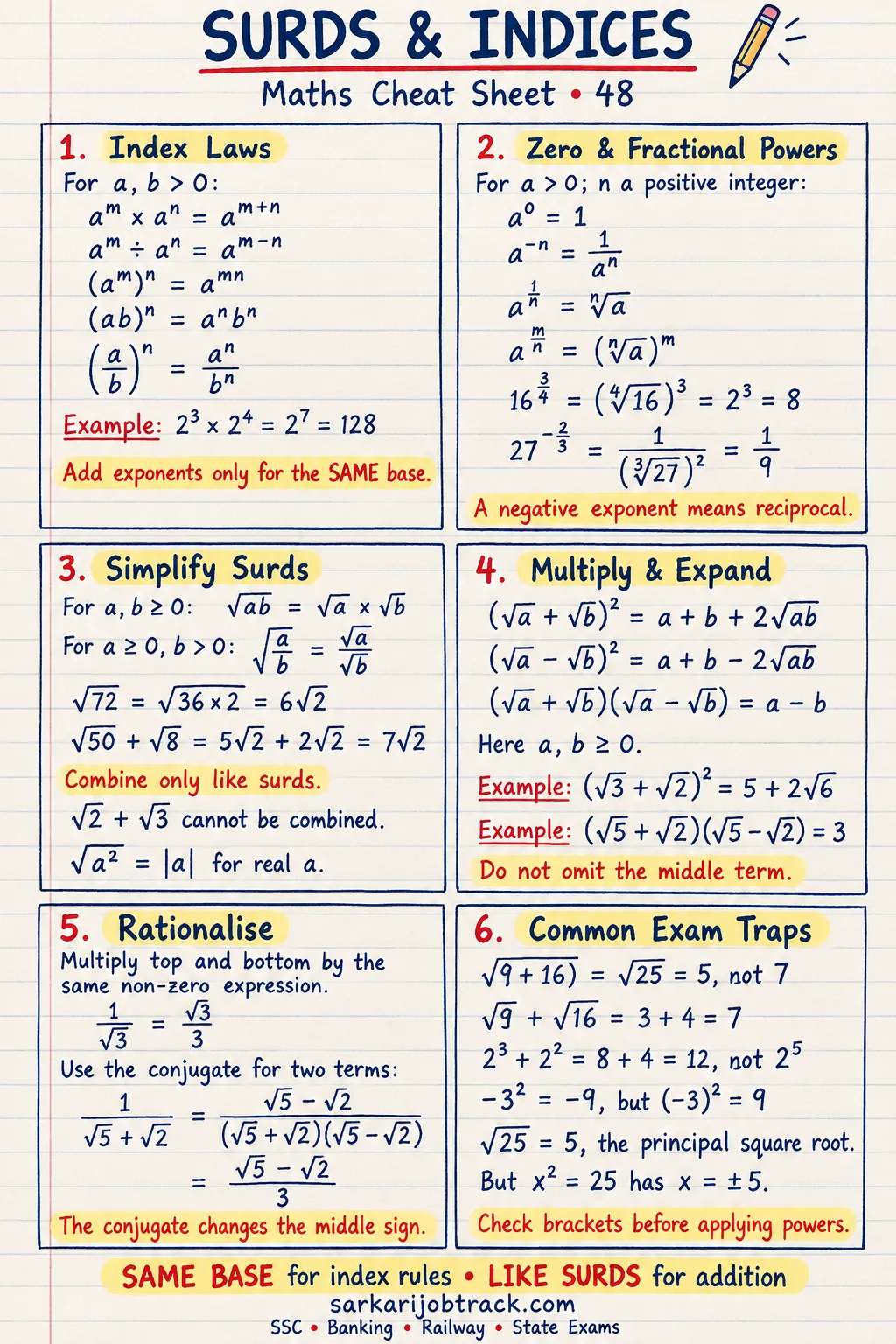
1. Laws of Indices
aᵐ × aⁿ = a⁽ᵐ⁺ⁿ⁾
aᵐ ÷ aⁿ = a⁽ᵐ⁻ⁿ⁾
(aᵐ)ⁿ   = a⁽ᵐ × ⁿ⁾
(a × b)ⁿ = aⁿ × bⁿ
2. Zero, Negative and Fractional Powers
a⁰   = 1          (a ≠ 0)
a⁻ⁿ  = 1 / aⁿ
a^(1/n) = ⁿ√a
a^(m/n) = ⁿ√(aᵐ)
3. Rules for Surds
√a × √b = √(a × b)
√a ÷ √b = √(a / b)
Simplify a surd by pulling out the largest square factor, e.g. √50 = √(25 × 2) = 5√2.
4. Rationalising the Denominator
Remove a surd from the denominator by multiplying by its conjugate:
1 / (√3 − 1) = (√3 + 1) / [(√3 − 1)(√3 + 1)] = (√3 + 1) / 25. Worked Example
2³ × 2²  = 2⁵ = 32
8^(2/3)  = (³√8)² = 2² = 4
√50      = 5√2
6. Exam Quick Tips
- You can only add or subtract like surds:
2√3 + 5√3 = 7√3, but√2 + √3does not simplify. - A negative power means reciprocal, not a negative number.
- Always simplify a surd before comparing or adding.
Keep revising with the rest of the Maths section:
How this was made: Drafted with AI assistance; spot-checked by the editor on 31 October 2026.