
Syllogism Cheat Sheet
2 Nov 2026
Quick answer
A quick reasoning revision sheet for syllogism — reading All, Some and No statements, the reliable Venn-diagram method for testing conclusions, the valid combinations, and the either-or and possibility cases — with worked examples, for fast SSC, Banking and Railway revision.
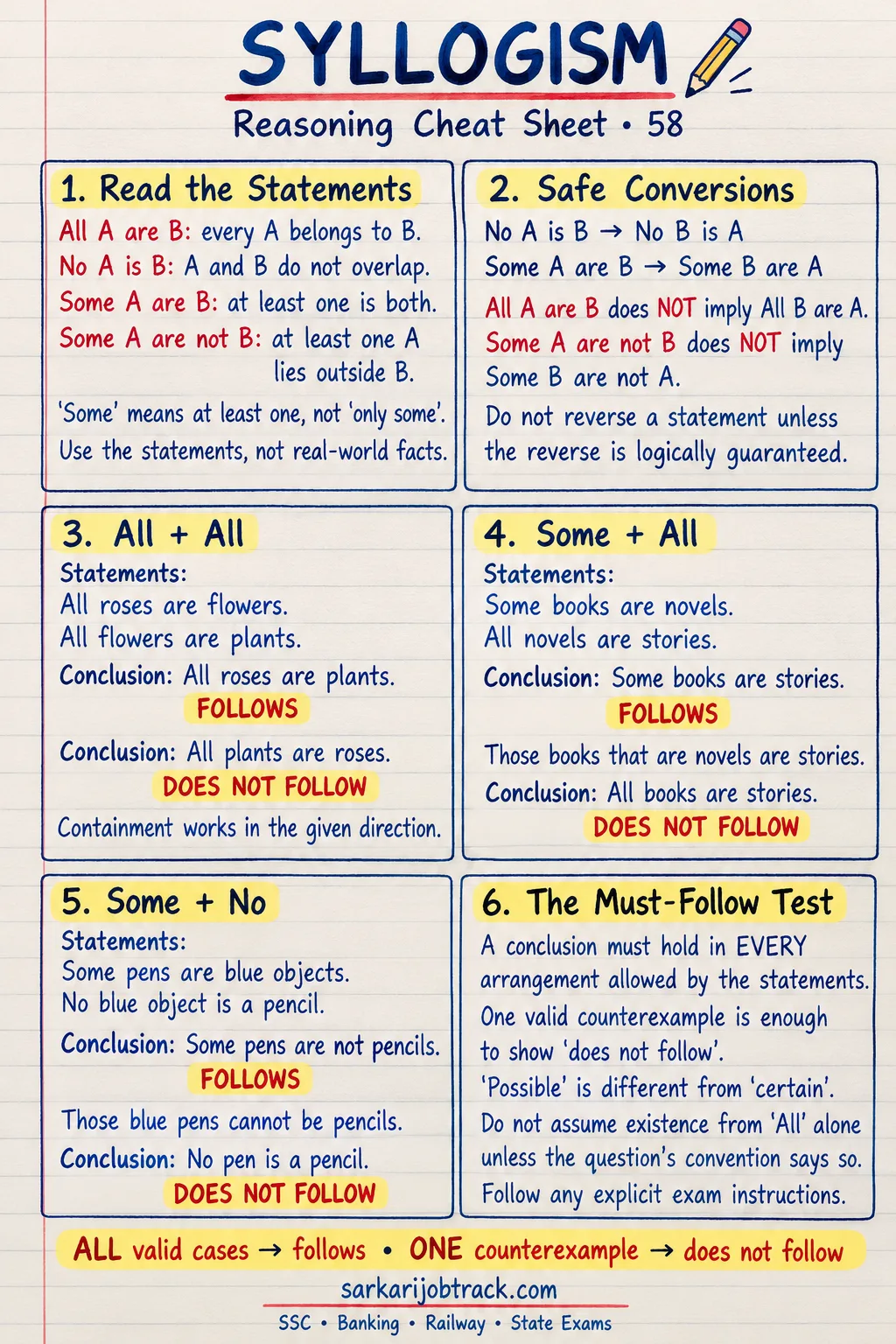
A syllogism gives two or more statements and asks which conclusions definitely follow. The only safe method is to draw the statements as Venn diagrams and accept a conclusion only if it holds in every possible diagram.
Reading the statements
| Statement | Meaning | Venn picture |
|---|---|---|
| All A are B | every A is inside B | circle A inside circle B |
| Some A are B | A and B overlap in at least one | two overlapping circles |
| No A is B | A and B are completely separate | two disjoint circles |
| Some A are not B | at least one A lies outside B | A partly outside B |
The method
- Draw the statements as circles, using the least that each statement forces (do not add overlaps it does not require).
- A conclusion follows only if it is true in every diagram you can legally draw. If even one valid diagram breaks it, it does not follow.
- Treat "Some A are B" as also meaning "Some B are A" — some is two-way.
Valid combinations to know
- All A are B + All B are C → All A are C.
- All A are B + No B is C → No A is C.
- Some A are B + All B are C → Some A are C.
- Some A are B does not give "All" anything, and "No A is B" never yields a "Some are" conclusion.
Worked example
Statements: All cats are animals. All animals are living things.
- Draw cats inside animals, animals inside living things — so cats sit inside living things in every diagram.
- Conclusion "All cats are living things" follows. "All living things are cats" does not (the big circle is not inside the small one).
Either-or and possibility
- When two conclusions are each only possible but together cover all cases (e.g. "Some A are B" and "No A is B"), the answer is "either … or".
- A "possibility" conclusion follows only if it can be drawn without breaking any statement.
Quick tips
- Never bring outside knowledge — judge only from the statements, even if a statement is factually odd.
- Draw the minimum diagram first; most wrong answers come from adding an overlap the statement did not state.
Revise the full method in the Syllogism and Statement–Conclusion lesson, then practise syllogism questions or browse more reasoning revision sheets.
How this was made: Drafted with AI assistance; every formula and worked figure recomputed independently; every fact checked against the source it cites.