
Syllogism and Statement-Conclusion: Which Conclusion Really Follows
Learn to test a syllogism by drawing the circles and keeping only what is true in every possible picture, through worked examples of each shape (all, some, no, the some-not trap and the either-or pair), a short look at statement-conclusion items, a checklist for any question and a revision list.
By the end of this lesson you will be able to read two or three statements, draw them as circles, and decide which given conclusion must be true in every possible picture.
Already confident? Skip to practice: Syllogism and Statement-Conclusion quiz
Before this: no special facts are needed, but the habit of testing a rule against every case — not just the first one — is the same habit the Number and Letter Series lesson builds. Keep it.
What a syllogism question looks like
You are given two or three statements and asked which conclusion follows from them. You must treat the statements as true, even when they are silly ("All cats are tables"), and ask one question only: does the conclusion have to be true?
The conclusions are judged with a fixed set of verdicts:
- Only conclusion I follows
- Only conclusion II follows
- Both conclusions follow
- Neither conclusion follows
- Either I or II follows (a special case, explained below)
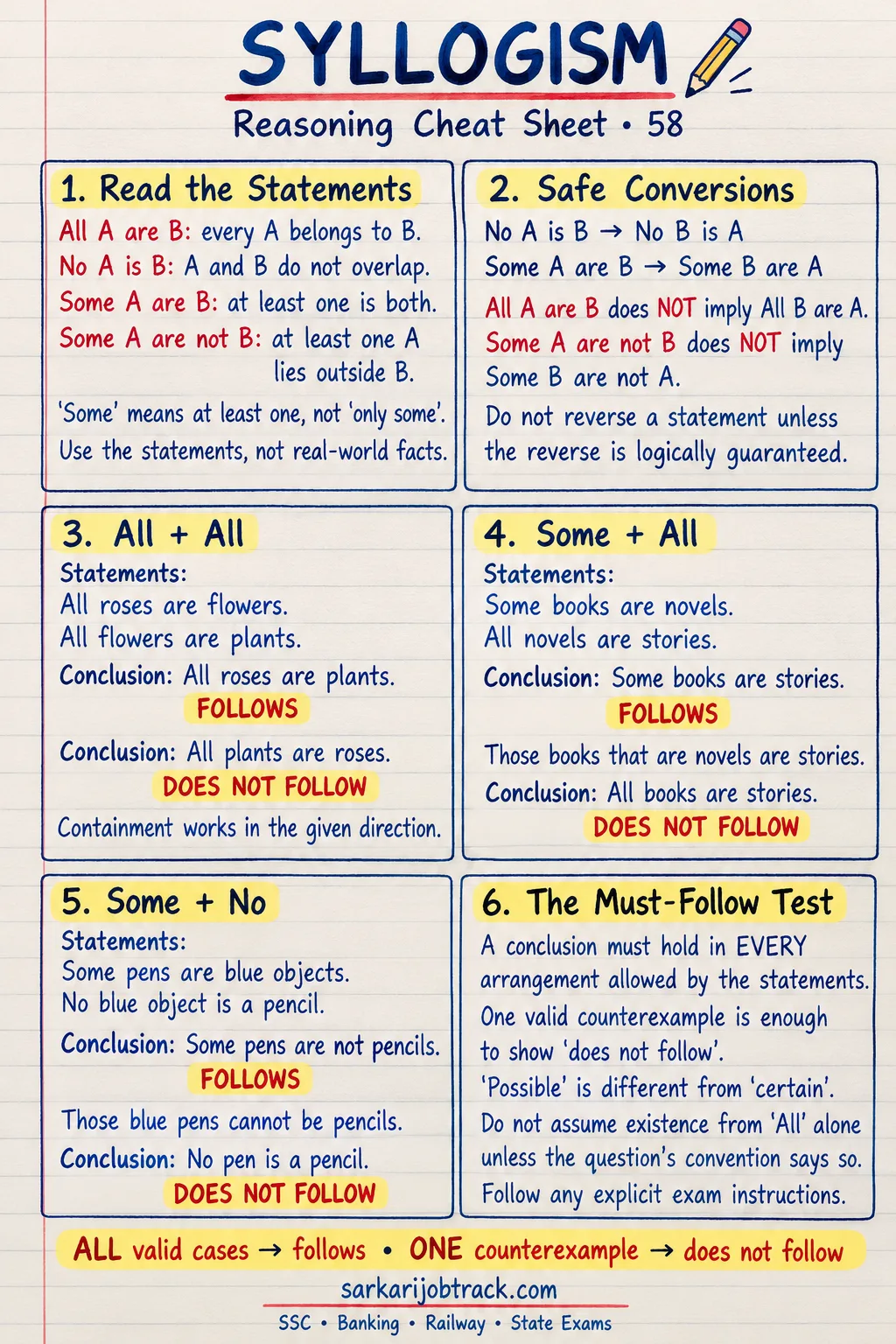
The four kinds of statement you will meet are:
- All A are B — every A is inside B.
- No A is B — A and B are completely apart.
- Some A are B — at least one A is also a B.
- Some A are not B — at least one A is outside B.
The method: draw the circles, keep what is always true
Picture each group as a circle. A statement tells you how two circles sit together. A conclusion follows only if it is true in every picture you can draw that still obeys the statements. If you can draw even one correct picture in which the conclusion is false, it does not follow.
So the work is always the same:
- Draw the circles the way the statements force.
- Try to draw a second, different picture that still obeys the statements but makes the conclusion false.
- If you cannot — the conclusion is forced in every picture — it follows. If you can, it does not.
How each statement is drawn:
- All A are B: the A circle sits wholly inside the B circle.
- No A is B: the two circles do not touch.
- Some A are B: the two circles overlap, and at least one thing sits in the overlap.
- Some A are not B: at least one thing sits in A but outside B.
Two conventions you must know
"Some" works both ways, and it does not promise "some are not." "Some students are boys" means the student circle and the boy circle overlap. It also means "some boys are students" — overlap has no direction. But it does not tell you that "some students are not boys": every student might be a boy. Treat "Some A are B" and "Some A are not B" as separate claims; one does not give the other.
"All" does not promise that anything exists. In these puzzles "All unicorns are animals" is accepted as true without claiming a single unicorn exists. So from "All A are B" you may not jump to "Some A are B" or "Some B are A" — there might be no A at all. This is the single most common trap, and Example 5 is built on it.
Worked examples
Read each example slowly. The first two show every step. In the later ones, some steps are left for you, with the answer just below.
Example 1: All and All — a chain
Statements: All cars are vehicles. All vehicles are machines. Conclusions: (I) All cars are machines. (II) All machines are cars.
- Draw it: the car circle sits inside the vehicle circle, which sits inside the machine circle. Cars are the smallest circle, machines the largest.
- Conclusion I: is every car inside the machine circle? Yes — a car is inside vehicles, which is inside machines. There is no way to draw it otherwise, so I follows.
- Conclusion II: is every machine a car? The machine circle is the big one; it can hold vehicles and machines that are not cars. You can easily draw a machine outside the car circle, so II does not follow.
The principle: when "All A are B" meets "All B are C", the three circles nest, so "All A are C" always follows. The reverse ("All C are A") does not — the biggest circle is not trapped inside the smallest.
The answer is Only conclusion I follows.
Example 2: All and Some — the overlap trap
Statements: All poets are writers. Some writers are famous. Conclusions: (I) Some poets are famous. (II) Some poets are not famous.
- Draw the forced part: the poet circle sits inside the writer circle. Then some writers are famous — the famous circle overlaps the writer circle.
- Now ask where the famous part touches. The statement says famous overlaps writers. It never says the overlap reaches the poet circle. So you can draw the famous circle overlapping only the writers who are not poets.
- Conclusion I: "Some poets are famous" is true in some pictures but not in the one you just drew, so it is not forced. I does not follow.
- Your turn: can you also draw a picture where every poet is famous (so "Some poets are not famous" is false)?
Check: yes — slide the famous circle across so it covers all the poets. Then "Some poets are not famous" is false. So II does not follow either.
The principle: "Some B are C" tells you nothing certain about A, even when "All A are B". The famous part may miss the A circle completely, or cover it completely. When both a "some" conclusion and its "some are not" partner can each be made false, the answer is Neither conclusion follows.
Example 3: No and Some — this gives a "some are not"
Statements: No soldier is a coward. Some cowards are liars. Conclusions: (I) Some liars are not soldiers. (II) Some liars are soldiers.
- Draw it: the soldier circle and the coward circle do not touch (no soldier is a coward). Some cowards are liars, so put a thing in the overlap of coward and liar.
- Look at that thing: it is a coward, so it is a liar, and — because no soldier is a coward — it is not a soldier. So here is at least one liar who is not a soldier.
- Your turn: does that force "Some liars are not soldiers"? And is "Some liars are soldiers" forced?
Check: the coward-liar is a liar outside the soldier circle, so I follows. "Some liars are soldiers" is not forced — the liar circle need not reach the soldiers at all — so II does not follow.
The principle: "No A is B" plus "Some B are C" puts a C firmly outside the A circle, which gives "Some C are not A". Notice the shape of the answer: a "no" feeding into a "some" produces a some-are-not conclusion, not a plain "some".
The answer is Only conclusion I follows.
Example 4: The Either-Or case (a complementary pair)
Statements: Some lions are tigers. Some tigers are bears. Conclusions: (I) Some lions are bears. (II) No lion is a bear.
- Draw the forced part: lion overlaps tiger, and tiger overlaps bear. But the lions that are tigers need not be the same tigers that are bears.
- Try picture one: let the lion-tigers and the tiger-bears be the same tigers. Now lions and bears touch, so "Some lions are bears" is true.
- Try picture two: keep the lion-tigers and the tiger-bears apart inside the tiger circle. Now lions and bears never meet, so "No lion is a bear" is true.
- So neither conclusion is forced on its own. But look at the pair: in every possible picture, lions and bears either overlap or they do not. One of the two conclusions is always true, and they can never both be true.
The principle: when neither conclusion follows alone, check whether the two conclusions are a complementary pair — contradictory statements about the same two groups, so that exactly one of them must be true in every picture. The classic pairs are "Some A are B" with "No A is B", and "All A are B" with "Some A are not B". When you see such a pair and neither follows by itself, the answer is Either I or II follows.
The answer is Either I or II follows.
Example 5: "All" does not create a "some"
Statements: All squares are shapes. All squares are drawings. Conclusions: (I) Some shapes are drawings. (II) Some shapes are not drawings.
- Draw the forced part: the square circle sits inside the shape circle, and the square circle sits inside the drawing circle. Both big circles share the square circle.
- It is tempting to say "then shapes and drawings must overlap at the squares, so some shapes are drawings." But this assumes a square actually exists. In these puzzles "All squares are ..." does not promise any square at all.
- Your turn: can you draw a picture where the shape circle and the drawing circle do not touch, while still obeying both statements?
Check: yes — if the square circle is empty, shapes and drawings can sit completely apart. Then "Some shapes are drawings" is false. So I does not follow. And you can also draw shapes and drawings overlapping entirely, which makes "Some shapes are not drawings" false too, so II does not follow.
The principle: two "All" statements that share a smaller group do not make that group's two parents overlap, because the shared group may be empty. Never turn an "All" into a "Some". The answer is Neither conclusion follows.
Example 6: A statement-conclusion item
Some questions give a short passage instead of "All/Some/No" lines, then ask whether a conclusion follows. The rule is the same in spirit: accept the passage as true and ask whether the conclusion is a direct, necessary result of it — not merely something that could be true, and not something you can reach only by adding your own knowledge.
Statement: The city has banned plastic bags in all shops from next month. Conclusion: Shopkeepers will need another way to pack goods for customers from next month.
- Accept the statement as given: plastic bags are banned in shops.
- Ask what must follow. Shopkeepers still pack goods, and they can no longer use plastic bags, so they must use something else. This is a direct result, not an added guess.
- So the conclusion follows.
Compare a conclusion that does not follow: "Customers will stop shopping in the city." Nothing in the statement forces that — it needs an extra assumption about how people react. For a statement-conclusion item, reject any conclusion that needs information the passage does not give, and accept only what the passage makes certain.
How to attack any syllogism question
- Draw the circles the statements force: inside for "all", apart for "no", overlapping for "some".
- Test each conclusion by trying to break it. If you can draw one correct picture where the conclusion is false, it does not follow.
- A conclusion follows only if it is true in every possible picture, not just the first one you drew.
- Do not read "some are not" into "some". "Some A are B" never gives "Some A are not B".
- Do not turn "all" into "some". "All A are B" does not promise any A exists, so it gives no "Some" conclusion.
- Remember the some-are-not shape: "No A is B" with "Some B are C" gives "Some C are not A".
- Check for the Either-Or pair whenever neither conclusion follows alone and the two conclusions contradict each other about the same two groups.
At a glance: the rules in one place
A conclusion follows only when it is true in every picture that obeys the statements. Test it by trying to draw a picture that makes it false.
- All A are B, All B are C gives All A are C (the circles nest). The reverse does not follow.
- All A are B, No B is C gives No A is C.
- Some A are B, All B are C gives Some A are C (and "Some C are A").
- No A is B, Some B are C gives Some C are not A.
- Some A are B, Some B are C gives no certain conclusion about A and C — and if the two conclusions are "Some A are C" and "No A is C", the answer is Either I or II.
- "Some" has no direction (some A are B means some B are A) and does not give "some are not".
- "All" does not create existence, so it never yields a "Some" conclusion by itself.
- Complementary pairs (Some/No about one pair, or All/Some-are-not about one pair) are the Either-Or signal when neither follows alone.
Common mistakes
- Trusting the first picture. One picture can make a conclusion look true. Try to draw a second that breaks it before you accept it.
- Turning "some" into "some are not". "Some pens are red" does not mean "some pens are not red".
- Turning "all" into "some". From "All A are B" you cannot get "Some A are B": there may be no A.
- Forgetting the direction of "some". "Some A are B" is the same as "Some B are A"; do not mark the reverse wrong.
- Missing the Either-Or pair. When neither conclusion follows but the two are contradictory about the same groups, the answer is not "Neither" — it is "Either I or II".
- Adding outside knowledge in a statement-conclusion item. Use only what the passage says; reject a conclusion that needs an extra assumption.
Next
The later Reasoning topics are Blood Relations, Direction Sense, Puzzles and Seating Arrangement and Non-Verbal Reasoning. Syllogism is also the base for Venn Diagrams, which draw these same circles for counting problems.
Ready to test this lesson? Take the Syllogism and Statement-Conclusion quiz
How this was made: Drafted with AI assistance; every formula and worked figure recomputed independently; spot-checked by the editor on 30 October 2026.