
Prepositions: A Beginner's Lesson on Place, Time and the Right Word
Learn what a preposition does, and how to choose between in, on and at for both place and time, the prepositions of movement and direction, and the fixed pairs like good at, depend on and married to that the exam tests most. Worked through the error-spotting and fill-in-the-blank styles, with a revision table and the mistakes to avoid.
By the end of this lesson you will know what a preposition joins to what, choose correctly between in, on and at for a place and for a time, and get the fixed pairs — good at, depend on, married to — right, so that you can answer "Fill in the blank: She is good ___ mathematics" and spot the wrong preposition in an error-spotting sentence.
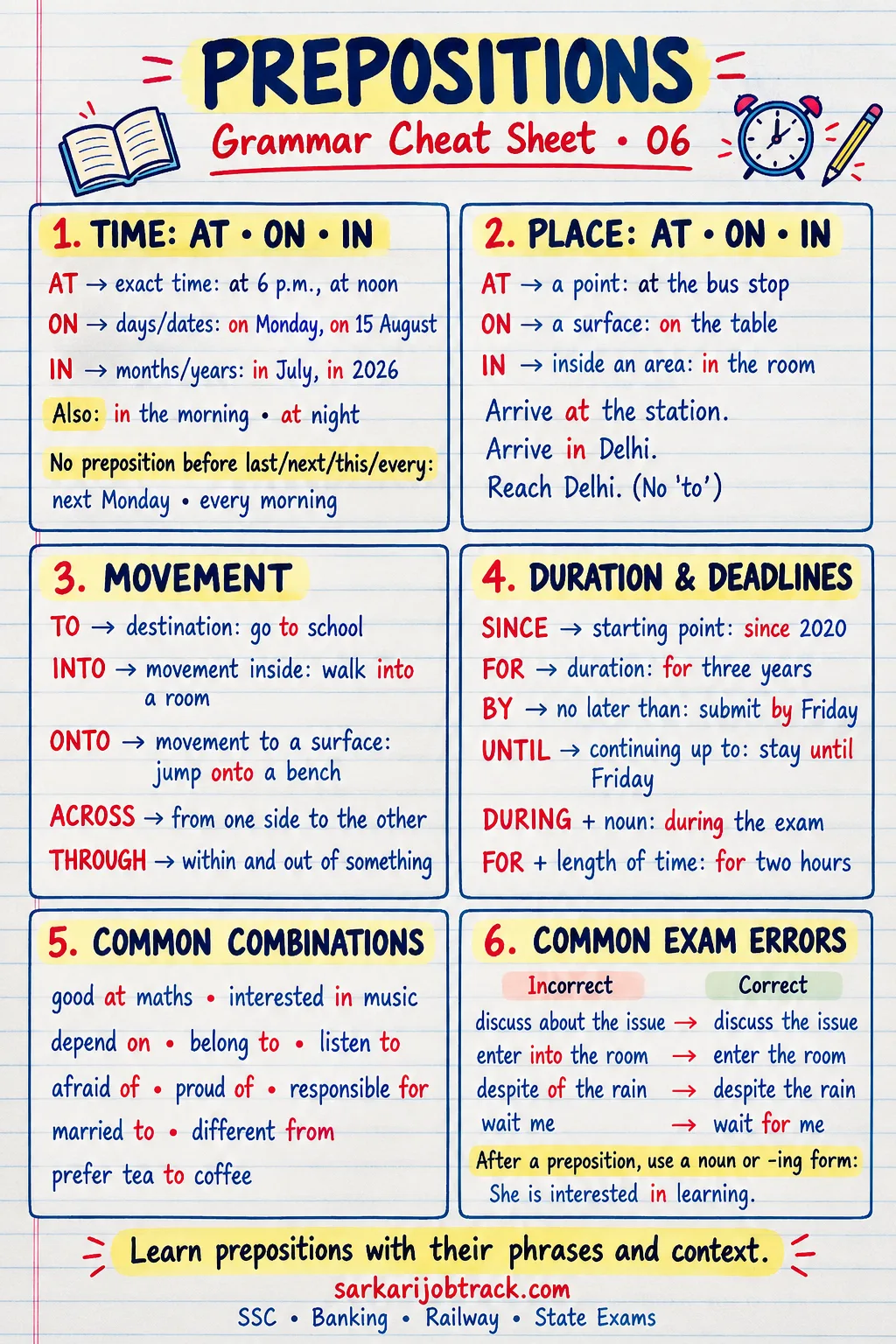
Already confident? Skip to practice: Prepositions quiz
Before this: a preposition is one of the eight parts of speech, and it works with a noun or pronoun. If naming the parts of a sentence feels shaky, read the Parts of Speech lesson first.
What a preposition does
A preposition is a word placed before a noun or pronoun to show how that noun relates to another word in the sentence — in place, in time, or in direction.
- "The book is on the table." (on shows where the book is, in relation to the table.)
- "We will meet after lunch." (after shows when, in relation to lunch.)
- "She walked towards the gate." (towards shows the direction of the walking.)
The noun or pronoun that follows is called the object of the preposition: in "on the table", the object is the table. A preposition almost never stands alone — it needs that object. Because the object is a noun or pronoun, a pronoun after a preposition takes its object form: between you and me*, never between you and I*.
The exam rarely asks you to define a preposition. It asks you to pick the right one in a blank, or to find the wrong one in a sentence. The whole skill is knowing which preposition goes with which situation, so the rest of this lesson is the situations.
In, on, at — for place
These three cause the most errors, because each narrows the space differently. Learn them as a scale from large to small.
| Preposition | Used for | Example |
|---|---|---|
| in | an enclosed or large area — a country, city, room, or container | in India, in Delhi, in the room, in a box |
| on | a surface, or a line such as a road, floor or coast | on the table, on the wall, on the first floor, on the coast |
| at | a precise point, or a specific address or place | at the bus stop, at the door, at 10 Downing Street |
So a letter is written in a room, placed on a desk, and left at the office. The space gets smaller and more exact as you move in → on → at.
Check: which fits — "The train stopped ___ the station"? A station is a specific point on a journey, so the answer is at the station. ("In the station" is used only when you mean physically inside the building.)
In, on, at — for time
The same three words carry over to time, and the scale is the same idea: large stretch → day → exact moment.
| Preposition | Used for | Example |
|---|---|---|
| in | months, years, seasons, centuries, and parts of the day | in May, in 1947, in summer, in the morning |
| on | days and dates | on Monday, on 15 August, on my birthday |
| at | a clock time, and the fixed phrases at night, at noon, at midnight | at 5 o'clock, at night, at noon |
The one to memorise against instinct is in the morning / in the afternoon / in the evening but at night. Three parts of the day take in; night alone takes at.
Check: "India became independent ___ 15 August 1947." A date takes on, so the answer is on 15 August 1947. If the blank had only the year — "___ 1947" — it would be in 1947.
Prepositions of movement and direction
When something moves, the preposition shows the path, not the position.
- to — movement towards a destination: "She went to school."
- into — movement to the inside of something: "He jumped into the pool."
- onto — movement to a surface: "The cat climbed onto the roof."
- from — the starting point: "The train runs from Delhi to Agra."
- towards — in the direction of, without saying it is reached: "He ran towards the exit."
- through — in one side and out the other: "We drove through the tunnel."
- across — from one side to the other: "She swam across the river."
Do not confuse in/on (position) with into/onto (movement). "The keys are in the drawer" is position; "He put the keys into the drawer" is movement.
The fixed pairs the exam loves
Many adjectives, verbs and nouns always take one particular preposition. There is no rule for these — each is fixed by usage, and the exam tests them constantly in both the fill-in-the-blank and error-spotting styles. These are the ones worth memorising.
| Word | Preposition | Example |
|---|---|---|
| good, bad, poor | at | good at mathematics |
| depend, rely | on | depend on your friends |
| married, related | to | married to a doctor |
| afraid, scared | of | afraid of the dark |
| interested | in | interested in history |
| angry (with a person) | with | angry with him |
| angry (about a thing) | about | angry about the delay |
| congratulate, insist | on | congratulate her on her success |
| differ, different | from | different from the others |
| composed, consists | of | the team consists of eleven players |
| superior, senior | to | senior to me (never senior than) |
The last row is a favourite trap: superior, inferior, senior, junior and prior take to, not than. "He is senior to me", never "senior than me".
Check: "She is good ___ mathematics." From the table, good takes at, so the answer is good at mathematics.
Solved example (error-spotting style)
Find the error: "The committee consists of five members / who are all senior than / the new chairman."
Work it part by part. Consists of is correct — consist takes of. The error is senior than: senior takes to, so it should read senior to the new chairman. The wrong preposition is the error, which is exactly what this question type hides.
Common mistakes to avoid
- "Discuss about" / "order for" — some verbs take no preposition at all. You discuss a plan, not discuss about it; you order a book, not order for it. Adding a preposition is the error.
- "Reach to" a place — reach is already complete: "We reached the station", not "reached to the station".
- "Between" three or more — between is normally for two and among for three or more: "Divide it between the two" but "divide it among the three". (The exam tests this split; in careful English between can take more than two when the relationship is one-to-one, as in "a treaty between four nations".)
- Preposition at the end with a pronoun — after a preposition, use the object pronoun: "This is between you and me", not "between you and I".
Quick revision table
| Situation | Preposition | Example |
|---|---|---|
| Large area / enclosed space | in | in Delhi, in the room |
| Surface or line | on | on the table, on the road |
| Exact point or address | at | at the door, at the station |
| Month, year, season, part of day | in | in May, in 1947, in the morning |
| Day or date | on | on Monday, on 15 August |
| Clock time; night, noon, midnight | at | at 5 o'clock, at night |
| Movement into / onto | into, onto | into the pool, onto the roof |
| good / bad | at | good at drawing |
| depend / rely / insist / congratulate | on | depend on help |
| married / related / senior / superior | to | senior to him |
| afraid / composed / consists | of | afraid of heights |
| interested | in | interested in music |
| different / differ | from | different from yours |
Keep this table and the prepositions cheat sheet for last-minute revision, and move on to the Error Spotting lesson, where a wrong preposition is one of the commonest planted errors.
How this was made: Drafted with AI assistance; every answer re-solved by a separate check that had not seen the key; every fact checked against the source it cites.