
Error Spotting: Finding the Grammar Mistake in a Sentence
Learn a step-by-step method for error-spotting questions — read the whole sentence, find the real subject and its verb, then test each part against one rule at a time, covering subject–verb agreement, tense, articles, prepositions, pronouns, adjectives and adverbs, comparison and redundancy, through worked examples in the exam's own split-sentence style.
By the end of this lesson you will be able to work through an error-spotting question part by part, know which rule to test in each part, and avoid the traps that make a correct part look wrong and a wrong part look right.
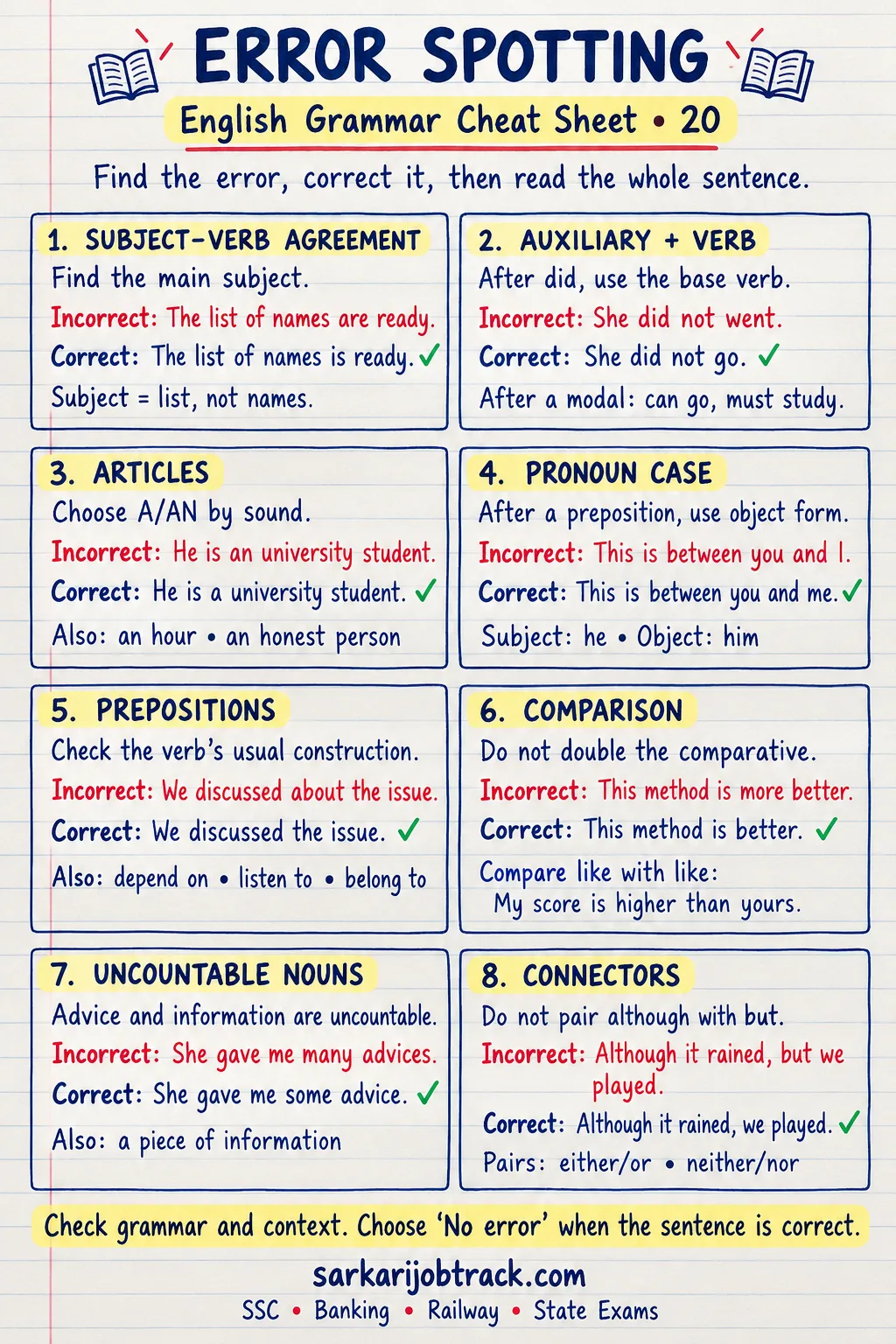
Already confident? Skip to practice: Error Spotting quiz
Before this: error spotting pulls together every grammar rule you have learnt, so finish the building blocks first. The single biggest source of errors is subject–verb agreement; read the Subject–Verb Agreement lesson if it feels shaky, and the Parts of Speech and Sentence Structure lesson to be sure you can find the subject, the verb and the part of speech of each word. Keep the Tenses cheat sheet, the Articles cheat sheet and the Prepositions cheat sheet nearby for the lists this lesson points to.
What an error-spotting question looks like
The sentence is cut into three or four parts, usually labelled (a), (b), (c) and (d). Exactly one part has a grammatical error, and you name that part. Many papers add a last choice, No error, which is right only when all the other parts are correct.
Select the part that contains an error: (a) The quality of the mangoes / (b) in these baskets / (c) are not good / (d) No error
Your job is not to rewrite the sentence. It is to decide which one part breaks a rule.
The method in one line
Read the whole sentence first, find the subject and its main verb, then test each part against one rule at a time. Treat No error as a claim you must prove, not a resting place.
This matters because the error is often not where your eye first lands. A part can sound odd and still be correct, and a part can read smoothly and still be wrong. You decide with a rule, not with your ear.
The error types SSC tests, commonest first
1. Subject–verb agreement (the commonest)
The tell: find the real subject, strike out any phrase that sits between it and the verb, then match the verb for number. A phrase beginning with a preposition (of, in, with) and an added phrase such as along with or as well as do not change the subject. With one of and every one of, the subject is one, which is singular, even though a plural noun follows.
- A bunch of keys was lying on the table. (the subject is bunch, not keys)
This is the type the Subject–Verb Agreement lesson teaches in full; revise it there if more than one of these parts troubles you.
2. Prepositions: the right one, a missing one, an extra one
The tell: many verbs and adjectives demand one fixed preposition, so when a part contains a preposition ask whether it is the right partner. Learn the pairs: good at, afraid of, fond of, capable of, interested in, composed of, differ from**. The full list is in the Prepositions cheat sheet.
Two kinds of mistake hide here:
- A verb that takes its object directly needs no preposition. For example, reach the office and enter the hall take no to or into.
- *A phrase that ends in the preposition to** is followed by the -ing form, not the base verb: used to working late, object to paying extra, addicted to playing. The to here is a preposition, not the to* of an infinitive.
3. Tense and verb form
The tell: a sentence usually keeps one time frame, and each helping verb forces a fixed form after it. After do, does or did, the main verb returns to its base form: She does not like tea, He did not go*. When one past action finishes before another, the earlier one takes the past perfect (had + past participle): The train had left before we arrived.*
4. Nouns: singular, plural and uncountable
The tell: check whether a noun can be counted and whether its plural is regular.
- Irregular plurals are already plural; do not add -s again: women (not womens), feet, teeth, phenomena.
- Uncountable nouns have no plural and take a singular verb: furniture, information, advice, luggage, equipment. Informations and advices are wrong.
- One of and one of the are always followed by a plural noun: one of my friends*, not one of my friend*.
5. Pronouns
The tell: check three things — case, the reflexive form, and agreement with the noun it stands for.
- Case: use the subject form (I, he, she, we, they) for a subject and the object form (me, him, her, us, them) after a verb or a preposition: He invited my brother and me**.
- Reflexive: a reflexive pronoun (myself, himself, themselves) is correct only when the subject also appears in the clause; it is not a plain subject. When two or more people act on each other, use each other or one another, not a reflexive.
- Agreement: a pronoun matches the noun it replaces in number and gender.
6. Adjective or adverb?
The tell: ask what the word describes. A word that describes a verb (telling how the action is done) must be an adverb, usually ending in -ly: She writes neatly*, not neat. A word that describes a noun is an adjective, even after a linking verb: The soup tastes good*.
7. Comparison
The tell: three checks.
- No double comparison. A word already in -er or more is not made comparative again, and -est or most is not doubled: wiser (not more wiser), the cleverest (not the most cleverest).
- Complete the pair. Correlatives come in fixed pairs: either…or, neither…nor, not only…but also, no sooner…than, hardly…when, scarcely…when, so…that, such…that. The wrong second half is a common trap.
- Compare like with like. The weather of Delhi is hotter than that of Chennai, not than Chennai.
8. Redundancy: saying it twice
The tell: a part that repeats an idea already carried by another word has an error, even though every word is itself correct. Common doublings: mutual cooperation, free gift, close proximity, final conclusion, past history, cousin brother. Drop the extra word.
Worked examples
Example 1: Subject–verb agreement
Question: Which part has an error? (a) The quality of the mangoes / (b) in these baskets / (c) are not good / (d) No error
- Find the main verb: are.
- Ask "what + are?" Not the mangoes and not the baskets, but their quality.
- Set aside the phrases that begin with a preposition: of the mangoes and in these baskets. What is left is The quality.
- Quality is singular, so the verb must be singular: is.
Answer: (c). Correct sentence: "The quality of the mangoes in these baskets is not good."
The principle: the verb agrees with the main word of the subject, not with the nearest noun. Remove phrases that begin with a preposition, and added phrases such as along with and as well as, before you decide the number.
Example 2: Tense sequence
Question: Which part has an error? (a) When we reached / (b) the cinema hall / (c) the film already started / (d) No error
- There are two past actions: the film starting, and our reaching the hall.
- The word already shows the film started before we reached.
- The earlier of two past actions takes the past perfect: had + past participle.
- So started should be had already started.
Answer: (c). Correct sentence: "When we reached the cinema hall, the film had already started."
The principle: when one past action finishes before another, put the earlier one in the past perfect (had + past participle) and the later one in the simple past. Words such as already, before and by the time are the clue.
Example 3: Article
Question: Which part has an error? (a) He is / (b) an university student / (c) in Delhi / (d) No error
- Look at the article in part (b): an.
- The choice between a and an follows the sound of the next word, not its spelling.
- University begins with a "yoo" sound, a consonant sound, so it takes a.
- So an university should be a university.
Answer: (b). Correct sentence: "He is a university student in Delhi."
The principle: use an before a vowel sound (an hour, an MLA) and a before a consonant sound (a university, a one-rupee coin). Also check whether a the is missing before a superlative or a thing already known: the best singer, not best singer.
Example 4: Preposition
Question: Which part has an error? (a) He did not / (b) listen my advice / (c) carefully / (d) No error
- Check the verb in part (b): listen.
- Listen does not take its object directly; it needs the preposition to.
- Your turn: what should part (b) read?
Check: listen to my advice. The verb listen is always followed by to before the thing heard.
Answer: (b). Correct sentence: "He did not listen to my advice carefully."
The principle: when a part contains a verb or an adjective with a preposition, test the pair. Some verbs demand a particular preposition (listen to, depend on), and a few take none at all (reach the office). The Prepositions cheat sheet has the list to learn.
Example 5: Pronoun
Question: Which part has an error? (a) Ravi and myself / (b) will complete / (c) the project / (d) No error
- Part (a) is the subject of the sentence: who will complete the project?
- A reflexive pronoun such as myself can only turn an action back on a subject that is already named; it cannot be the subject.
- Your turn: which pronoun should stand in the subject?
Check: the subject form I. Write Ravi and I.
Answer: (a). Correct sentence: "Ravi and I will complete the project."
The principle: use the subject form (I, he, she) for a subject and the object form (me, him, her) after a verb or a preposition. Keep myself and himself for sentences where the subject also appears (I taught myself), never as a plain subject.
Example 6: Adjective or adverb
Question: Which part has an error? (a) He drives / (b) very careful / (c) on the highway / (d) No error
- Ask what careful describes.
- It tells how he drives, so it describes the verb drives.
- Your turn: a word that describes a verb is which part of speech, and what should part (b) read?
Check: an adverb. Write very carefully**.
Answer: (b). Correct sentence: "He drives very carefully on the highway."
The principle: a word that describes an action is an adverb (usually -ly): drives carefully, sings well. A word that describes a noun, or that follows a linking verb and describes the subject, stays an adjective: a careful driver, the soup tastes good.
How to attack an error-spotting question
- Read the whole sentence first. Understand what it means before you judge any part.
- Find the subject and its main verb. Check that they agree in number; this is the commonest error.
- Take each part in turn and test one rule at a time. Ask: is this a preposition, a tense, an article, a pronoun, an adjective-or-adverb, a comparison or a repeated idea? Test only that rule on that part.
- Do not pick No error just because nothing jumps out. Prove every part is correct before you choose it. The error is often in a smooth-sounding part.
- Mark the first part that breaks a rule. There is only one error, so once you can name the broken rule and the correction, you are done.
Common mistakes
- Trusting your ear. "He is senior than me" sounds fine to many speakers and is still wrong. Decide with a rule.
- Blaming the nearest noun. In a long subject, the verb agrees with the main noun, not the noun just before it.
- *Forgetting that to is sometimes a preposition. After used to, object to and look forward to, the next word takes -ing*, not the base form.
- Choosing No error too soon. It is the right answer sometimes, but only after every other part has passed its rule.
- Trying to correct two parts. Exactly one part is wrong. If you think two are wrong, re-read: one of them is correct.
Error types at a glance
No cheat sheet accompanies this lesson, so keep this table for quick revision. Each row gives the tell to check and a tiny example of the correct form.
| Error type | What to check | Example (correct) |
|---|---|---|
| Subject–verb agreement | Find the real subject; strike the phrase in between; match number | A bunch of keys was there. |
| Preposition | Right partner for the verb or adjective; some verbs take none | afraid of, depend on, reach the office |
| to + -ing | After used to, object to, look forward to, use -ing | used to working late |
| Tense / verb form | One time frame; base form after did/does; past perfect for the earlier past act | did not go; had left before we came |
| Noun number | Irregular plural not doubled; uncountable has no plural; one of + plural | women, information, one of my friends |
| Pronoun | Subject vs object form; reflexive needs its subject; each other for two people | invited me; Ravi and I; help each other |
| Adjective vs adverb | A word describing a verb is an adverb (-ly) | writes neatly |
| Comparison | No double comparative; complete the pair; compare like with like | wiser; neither…nor; that of Delhi |
| Redundancy | A word that repeats an idea already present | cooperation (not mutual cooperation) |
Practise and go next
Practise now: Error Spotting quiz
Next: the natural step up is Sentence Improvement, where the whole underlined part is replaced rather than only named — the same rules, asked the other way round. Until that lesson is ready, revise the rules in the Important Grammar Rules cheat sheet, then test yourself with the Subject–Verb Agreement quiz.
How this was made: Drafted with AI assistance; spot-checked by the editor on 24 October 2026.