
Number System: Place Value, Divisibility, Unit Digits and Remainders
Learn the place value of a digit and the family of numbers it belongs to, the divisibility rules for 2, 3, 4, 5, 6, 8, 9 and 11, how to find the smallest number to add or subtract to make a number divisible, how to read the unit digit of a large power from its cycle, how to find a remainder for a big power or a shared divisor, and how to count the multiples in a range, through six worked examples and a revision block.
By the end of this lesson you will be able to give the place value of any digit and name the family a number belongs to, test a number against the divisibility rules for 2, 3, 4, 5, 6, 8, 9 and 11, find the smallest number to add or subtract to make a number divisible, read off the unit digit of a large power from its repeating cycle, find the remainder of a big power or of a number with a shared divisor, and count how many multiples of a number lie in a range.
Already confident? Skip to practice: Number System quiz
This is the first topic in Maths, so there is nothing to read before it. Everything you need is counting, adding, and dividing with a remainder — the kind of division where 17 ÷ 5 is "3 remainder 2", not 3.4. If you want to see where this topic sits among the others, the Maths hub lists them in order.
The one idea behind the whole topic
Every whole number is built from its digits and the column each digit sits in. In 58,316 the 8 is not worth 8 — it sits in the thousands column, so it is worth 8,000. That is its place value. The digit on its own, 8, is its face value. Reading a number as "a digit times its column" is the idea the whole topic rests on:
place value of a digit = the digit × the value of its column (ones, tens, hundreds, thousands, …).
The second idea is division with a remainder. Any number, divided by another, gives a quotient and a remainder left over, and the remainder is always smaller than what you divided by. 17 divided by 5 is 3 with 2 left over, because 5 × 3 = 15 and 17 − 15 = 2. Written out, number = divisor × quotient + remainder. A number is exactly divisible when that remainder is 0. Almost every question below is really a question about the remainder.
A few names you will meet, so they do not trip you up later:
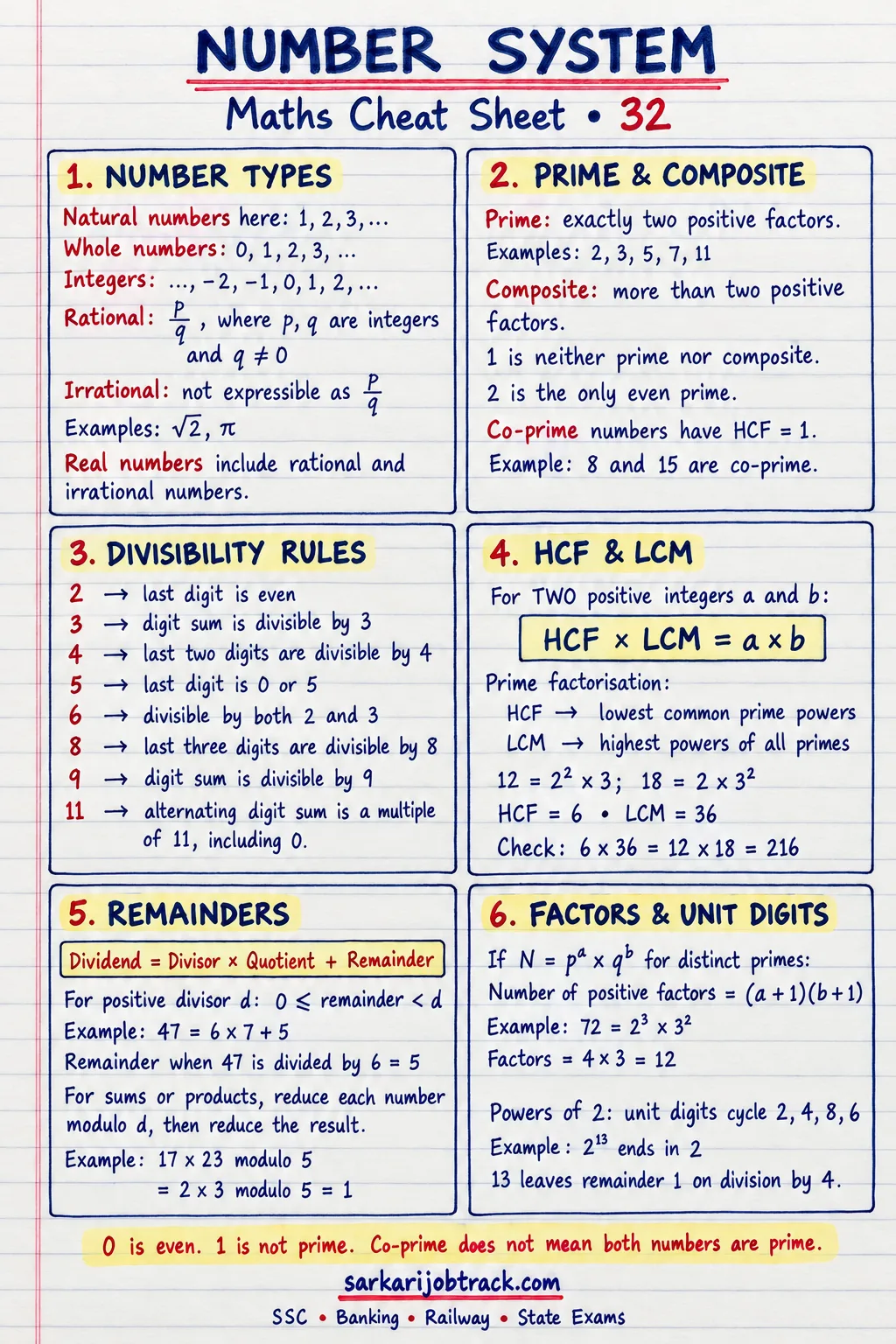
- Natural numbers are the counting numbers 1, 2, 3, … . Whole numbers are the same plus 0. Integers add the negatives: …, −2, −1, 0, 1, 2, … .
- A prime number has exactly two different factors, 1 and itself (2, 3, 5, 7, 11, …). A composite number has more than two (4, 6, 8, 9, …). The number 1 has only one factor, so it is neither prime nor composite, and 2 is the only even prime.
- Even numbers are the multiples of 2 (…, 2, 4, 6, …); odd numbers are the rest. Consecutive even numbers, or consecutive odd numbers, differ by 2.
Worked examples
Read each example slowly. The first two show every step. In the later ones, some steps are left for you, with the answer just below.
Example 1: Place value, and the families of numbers
Question: (a) In the number 58,316, what is the place value of the 8, and what is the place value of the 5? (b) How many prime numbers are there up to 20? (c) Find the sum of the first 10 natural numbers, and the sum of the first 5 odd numbers.
Part (a): place value
- Write the columns from the right: 6 is in the ones column, 1 in the tens, 3 in the hundreds, 8 in the thousands, 5 in the ten-thousands.
- The 8 sits in the thousands column, so its place value is 8 × 1,000 = 8,000. (Its face value, the digit alone, is just 8.)
- The 5 sits in the ten-thousands column, so its place value is 5 × 10,000 = 50,000.
Part (b): counting primes
- Go through the numbers up to 20 and keep the ones with exactly two factors: 2, 3, 5, 7, 11, 13, 17, 19.
- That is 8 primes. Remember 1 is not prime, and after 2 every prime is odd.
Part (c): two sums worth knowing by heart
- The sum of the first n natural numbers is n × (n + 1) ÷ 2. For the first 10: 10 × 11 ÷ 2 = 55.
- The sum of the first n odd numbers is always n × n. For the first 5 odd numbers (1, 3, 5, 7, 9): 5 × 5 = 25. Adding them the long way, 1 + 3 + 5 + 7 + 9 = 25, agrees.
Your turn: list the prime numbers less than 12, and say how many there are.
Check: they are 2, 3, 5, 7 and 11, which is 5 primes. (1 is left out because it is not prime.)
The principle: a digit's place value is the digit times the value of its column. Keep the families straight — 1 is neither prime nor composite, 2 is the only even prime — and remember the two sums: first n naturals is n(n + 1) ÷ 2, and first n odd numbers is n × n.
Example 2: The divisibility rules
You can tell whether a number divides exactly without doing the full division. Each small divisor has a quick test:
| Divisor | Test |
|---|---|
| 2 | last digit is even (0, 2, 4, 6, 8) |
| 3 | the digits add up to a multiple of 3 |
| 4 | the last two digits form a multiple of 4 |
| 5 | last digit is 0 or 5 |
| 6 | passes the tests for both 2 and 3 |
| 8 | the last three digits form a multiple of 8 |
| 9 | the digits add up to a multiple of 9 |
| 11 | (sum of digits in odd places) − (sum in even places) is 0 or a multiple of 11 |
Question: Test 5,23,164 against the rules for 4, 8, 3 and 6.
- By 4: the last two digits are 64, and 64 ÷ 4 = 16 with nothing left over, so yes, it is divisible by 4.
- By 8: the last three digits are 164, and 164 ÷ 8 = 20.5 — not a whole number — so no, it is not divisible by 8.
- By 3: add the digits: 5 + 2 + 3 + 1 + 6 + 4 = 21, which is a multiple of 3, so yes. (21 is not a multiple of 9, so it is not divisible by 9.)
- By 6: the number is even and divisible by 3, so it passes both parts of the 6 test — yes.
Now a common exam twist: a digit is missing and you must choose it.
Question: In the number 91▢4, what is the smallest digit for the blank that makes the whole number divisible by 3?
- Use the rule for 3: the digits must add to a multiple of 3. The known digits add to 9 + 1 + 4 = 14.
- The next multiple of 3 at or above 14 is 15, so the blank must add 15 − 14 = 1.
- Check: 9 + 1 + 1 + 4 = 15, a multiple of 3. The number 9114 ÷ 3 = 3038, exact.
Your turn: use the rule for 11 to decide whether 7,06,266 is divisible by 11. (Number the places from the right: 1st, 3rd, 5th are the odd places.)
Check: odd places hold 6, 2, 0 (sum 8); even places hold 6, 6, 7 (sum 19). The difference is 8 − 19 = −11, a multiple of 11, so yes, 706266 is divisible by 11 (it is 11 × 64,206).
The principle: the rules for 2, 5 and 4 and 8 look at the end digits; the rules for 3 and 9 add the digits; 6 is "2 and 3 together"; 11 compares the odd-place and even-place digit sums. When a digit is missing, write the condition on the digit sum and read the digit off.
Example 3: The smallest number to add or subtract
To make a number exactly divisible, divide it and look at the remainder r. Then:
- to reach the nearest multiple below, subtract r;
- to reach the next multiple above, add (divisor − r).
If r is already 0, the number is divisible as it stands.
Question: (a) What is the least number that must be subtracted from 500 to make it divisible by 23? (b) What is the least number that must be added to 2,024 to make it divisible by 7? (c) What is the smallest four-digit number divisible by 32? (d) What is the largest three-digit number divisible by 13?
Part (a): subtract to go down
- Divide: 500 ÷ 23 = 21 with a remainder, since 23 × 21 = 483 and 500 − 483 = 17.
- The remainder is 17, so subtracting 17 lands on 483, a multiple of 23. That is the least you can take away.
Part (b): add to go up
- Divide: 2,024 ÷ 7 = 289 with 7 × 289 = 2,023, so the remainder is 2,024 − 2,023 = 1.
- Here we want the next multiple up, so add (divisor − remainder) = 7 − 1 = 6, reaching 2,030 = 7 × 290.
Part (c): the first four-digit multiple
- The smallest four-digit number is 1,000. Divide: 1,000 ÷ 32 = 31 with 32 × 31 = 992, remainder 8.
- 992 is a three-digit multiple, so step up one: add (32 − 8) = 24 to reach the next multiple, 32 × 32 = 1,024.
Part (d): the last three-digit multiple
- The largest three-digit number is 999. Divide: 999 ÷ 13 = 76 with 13 × 76 = 988, remainder 11.
- Subtract the remainder to drop to the multiple below: 999 − 11 = 988.
Your turn: what is the largest three-digit number exactly divisible by 18?
Check: 999 ÷ 18 = 55 with 18 × 55 = 990 and a remainder of 9. Subtract it: 999 − 9 = 990.
The principle: divide and find the remainder r. Subtract r for the nearest multiple below (and for "largest number up to here"); add (divisor − r) for the next multiple above (and for "smallest number from here on").
Example 4: The unit digit of a large power
You never need to work out the whole of a big power to know its last digit. The unit digit of the powers of any digit repeats in a short cycle:
- 0, 1, 5 and 6 never change — their powers always end in the same digit.
- 4 repeats every 2 steps (4, 6, 4, 6, …) and 9 every 2 steps (9, 1, 9, 1, …).
- 2, 3, 7 and 8 repeat every 4 steps: 2 gives 2, 4, 8, 6; 3 gives 3, 9, 7, 1; 7 gives 7, 9, 3, 1; 8 gives 8, 4, 2, 6.
For the "every 4 steps" digits, divide the power by 4 and use the remainder to pick the place in the cycle; a remainder of 0 means the 4th (last) one.
Question: (a) Find the unit digit of 3 to the power 28. (b) Find the unit digit of 7 to the power 22. (c) Find the unit digit of the product of 2 to the power 35 and 9 to the power 16.
Part (a):
- The cycle for 3 is 3, 9, 7, 1, repeating every 4 steps.
- Divide the power by 4: 28 ÷ 4 = 7 with remainder 0, so take the 4th (last) digit in the cycle, which is 1.
Part (b):
- The cycle for 7 is 7, 9, 3, 1.
- 22 ÷ 4 = 5 remainder 2, so take the 2nd in the cycle, which is 9.
Part (c): a product
- Find each unit digit on its own. For 2 to the power 35: the cycle is 2, 4, 8, 6; 35 ÷ 4 = 8 remainder 3, so the 3rd one, 8.
- For 9 to the power 16: 9 repeats 9, 1; an even power ends in 1.
- Multiply the two unit digits: 8 × 1 = 8, so the product ends in 8.
Your turn: find the unit digit of 3 to the power 19.
Check: the cycle for 3 is 3, 9, 7, 1; 19 ÷ 4 = 4 remainder 3, so the 3rd one, 7.
The principle: the last digit of a power follows a short repeating cycle. For 2, 3, 7, 8 the cycle is 4 long — divide the power by 4 and let the remainder pick the place (remainder 0 means the last). For a product, find each unit digit first, then multiply those.
Example 5: Remainders — a big power, and a shared divisor
The same cycle idea gives the remainder of a large power, and a second kind of question uses the fact that one divisor divides another.
Question: What is the remainder when 7 to the power 40 is divided by 9?
- Look at the remainders of the powers of 7 on division by 9: 7 leaves 7; 7 × 7 = 49 leaves 4; the next leaves 1; and then it repeats. The cycle is 7, 4, 1, three long.
- Divide the power by the cycle length: 40 ÷ 3 = 13 remainder 1, so take the 1st in the cycle, which is 7.
The second type gives you a remainder for one divisor and asks for another that divides it.
Question: A number leaves a remainder of 13 when it is divided by 16. What remainder does it leave when divided by 8?
- Write the number as 16k + 13 for some whole number k, because that is what "remainder 13 on dividing by 16" means.
- Since 8 divides 16, the part 16k is a multiple of 8 and leaves nothing. Only the 13 matters.
- 13 ÷ 8 = 1 remainder 5, so the number leaves a remainder of 5 when divided by 8.
Your turn: a number leaves a remainder of 25 when divided by 30. What remainder does it leave when divided by 6?
Check: write it as 30k + 25. Since 6 divides 30, the 30k leaves nothing, so only the 25 counts. 25 ÷ 6 = 4 remainder 1.
The principle: for the remainder of a big power, find the short cycle of remainders and let the power (divided by the cycle length) pick the place. When the new divisor divides the old one, the quotient part disappears and only the given remainder decides the answer.
Example 6: How many multiples lie in a range
To count the multiples of a number up to some value, divide and throw away the remainder: the multiples of d from 1 up to N number N ÷ d, rounded down. For a range that does not start at 1, count up to the top and take away the ones below the bottom.
Question: (a) How many numbers from 1 to 500 are divisible by 12? (b) How many numbers between 100 and 200 are divisible by 6?
Part (a):
- Divide and drop the remainder: 500 ÷ 12 = 41 remainder 8, so there are 41 multiples of 12 up to 500 (they run 12, 24, … up to 12 × 41 = 492).
Part (b):
- The first multiple of 6 at or above 100 is 102 (that is 6 × 17), and the last at or below 200 is 198 (that is 6 × 33).
- Count the multiples from the 17th to the 33rd: 33 − 17 + 1 = 17. (The "+ 1" is because both ends are counted.)
Your turn: how many numbers between 150 and 250 are divisible by 8?
Check: the first is 152 (8 × 19) and the last is 248 (8 × 31). Count them: 31 − 19 + 1 = 13.
The principle: the count of multiples of d up to N is N ÷ d with the remainder dropped. For an in-between range, find the first and last multiples, then (last index − first index + 1) — and do not forget the + 1, which is the commonest slip.
Common mistakes
- Mixing up place value and face value. In 58,316 the face value of 8 is 8, but its place value is 8,000 — the digit times the value of its column. The question almost always wants the place value.
- Calling 1 a prime. A prime has exactly two different factors; 1 has only one, so it is neither prime nor composite. And 2 is the only even prime — every other even number is composite.
- Adding when you should subtract, or the other way round. To make a number divisible, subtract the remainder to reach the multiple below, and add (divisor − remainder) to reach the one above. "Largest up to here" subtracts; "smallest from here on" adds.
- Dividing the power by the wrong number for a unit digit. For the digits 2, 3, 7 and 8 the cycle is 4 long, so divide the power by 4, not by the cycle of a different digit. A remainder of 0 points at the last digit in the cycle, not the first.
- Forgetting the "+ 1" when counting a range. The multiples from the 17th to the 33rd number 33 − 17 + 1 = 17, not 16. Both ends are included.
- Treating a remainder as a decimal. "17 ÷ 5" in these questions is "3 remainder 2", not 3.4. The remainder is the whole number left over, and it is always smaller than the divisor.
Number System: the rules in one place
Here "digit sum" means the digits added together, and a "cycle" is the short list a unit digit repeats.
| To find | Rule | Worked numbers |
|---|---|---|
| Place value of a digit | digit × value of its column | 8 in 58,316: 8 × 1,000 = 8,000 |
| The families | prime = two factors; 1 is neither; 2 is the only even prime | primes up to 20: 2, 3, 5, 7, 11, 13, 17, 19 (eight) |
| Sum of first n natural numbers | n × (n + 1) ÷ 2 | first 10: 10 × 11 ÷ 2 = 55 |
| Sum of first n odd numbers | n × n | first 5: 5 × 5 = 25 |
| Divisible by 3 or 9 | digit sum is a multiple of 3 (or of 9) | 5,23,164: 5+2+3+1+6+4 = 21, a multiple of 3 |
| Divisible by 4 or 8 | last two digits (or last three) form a multiple | 523,164: last two 64 = 4 × 16, so divisible by 4 |
| Divisible by 11 | odd-place sum − even-place sum is 0 or a multiple of 11 | 706,266: 8 − 19 = −11, so divisible by 11 |
| Smallest to subtract for divisibility | the remainder r | 500 ÷ 23 leaves 17; 500 − 17 = 483 |
| Smallest to add for divisibility | divisor − r | 2,024 ÷ 7 leaves 1; add 7 − 1 = 6 to get 2,030 |
| Unit digit of a power (2, 3, 7, 8) | cycle of 4; power ÷ 4, remainder picks the place (0 = last) | 7 to the power 22: cycle 7,9,3,1; rem 2 gives 9 |
| Remainder of a big power | find the short cycle of remainders; power ÷ cycle length | 7 to the power 40 ÷ 9: cycle 7,4,1; rem 1 gives 7 |
| Remainder for a divisor of the given one | only the given remainder counts | 16k + 13 divided by 8: 13 ÷ 8 leaves 5 |
| Count of multiples of d up to N | N ÷ d, remainder dropped | up to 500 by 12: 500 ÷ 12 = 41 (drop the 8) |
| Count of multiples in a range | last index − first index + 1 | 100–200 by 6: 33 − 17 + 1 = 17 |
Next
The natural next topic is HCF and LCM, which uses the factors and multiples you have just met to find the largest number that divides two numbers and the smallest that both divide: try the HCF and LCM quiz. After that come Fractions, Decimals and Percentage Conversions and Simplification, where the same careful arithmetic is put to work, and then the word-problem topics — Percentage, Ratio and Proportion, Average and the rest — each with its own quiz once you reach it. For now, make the rules above second nature.
Ready to test this lesson? Take the Number System quiz
How this was made: Drafted with AI assistance; every formula and worked figure recomputed independently; spot-checked by the editor on 26 October 2026.