
Number System Cheat Sheet
31 Oct 2026
Quick answer
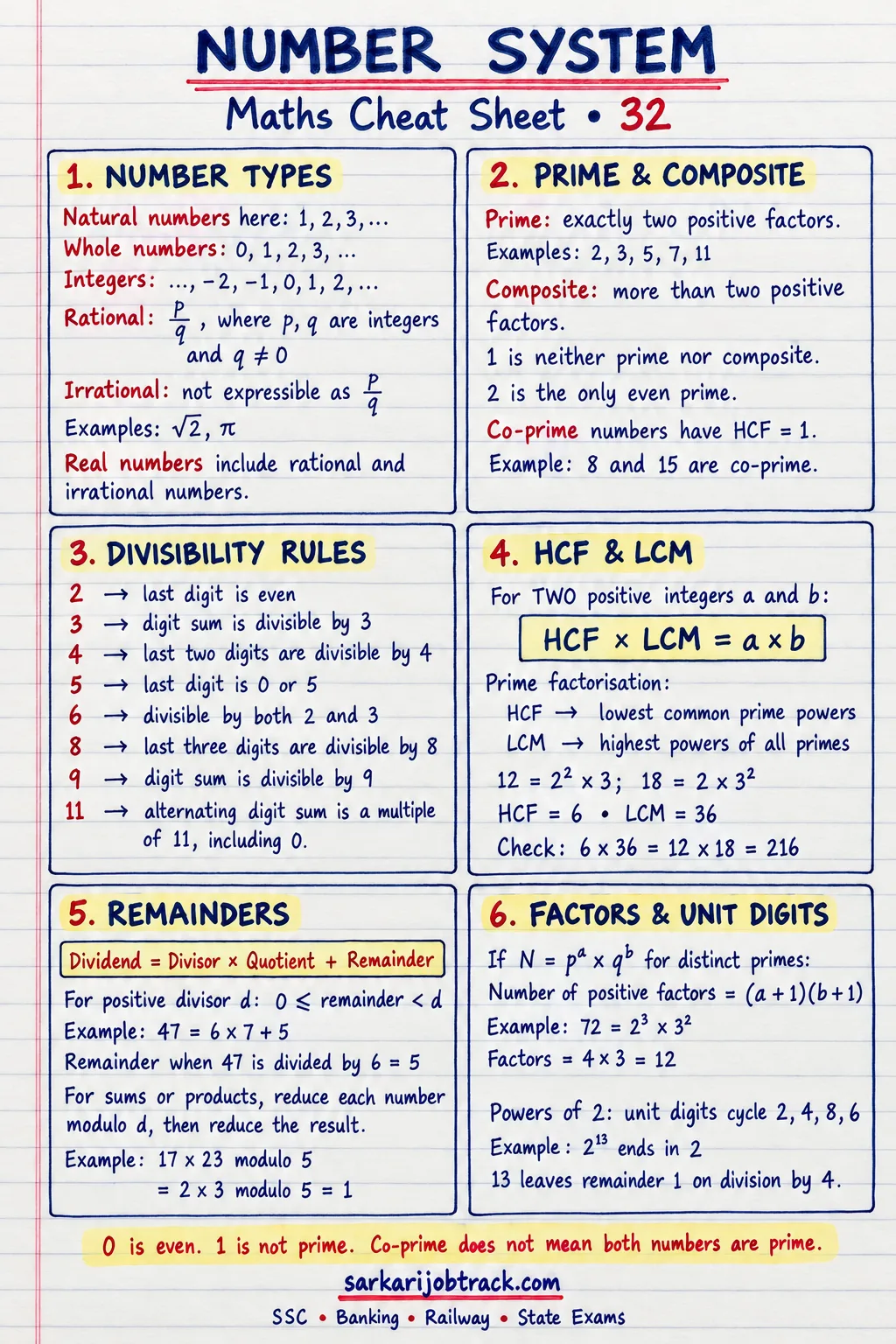
A quick revision cheat sheet on the number system for SSC, Banking, Railway and state exams. It covers the types of numbers, the divisibility rules from 2 to 11, the sum of the first n natural numbers, squares and cubes, unit-digit cyclicity, and how to count the factors of a number.
Number System Cheat Sheet
Quick Revision
The number system is the foundation of arithmetic — the kinds of numbers, how they divide, and the patterns their digits follow.
Ready to practise? Take the Number System quiz
1. Types of Numbers
| Type | Meaning |
|---|---|
| Natural | Counting numbers 1, 2, 3, … |
| Whole | Natural numbers together with 0 |
| Integers | …, −2, −1, 0, 1, 2, … |
| Rational | Can be written as p/q (q ≠ 0) |
| Irrational | Cannot (e.g. √2, π) |
| Prime | Exactly two factors: 1 and itself |
| Composite | More than two factors |
Note: 1 is neither prime nor composite; 2 is the only even prime.
2. Divisibility Rules
| Divisible by | Rule |
|---|---|
| 2 | Last digit is even (0, 2, 4, 6, 8) |
| 3 | Sum of the digits is divisible by 3 |
| 4 | Last two digits form a number divisible by 4 |
| 5 | Last digit is 0 or 5 |
| 6 | Divisible by both 2 and 3 |
| 8 | Last three digits form a number divisible by 8 |
| 9 | Sum of the digits is divisible by 9 |
| 10 | Last digit is 0 |
| 11 | Difference of the sums of alternate digits is 0 or divisible by 11 |
3. Sum Formulas
| Series | Sum |
|---|---|
| First n natural numbers | n(n + 1) / 2 |
| First n odd numbers | n² |
| First n even numbers | n(n + 1) |
| Squares of first n natural numbers | n(n + 1)(2n + 1) / 6 |
| Cubes of first n natural numbers | [n(n + 1) / 2]² |
4. Unit Digit (Cyclicity)
The unit digit of a power repeats in a short cycle:
| Base ends in | Cycle of unit digits | Length |
|---|---|---|
| 2 | 2, 4, 8, 6 | 4 |
| 3 | 3, 9, 7, 1 | 4 |
| 7 | 7, 9, 3, 1 | 4 |
| 8 | 8, 4, 2, 6 | 4 |
| 4 | 4, 6 | 2 |
| 9 | 9, 1 | 2 |
| 0, 1, 5, 6 | always the same | 1 |
To find the unit digit of a power, divide the exponent by the cycle length and use the remainder.
5. Counting the Factors of a Number
Write the number as its prime factorisation aᵖ × bᵠ × cʳ …. Then:
Number of factors = (p + 1)(q + 1)(r + 1) …Example
72 = 2³ × 3², so the number of factors = (3 + 1)(2 + 1) = 12.
6. Exam Quick Tips
- Memorise the divisibility rules for 3, 4, 8, 9 and 11 — they appear most.
- 1 is not prime; 2 is the only even prime.
- Use cyclicity to find the unit digit of large powers quickly.
- Use the prime factorisation method to count factors.
Keep revising with the rest of the Maths section:
How this was made: Drafted with AI assistance; spot-checked by the editor on 31 October 2026.