
Ratio and Proportion: Simplify, Share, Join Ratios and Find a Missing Term
Learn what a ratio such as 2 : 3 means, write a ratio in its simplest form even with fractions, decimals or different units, share an amount in a given ratio, join two ratios into one, find a fourth, third or mean proportional, and solve questions where a ratio changes, through six worked examples and a revision block.
By the end of this lesson you will be able to say what a ratio means in parts, write a ratio in its simplest form, share an amount in a given ratio, join two ratios into one, find a missing number in a proportion, and solve questions where a ratio changes.
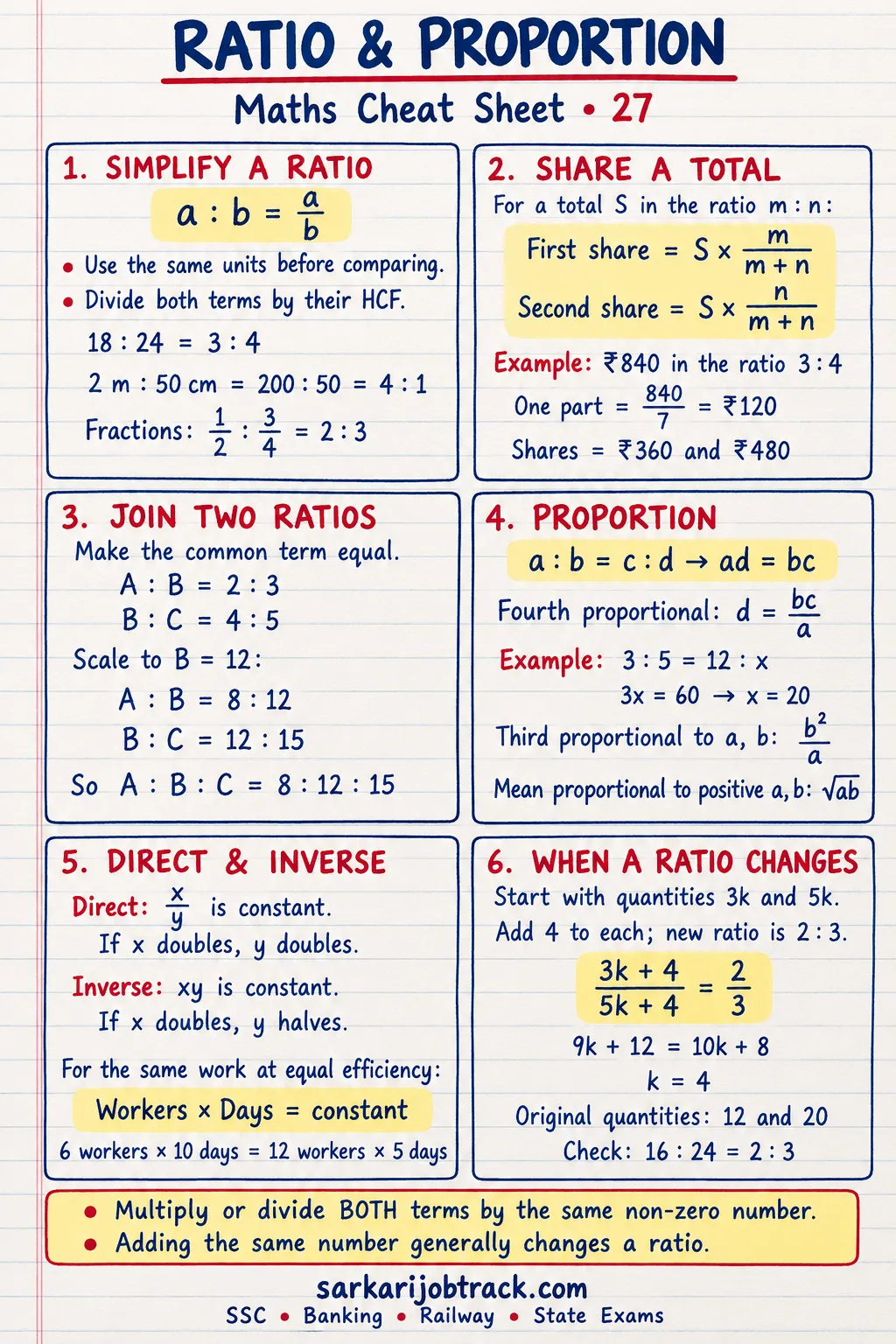
Already confident? Skip to practice: Ratio and Proportion quiz
Before this: you should be able to write a fraction in its lowest terms (18/24 = 3/4) and find the HCF and the LCM of two numbers (the HCF of 12 and 18 is 6, and their LCM is 36). If fractions feel shaky, read the Fractions, Decimals and Percentages lesson first. For HCF and LCM, try the LCM and HCF quiz.
What a ratio means
A ratio compares two amounts of the same kind by division: it says how many times one amount is of the other. The ratio of a to b is written a : b and read "a is to b". Questions often write it in words, so "5 is to 7" and "5 to 7" both mean 5 : 7. The two numbers are the terms of the ratio. A ratio can also have three terms, such as 2 : 3 : 4, which means 2 parts, 3 parts and 4 parts.
A ratio counts equal parts. Suppose a fruit seller's basket holds mangoes and bananas in the ratio 2 : 3. That does not mean there are 2 mangoes and 3 bananas. It means that for every 2 mangoes there are 3 bananas. Think of the fruit as split into equal parts:
- the mangoes are 2 parts;
- the bananas are 3 parts;
- the whole basket is 2 + 3 = 5 parts.
So the mangoes are 2/5 of the basket and the bananas are 3/5 of it. If the basket holds 40 pieces of fruit, one part is 40 ÷ 5 = 8 pieces. So there are 2 × 8 = 16 mangoes and 3 × 8 = 24 bananas. Check: 16 + 24 = 40, and 16 : 24 = 2 : 3 (divide both by 8).
The mangoes are not 2/3 of the basket. The fraction 2/3 compares the mangoes with the bananas (16 is 2/3 of 24), not with the whole basket.
Order matters. Mangoes to bananas is 2 : 3, but bananas to mangoes is 3 : 2. Write the terms in the order the question names them.
Equal ratios. Multiplying or dividing both terms by the same number (not zero) gives an equal ratio: 2 : 3 = 4 : 6 = 16 : 24. A ratio is in its simplest form when both terms are whole numbers with no common factor except 1.
Adding the same number to two amounts changes their ratio (unless the two amounts are equal). The new ratio depends on the actual amounts, not just on the ratio. 2 and 3 become 7 and 8 when you add 5 to each, but 16 and 24 (also in the ratio 2 : 3) become 21 and 29, and 21 : 29 is not 7 : 8. So add the number to the amounts (written as 2k and 3k, below), never to the terms of the ratio.
One part as k. If two amounts are in the ratio 2 : 3, the first is 2 parts and the second is 3 parts. If we call the size of one part k, the amounts are 2k and 3k. Example 5 uses this.
A ratio has no unit. A ratio is one amount divided by another amount of the same kind, so the units cancel. For example, 6 kg : 9 kg is 6 kg ÷ 9 kg = 2/3. The "kg" on the top and the "kg" on the bottom cancel, so the ratio is just 2 : 3, with no unit. For the units to cancel, both amounts must be in the same unit first. So 600 g to 1.5 kg is not 600 : 1.5. Change 1.5 kg to 1,500 g first: 600 : 1,500 = 2 : 5. This is also why a ratio compares only amounts of the same kind: lengths with lengths, money with money, time with time, numbers of things with numbers of things (mangoes with bananas, boys with girls).
Worked examples
Read each example slowly. The first two show every step. In the later ones, some steps are left for you, with the answer just below.
Example 1: Writing a ratio in its simplest form
Question: Write each ratio in its simplest form. (a) 72 : 120 (b) 3/4 : 5/6, and 1.25 : 0.4 (c) 36 minutes to 1 hour 20 minutes.
Part (a): whole numbers
- Find the HCF (highest common factor) of 72 and 120. 72 = 2 × 2 × 2 × 3 × 3 and 120 = 2 × 2 × 2 × 3 × 5, so the HCF is 2 × 2 × 2 × 3 = 24.
- Divide both terms by 24: 72 ÷ 24 = 3 and 120 ÷ 24 = 5.
- So 72 : 120 = 3 : 5.
If you cannot see the HCF, divide both terms by any common factor and repeat until no common factor is left: 72 : 120 = 36 : 60 = 12 : 20 = 3 : 5.
Part (b): fractions and decimals
- For fractions, clear the denominators. Multiply both terms by the LCM of 4 and 6, which is 12.
- 3/4 × 12 = 9 and 5/6 × 12 = 10. So 3/4 : 5/6 = 9 : 10.
- For decimals, move the decimal point the same number of places in both terms. 1.25 has two decimal places, so multiply both terms by 100: 1.25 : 0.4 = 125 : 40.
- The HCF of 125 and 40 is 5, so 125 : 40 = 25 : 8.
Part (c): different units
- Put both amounts in the same unit. 1 hour 20 minutes = 60 + 20 = 80 minutes.
- The ratio is 36 minutes : 80 minutes = 36 : 80. The minutes cancel, so the ratio has no unit.
- The HCF of 36 and 80 is 4, so 36 : 80 = 9 : 20.
The principle: divide both terms by their HCF. Clear fractions by multiplying both terms by the LCM of the denominators, and clear decimals by multiplying both terms by 10, 100 or 1,000. Put both amounts in the same unit before you write the ratio.
Example 2: Sharing in a given ratio
Question: (a) Share ₹5,400 between Seema and Kavita in the ratio 5 : 7. (b) Share ₹6,300 among three brothers in the ratio 2 : 3 : 4. (c) Two numbers are in the ratio 4 : 9, and their difference is 35. Find the numbers. (d) In a library, Hindi and English books are in the ratio 8 : 3. There are 360 Hindi books. How many English books are there?
Part (a): two shares
- Add the terms to get the number of parts: 5 + 7 = 12 parts.
- One part = ₹5,400 ÷ 12 = ₹450.
- Seema gets 5 parts: 5 × 450 = ₹2,250. Kavita gets 7 parts: 7 × 450 = ₹3,150.
- Check: 2,250 + 3,150 = 5,400.
The same with fractions: Seema's share is 5/12 of ₹5,400, and Kavita's share is 7/12 of it.
Part (b): three shares
- Add the terms: 2 + 3 + 4 = 9 parts.
- One part = ₹6,300 ÷ 9 = ₹700.
- The shares are 2 × 700 = ₹1,400, 3 × 700 = ₹2,100 and 4 × 700 = ₹2,800.
- Check: 1,400 + 2,100 + 2,800 = 6,300.
Part (c): from the difference
- The numbers are 4 parts and 9 parts. Their difference is 9 − 4 = 5 parts.
- So 5 parts = 35, and one part = 35 ÷ 5 = 7.
- The numbers are 4 × 7 = 28 and 9 × 7 = 63.
- Check: 63 − 28 = 35, and 28 : 63 = 4 : 9 (divide both by 7).
Part (d): from one share
- The Hindi books are 8 parts, so 8 parts = 360 books.
- One part = 360 ÷ 8 = 45 books.
- The English books are 3 parts: 3 × 45 = 135 books.
- Check: 360 : 135 = 8 : 3 (divide both by 45).
The principle: first find what one part is worth, then multiply by the number of parts you need. Divide the total by the sum of the terms, the difference by the difference of the terms, or a known share by its own number of parts. Use the one that matches what the question gives you.
Example 3: Joining two ratios into one
Question: (a) A : B = 3 : 5 and B : C = 2 : 7. Find A : B : C, and A : C. (b) P : Q = 4 : 3 and Q : R = 5 : 6. Find P : Q : R, and P : R.
You cannot simply write 3 : 5 : 7. B is 5 parts in the first ratio but 2 parts in the second, so the parts are of different sizes. First make B the same number in both ratios.
Part (a)
- B is 5 in the first ratio and 2 in the second. The LCM of 5 and 2 is 10.
- Multiply both terms of the first ratio by 2: A : B = 3 : 5 = 6 : 10.
- Multiply both terms of the second ratio by 5: B : C = 2 : 7 = 10 : 35.
- Now B is 10 in both, so A : B : C = 6 : 10 : 35.
- Read A : C from it: A : C = 6 : 35. With fractions: A/C = A/B × B/C = 3/5 × 2/7 = 6/35.
A quick way to write the joined ratio: if A : B = a : b and B : C = c : d, then A : B : C = a × c : b × c : b × d. Here that is 3 × 2 : 5 × 2 : 5 × 7 = 6 : 10 : 35. If all three terms share a common factor, simplify at the end. (6 and 10 share 2, but 35 does not, so 6 : 10 : 35 is already in its simplest form.)
Part (b)
- Q is 3 in the first ratio and 5 in the second.
- Your turn: make Q the same in both ratios, then find P : Q : R, and P : R in its simplest form.
Check: The LCM of 3 and 5 is 15. P : Q = 4 : 3 = 20 : 15 and Q : R = 5 : 6 = 15 : 18, so P : Q : R = 20 : 15 : 18. Then P : R = 20 : 18 = 10 : 9 (divide both by 2). With fractions: 4/3 × 5/6 = 20/18 = 10/9.
The principle: to join A : B and B : C, make the shared term B the same number in both ratios, using the LCM of its two values. Then read all three terms in order. A : C is A/B × B/C.
Example 4: Proportion, and the missing term
Some words first:
- Four numbers a, b, c and d are in proportion when a : b = c : d. This is also written a : b :: c : d, and read "a is to b as c is to d".
- In a : b :: c : d, the outer terms a and d are the extremes, and the inner terms b and c are the means.
- The key rule: in a proportion, the product of the extremes equals the product of the means, so a × d = b × c. This is the same as cross-multiplying a/b = c/d.
- d is the fourth proportional to a, b and c.
- When a : b = b : c (the middle number is used twice), the three numbers are in continued proportion. Then c is the third proportional to a and b, and b is the mean proportional between a and c.
Question: (a) If 4 is to 10 as 14 is to x, find x. This x is the fourth proportional to 4, 10 and 14. (b) Find the third proportional to 6 and 18. (c) Find the mean proportional between 7 and 28.
Part (a): the fourth proportional
- Write the proportion: 4 : 10 :: 14 : x.
- Product of the extremes = product of the means: 4 × x = 10 × 14 = 140.
- So x = 140 ÷ 4 = 35.
- Check: 4 : 10 = 2 : 5, and 14 : 35 = 2 : 5 (divide both by 7).
Part (b): the third proportional
- The third proportional x makes 6 : 18 = 18 : x. The 18 is used twice.
- Product of the extremes = product of the means: 6 × x = 18 × 18 = 324.
- So x = 324 ÷ 6 = 54. Check: 6 : 18 = 1 : 3, and 18 : 54 = 1 : 3.
Part (c): the mean proportional
- The mean proportional x makes 7 : x = x : 28. Now x is used twice.
- Product of the extremes = product of the means: x × x = 7 × 28 = 196.
- Your turn: which positive number times itself is 196?
Check: 14 × 14 = 196, so the mean proportional is 14. Check: 7 : 14 = 1 : 2, and 14 : 28 = 1 : 2. ((−14) × (−14) is also 196, but the mean proportional between two positive numbers is always taken as the positive number.)
The mean proportional is not the average. The average of 7 and 28 is (7 + 28) ÷ 2 = 17.5, and 7 : 17.5 is not equal to 17.5 : 28.
The principle: in a : b :: c : d, a × d = b × c. So the fourth proportional to a, b and c is b × c ÷ a. The third proportional to a and b is b × b ÷ a. The mean proportional between two positive numbers a and b is the positive number which, multiplied by itself, gives a × b: it is the positive square root, √(a × b).
Example 5: Using k for unknown amounts, and ratios that change
Question: (a) If p : q = 4 : 5, find (2p + 3q) : (3p + q). (b) The ages of a father and his son are in the ratio 9 : 2. In 6 years' time, the ratio of their ages will be 3 : 1. Find their present ages. (c) Arun's monthly income and expenditure (spending) are in the ratio 5 : 4. His income goes up by ₹5,000 and his expenditure by ₹2,000, and the ratio becomes 4 : 3. What was his income before the rise?
Part (a): a ratio of expressions
- p is 4 parts and q is 5 parts, so write p = 4k and q = 5k, where k is the size of one part.
- 2p + 3q = 8k + 15k = 23k, and 3p + q = 12k + 5k = 17k.
- So (2p + 3q) : (3p + q) = 23k : 17k = 23 : 17. The k cancels, just as a unit does.
Because k cancels, you may take k = 1, that is, p = 4 and q = 5: then 2 × 4 + 3 × 5 = 23 and 3 × 4 + 5 = 17. This works because every term in both expressions is a number times p or a number times q, so every term carries exactly one k, and the k cancels. It would not work for (p + 3) : q, because the 3 has no k with it, or for (p × p + q) : q, because p × p carries k twice but q carries it only once, so the k's do not all cancel. (When every term carries k the same number of times, the shortcut still works: (p × p + q × q) : (p × q) is 41 : 20 whatever k is.)
Part (b): the same number added to both
- Write the present ages as 9k years and 2k years.
- In 6 years' time both people are 6 years older: 9k + 6 and 2k + 6. The same number is added to both amounts (not to the 9 and the 2), so the ratio changes.
- The new ratio is 3 : 1, so (9k + 6) : (2k + 6) = 3 : 1.
- Product of the extremes = product of the means (Example 4): (9k + 6) × 1 = (2k + 6) × 3, so 9k + 6 = 6k + 18.
- Take 6k from both sides: 3k + 6 = 18. Take 6 from both sides: 3k = 12, so k = 4.
- Your turn: find the two present ages, and check the ratio of their ages in 6 years' time.
Check: The father is 9 × 4 = 36 years old and the son is 2 × 4 = 8 years old. In 6 years they will be 42 and 14, and 42 : 14 = 3 : 1 (divide both by 14). The difference between their ages is 28 years now and 28 years then: the difference between two people's ages never changes.
Part (c): income and expenditure
- Write the income as 5k rupees and the expenditure as 4k rupees.
- After the rise, the income is 5k + 5,000 and the expenditure is 4k + 2,000. These are in the ratio 4 : 3.
- Your turn: cross-multiply, find k, and then find his income before the rise.
Check: (5k + 5,000) × 3 = (4k + 2,000) × 4, so 15k + 15,000 = 16k + 8,000, and k = 7,000. His income was 5 × 7,000 = ₹35,000, and his expenditure was 4 × 7,000 = ₹28,000. Check: after the rise, ₹40,000 : ₹30,000 = 4 : 3.
The principle: when a ratio a : b describes two unknown amounts, write them as ak and bk. Turn the words of the question into one equation in k, and cross-multiply when two ratios are equal. Adding the same number to both amounts, or taking it away from both, changes their ratio (unless the two amounts are equal); multiplying or dividing both terms by the same number (not zero) keeps a ratio the same.
Example 6: Coins in a money box
Question: A money box holds ₹5, ₹2 and ₹1 coins in the ratio 2 : 3 : 5 by number. The coins are worth ₹336 in all. (a) How many coins of each kind are there? (b) What is the ratio of the total values of the ₹5 coins, the ₹2 coins and the ₹1 coins?
Part (a)
- The ratio 2 : 3 : 5 compares the number of coins, not their total value. So think in sets: one set is 2 coins of ₹5, 3 coins of ₹2 and 5 coins of ₹1.
- One set is worth 2 × 5 + 3 × 2 + 5 × 1 = 10 + 6 + 5 = ₹21.
- The box holds ₹336, so it holds 336 ÷ 21 = 16 sets.
- So there are 2 × 16 = 32 coins of ₹5, 3 × 16 = 48 coins of ₹2 and 5 × 16 = 80 coins of ₹1.
- Check: 32 × 5 + 48 × 2 + 80 × 1 = 160 + 96 + 80 = ₹336.
Part (b)
- The total values are ₹160 for the ₹5 coins, ₹96 for the ₹2 coins and ₹80 for the ₹1 coins.
- Your turn: write 160 : 96 : 80 in its simplest form. Is it the same as 2 : 3 : 5?
Check: The HCF of 160, 96 and 80 is 16, so 160 : 96 : 80 = 10 : 6 : 5. That is not 2 : 3 : 5. It is the ratio of the total values in one set (₹10, ₹6 and ₹5), because the box holds 16 equal sets.
The principle: a ratio of the numbers of coins (or notes, or tickets at different prices) is not a ratio of their total values. Multiply each term by the value of its coin (or note, or ticket) and add the results to get the value of one set, find how many sets there are, then multiply back.
Revision: the rules in one place
| To find | Rule | Worked numbers |
|---|---|---|
| What a : b means | a parts and b parts, a + b parts in all; the first amount is a/(a + b) of the two amounts together | 2 : 3 is 5 parts; the first amount is 2/5 of the two together |
| Simplest form | divide both terms by their HCF | 72 : 120 = 3 : 5 (HCF 24) |
| A ratio of fractions | multiply both terms by the LCM of the denominators | 3/4 : 5/6 = 9 : 10 (both × 12) |
| A ratio of decimals | multiply both terms by 10, 100 or 1,000 | 1.25 : 0.4 = 125 : 40 = 25 : 8 |
| Amounts in different units | change to the same unit first; the ratio has no unit | 600 g : 1.5 kg = 600 : 1,500 = 2 : 5 |
| Share an amount in the ratio a : b | one part = amount ÷ (a + b); the shares are a parts and b parts | ₹5,400 in 5 : 7: one part ₹450; ₹2,250 and ₹3,150 |
| The two numbers, from their difference | one part = difference ÷ (the difference of the terms) | 4 : 9, difference 35: one part 7; 28 and 63 |
| The other amount, from one known amount | one part = known amount ÷ its own term | 8 : 3 with 360 Hindi books: one part 45; 135 English books |
| A : B : C from A : B and B : C | make B the same (LCM), or write a × c : b × c : b × d | 3 : 5 and 2 : 7 give 6 : 10 : 35 |
| A : C from A : B and B : C | A/B × B/C | 3/5 × 2/7 = 6/35, so 6 : 35 |
| a : b :: c : d (a proportion) | a × d = b × c | 4 : 10 :: 14 : 35, and 4 × 35 = 10 × 14 = 140 |
| Fourth proportional to a, b, c | b × c ÷ a | 4, 10, 14: 140 ÷ 4 = 35 |
| Third proportional to a, b | b × b ÷ a | 6, 18: 324 ÷ 6 = 54 |
| Mean proportional between positive numbers a and b | the positive square root, √(a × b) | 7, 28: √196 = 14 |
| Two unknown amounts in the ratio a : b | write them as ak and bk | p : q = 4 : 5 gives p = 4k, q = 5k |
| The same number n added to both amounts | (ak + n) : (bk + n) = the new ratio; cross-multiply to find k | (9k + 6) : (2k + 6) = 3 : 1 gives k = 4 |
| Coins in a ratio by number | value of one set = each term × its coin's value, all added | 2 : 3 : 5 of ₹5, ₹2 and ₹1: ₹21 a set |
Common mistakes
- Reading 2 : 3 as "2/3 of the whole". In a ratio of 2 : 3, the first amount is 2/5 of the two amounts together, not 2/3. The fraction 2/3 compares the first amount with the second.
- Changing the order. Mangoes to bananas is 2 : 3, so bananas to mangoes is 3 : 2. Keep the order of the words.
- Mixing units. 600 g to 1.5 kg is 600 : 1,500 = 2 : 5, not 600 : 1.5. Change both amounts to one unit first.
- Using the total when the question gives a difference. For 4 : 9 with a difference of 35, the difference is 9 − 4 = 5 parts, not 4 + 9 = 13 parts.
- Joining ratios without matching the shared term. A : B = 3 : 5 and B : C = 2 : 7 do not give 3 : 5 : 7. Make B the same first: 6 : 10 : 35.
- Taking the average for the mean proportional. Between 7 and 28, the mean proportional is √196 = 14, not the average, 17.5.
- Adding a number to the terms of the ratio. If two amounts are in the ratio 2 : 3 and 5 is added to each, the new ratio is not simply 7 : 8. It is 7 : 8 only if the amounts are exactly 2 and 3; amounts of 16 and 24 become 21 and 29, and 21 : 29 is not 7 : 8. Write the amounts as 2k and 3k and add 5 to those, as in Example 5(b). Multiplying or dividing both terms by the same number (not zero) is what keeps a ratio the same.
- Treating a ratio of numbers as a ratio of values. In Example 6, coins in the ratio 2 : 3 : 5 by number had total values in the ratio 10 : 6 : 5.
Next
Partnership, time and work, and time, speed and distance all use the ratio ideas in this lesson. When you are ready, try the Time and Work quiz or the Time, Speed and Distance quiz.
Ready to test this lesson? Take the Ratio and Proportion quiz
How this was made: Drafted with AI assistance; every formula and worked figure recomputed independently; spot-checked by the editor on 24 October 2026.