
Average: Find It, Work Backwards, and Combine Groups the Right Way
Learn that the average is the total divided by how many, find the total back from the average, use the first-plus-last shortcut for evenly spaced numbers, see how adding, removing or replacing a value shifts the average, correct a wrongly recorded number, and combine two groups with the weighted average instead of the plain mean, through six worked examples and a revision block.
By the end of this lesson you will be able to find the average of a set of numbers, find the total back from the average, use the first-plus-last shortcut for evenly spaced numbers, work out how adding, removing or replacing a value changes the average, correct a wrongly recorded number, and combine two groups with the right weighted average.
Already confident? Skip to practice: Average quiz
Before this: you should be comfortable adding whole numbers and dividing, and happy turning a division into a decimal (330 ÷ 5 = 66, and 21 ÷ 2 = 10.5). If dividing and decimals feel shaky, read the Fractions, Decimals and Percentages lesson first.
The one idea behind the whole topic
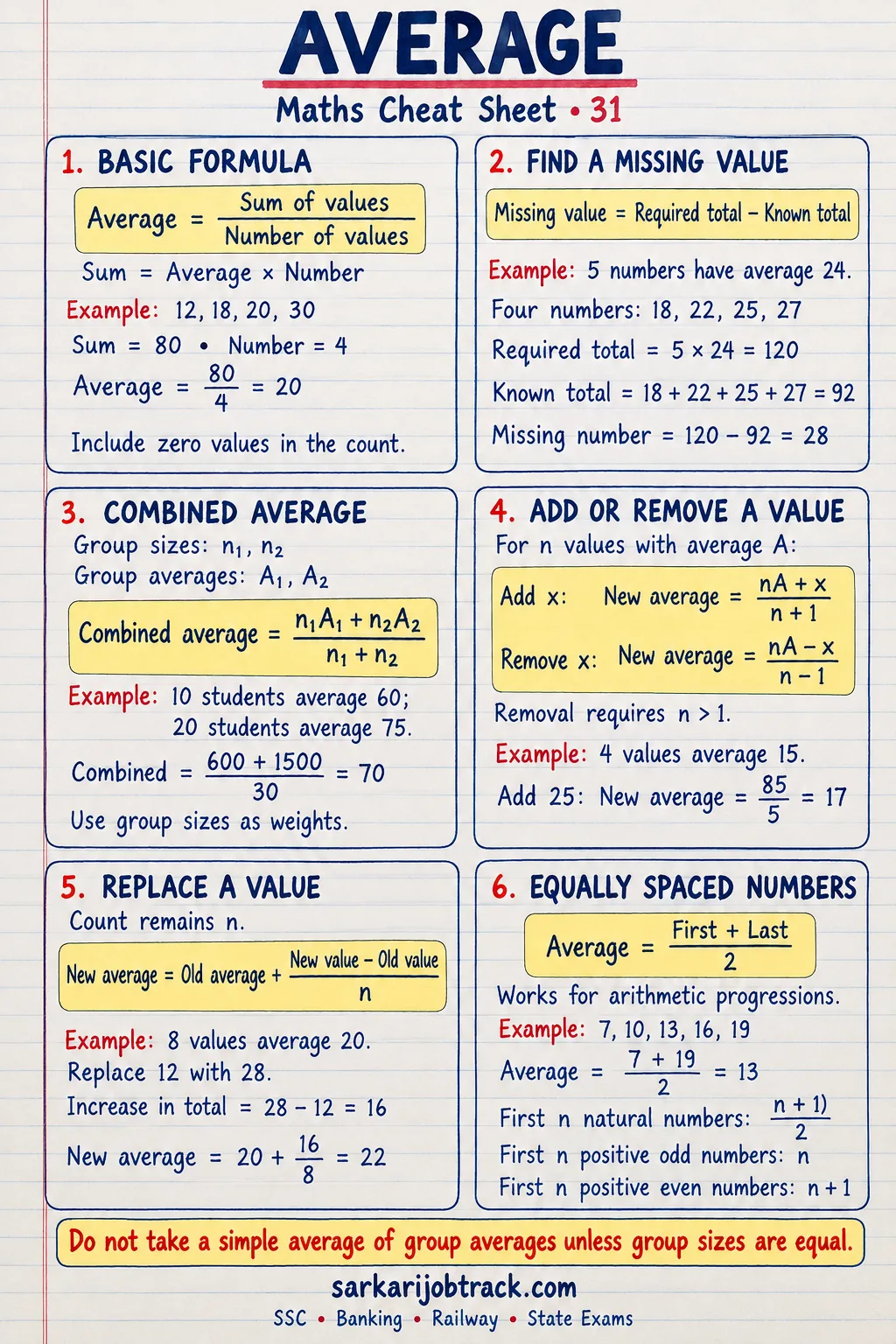
The average (also called the mean) of some numbers is what each one would be if the total were shared out equally among them. You get it in two steps: add the numbers to get their total, then divide by how many there are.
average = total ÷ how many.
So the average of 4, 6 and 11 is (4 + 6 + 11) ÷ 3 = 21 ÷ 3 = 7. Sharing 21 equally among three gives 7 each.
Two things follow from that one relation, and the whole lesson is built on them:
- The total comes back by multiplying. If average = total ÷ how many, then total = average × how many. Knowing the average of 5 numbers is 20 tells you their total is 20 × 5 = 100, even without knowing the numbers. This "find the total first" step unlocks almost every harder question.
- The average sits among the numbers, never below the smallest or above the biggest. The average of 40 and 60 is 50; it cannot be 30 or 70. If your answer falls outside the range of the numbers, something has gone wrong.
One more idea, used from Example 3 onwards: each number's distance from the average matters. A value above the average pulls the average up, one below pulls it down, and how far it pulls depends on how many numbers share the pull. This is the "weight" idea.
Worked examples
Read each example slowly. The first two show every step. In the later ones, some steps are left for you, with the answer just below.
Example 1: The average, and the total back from it
Question: (a) In five mock tests Ravi scored 62, 70, 58, 75 and 65 marks. What is his average score? (b) The average monthly salary of 8 workers in a workshop is ₹14,500. What do they earn in all each month?
Part (a): the average from the numbers
- Add the five scores: 62 + 70 + 58 + 75 + 65 = 330.
- There are 5 numbers, so divide the total by 5: 330 ÷ 5 = 66.
- Check it sits among the scores: 66 is between the lowest (58) and the highest (75). Good.
Part (b): the total from the average
- Here the average is given and the total is wanted. Turn the relation around: total = average × how many.
- Total = 14,500 × 8 = ₹116,000.
- Check: ₹116,000 shared among 8 workers is 116,000 ÷ 8 = ₹14,500 each, the average we started with.
Your turn: the average weight of 6 parcels is 4.5 kg. What is their total weight?
Check: total = average × how many = 4.5 × 6 = 27 kg.
The principle: average = total ÷ how many, so total = average × how many. When a question gives you the average and the count, find the total first; it is the step that most questions are built on.
Example 2: Evenly spaced numbers — the first-plus-last shortcut
When numbers are evenly spaced — they go up by the same step each time, like 5, 10, 15, 20 (step 5) or 1, 2, 3, 4 (step 1) — you do not need to add them all. The average is simply the middle of the list:
average of evenly spaced numbers = (first + last) ÷ 2.
Question: (a) Find the average of the first 20 natural numbers (1, 2, 3, …, 20). (b) Find the average of 41, 42, 43, 44 and 45. (c) Find the average of the first five multiples of 4.
Part (a): the counting numbers 1 to 20
- These go up by 1 each time, so they are evenly spaced. The first is 1 and the last is 20.
- Average = (first + last) ÷ 2 = (1 + 20) ÷ 2 = 21 ÷ 2 = 10.5.
- The long way agrees: 1 + 2 + … + 20 = 210, and 210 ÷ 20 = 10.5. The shortcut just saved the adding.
Part (b): a run of five numbers
- 41, 42, 43, 44, 45 go up by 1 each time, so they are evenly spaced. First 41, last 45.
- Average = (41 + 45) ÷ 2 = 86 ÷ 2 = 43.
- Because there is an odd count (five numbers), the average is exactly the middle one, 43. That is a quick check.
Part (c): multiples of 4
- The first five multiples of 4 are 4, 8, 12, 16 and 20. They go up by 4 each time, so they are evenly spaced.
- Average = (first + last) ÷ 2 = (4 + 20) ÷ 2 = 24 ÷ 2 = 12.
- The long way agrees: 4 + 8 + 12 + 16 + 20 = 60, and 60 ÷ 5 = 12.
The shortcut only works when the step is the same throughout. Your turn: find the average of 6, 9, 10 and 19. Are these evenly spaced? Does the shortcut work?
Check: the gaps are 3, 1 and 9, so they are not evenly spaced and the shortcut does not apply. The first-plus-last guess would give (6 + 19) ÷ 2 = 12.5, which is wrong. Do it the sure way: 6 + 9 + 10 + 19 = 44, and 44 ÷ 4 = 11.
The principle: for evenly spaced numbers the average is (first + last) ÷ 2, and for an odd count that is the middle number. Check the step is the same before you use it; for numbers that are not evenly spaced, go back to total ÷ how many.
Example 3: A value joins, a value leaves, or one is missing
Every question here is solved by finding the total first (Example 1), changing it, and dividing again.
Question: (a) The average age of 9 members of a club is 32 years. A new member aged 42 joins. What is the new average age? (b) The average of 7 numbers is 24. If one of them, 30, is taken away, what is the average of the remaining six?
Part (a): a value joins
- Find the total age of the 9 members first: total = 32 × 9 = 288 years.
- The new member adds 42, so the new total is 288 + 42 = 330 years, now shared among 9 + 1 = 10 people.
- New average = 330 ÷ 10 = 33 years.
- The weight idea as a check: the newcomer is 42, which is 10 years above the old average of 32. Spread that extra 10 across the 10 people now in the club, and the average rises by 10 ÷ 10 = 1 year, from 32 to 33. Same answer.
Part (b): a value leaves
- Total of the 7 numbers = 24 × 7 = 168.
- Take away the 30: new total = 168 − 30 = 138, now shared among 6 numbers.
- New average = 138 ÷ 6 = 23.
Your turn: the average of 5 numbers is 28. Four of them are 22, 25, 30 and 35. Find the fifth number.
Check: the total of all five is 28 × 5 = 140. The four known numbers add to 22 + 25 + 30 + 35 = 112. So the fifth number is 140 − 112 = 28.
The principle: find the total, adjust it for the value that joins, leaves or is missing, then divide by the new count. A value above the current average pulls the average up and one below pulls it down, by an amount shared across however many numbers there now are.
Example 4: One value replaced, and a wrongly recorded number
A replacement swaps one value for another but keeps the count the same, so only the total changes. The change in the total is the count times the change in the average.
Question: The average weight of 10 students is 45 kg. One student weighing 40 kg leaves, and a new student joins in their place, so the average rises to 46.5 kg. What is the new student's weight?
- The count stays at 10 (one in, one out), so only the total changes. The average rises by 46.5 − 45 = 1.5 kg across 10 students.
- So the total rises by 10 × 1.5 = 15 kg. That whole rise is down to the swap.
- The new student is heavier than the one who left by exactly that rise: new weight = 40 + 15 = 55 kg.
- Check: the old total was 45 × 10 = 450. Swapping 40 kg for 55 kg gives 450 − 40 + 55 = 465, and 465 ÷ 10 = 46.5 kg, as stated.
A wrongly recorded number is the same idea: the count never changes, only the total, by the difference between the right value and the wrong one.
Your turn: the average of 20 numbers was worked out as 35. Then it was found that one number had been read as 28 when it should have been 48. What is the correct average?
Check: the recorded total was 35 × 20 = 700. The number was 48 − 28 = 20 too small, so the true total is 700 + 20 = 720. The correct average is 720 ÷ 20 = 36. (The count is still 20; only the total was wrong.)
The principle: when one value is swapped for another, or a number was recorded wrongly, the count stays the same and only the total moves — by (new − old). Change in total = count × change in average, so you can go either way between them.
Example 5: Combining two groups — use the weighted average
When two groups are put together, the average of the whole is not the plain average of the two group averages, unless the groups are the same size. Add the two totals, then divide by the total count. This is called the weighted average, because the bigger group pulls the combined average towards its own.
Question: In a test, one section of 20 students averaged 60 marks, and another section of 30 students averaged 50 marks. What is the average mark of all 50 students together?
- Find each group's total. First section: 20 × 60 = 1,200. Second section: 30 × 50 = 1,500.
- Add the totals: 1,200 + 1,500 = 2,700 marks in all, for 20 + 30 = 50 students.
- Combined average = 2,700 ÷ 50 = 54 marks.
- Notice the trap: the plain average of 60 and 50 would be (60 + 50) ÷ 2 = 55. The real answer, 54, is lower, because the larger group (30 students) scored the lower 50 and so counts for more.
Your turn: the average of 10 numbers is 50. The average of the first 6 of them is 45. What is the average of the remaining 4?
Check: the total of all ten is 50 × 10 = 500. The first six total 45 × 6 = 270. So the last four total 500 − 270 = 230, and their average is 230 ÷ 4 = 57.5.
The principle: to combine groups, add their totals and divide by the total count: (first count × first average + second count × second average) ÷ (both counts). The plain mean of the two averages is right only when the groups are equal in size.
Example 6: Everyday averages — innings and overlapping days
Question: A batsman has an average of 36 runs after 10 innings. How many runs must he score in his 11th innings to raise his average to 38?
- Find the runs so far: total after 10 innings = 36 × 10 = 360.
- He wants an average of 38 over 11 innings, so he will need a total of 38 × 11 = 418.
- The 11th innings must make up the difference: 418 − 360 = 58 runs.
- The weight idea as a check: he wants the new innings itself to be worth the new average, 38, and on top of that to lift each of the 10 earlier innings by 2 runs, which needs 2 × 10 = 20 more. So 38 + 20 = 58 runs. Same answer.
Your turn: the average temperature on Tuesday, Wednesday and Thursday was 28°C. The average on Wednesday, Thursday and Friday was 30°C. If Friday was 32°C, what was Tuesday's temperature?
Check: Tuesday + Wednesday + Thursday = 28 × 3 = 84. Wednesday + Thursday + Friday = 30 × 3 = 90. Take Friday's 32 out of the second total: Wednesday + Thursday = 90 − 32 = 58. Then Tuesday = 84 − 58 = 26°C. (The two triples share Wednesday and Thursday, so subtracting one total from the other leaves the days that differ.)
The principle: turn each average into a total (average × how many), then add and subtract the totals as the story needs. To lift an average, the new entry must equal the target average plus the lift spread over all the earlier entries.
Common mistakes
- Forgetting to divide, or dividing by the wrong count. The average is the total divided by how many numbers there are. After a value joins or leaves, the count changes too — divide by the new count, not the old one.
- Using the first-plus-last shortcut on numbers that are not evenly spaced. For 6, 9, 10, 19 the gaps differ, so (first + last) ÷ 2 = 12.5 is wrong; the true average is 44 ÷ 4 = 11. Only evenly spaced numbers have their average in the middle.
- Taking the plain mean of two group averages. Two sections averaging 60 and 50 do not together average 55 unless the sections are the same size. Add the totals and divide by the total count: here 54, pulled towards the bigger group.
- Changing the count on a replacement. When one value replaces another, the count stays the same; only the total moves, by (new − old). The same is true when a number was recorded wrongly.
- Answering outside the range. An average can never be less than the smallest value or more than the largest. If it is, re-check the total and the count.
- Confusing "how much the average changes" with "how much the total changes". They differ by the count: change in total = count × change in average. A 1.5 kg rise in the average of 10 students is a 15 kg rise in the total.
Average: the rules in one place
In this table "how many" means the count of numbers, and a "value" is any one of them.
| To find | Rule | Worked numbers |
|---|---|---|
| The average (mean) | total ÷ how many | 62 + 70 + 58 + 75 + 65 = 330; 330 ÷ 5 = 66 |
| The total, from the average | average × how many | 8 workers at ₹14,500: 14,500 × 8 = ₹116,000 |
| Evenly spaced numbers | (first + last) ÷ 2 | 41 to 45: (41 + 45) ÷ 2 = 43 |
| First n multiples of k | k × (n + 1) ÷ 2 | first 5 multiples of 4: 4 × 6 ÷ 2 = 12 |
| A value joins | (old total + the value) ÷ (count + 1) | 9 at 32 = 288; (288 + 42) ÷ 10 = 33 |
| A value leaves | (old total − the value) ÷ (count − 1) | 7 at 24 = 168; (168 − 30) ÷ 6 = 23 |
| A missing value | total − sum of the known values | 5 at 28 = 140; 140 − 112 = 28 |
| One value replaced | change in total = count × change in average | up 1.5 over 10 = 15; 40 + 15 = 55 kg |
| A wrongly recorded number | add (right value − wrong value) to the total | 20 at 35 = 700; (700 + 20) ÷ 20 = 36 |
| Combine two groups (weighted average) | (count₁ × avg₁ + count₂ × avg₂) ÷ (count₁ + count₂), not the plain mean | (20 × 60 + 30 × 50) ÷ 50 = 54 |
| Score to lift an average | new value = target average + (lift × earlier count) | lift 2 over 10 innings: 38 + 20 = 58 |
Next
Average feeds straight into Data Interpretation, where you read averages off tables and bar charts, and into Statistics, where the mean sits beside the median and the mode; both use exactly the total-divided-by-count idea from this lesson, and both will get their own quizzes once the bank has questions for them. For your next full topic with practice ready, go on to Profit, Loss and Discount, which uses the "find the total first" habit again with cost and selling prices: try the Profit and Loss quiz.
Ready to test this lesson? Take the Average quiz
How this was made: Drafted with AI assistance; every formula and worked figure recomputed independently; spot-checked by the editor on 25 October 2026.