
Analogy and Classification Cheat Sheet
2 Nov 2026
Quick answer
A quick reasoning revision sheet for analogy and classification — the common relationship types the exam uses (synonym, antonym, part-whole, worker-tool, cause-effect, category), the method for completing an analogy, and the odd-one-out technique for classification — with worked examples, for fast SSC, Banking and Railway revision.
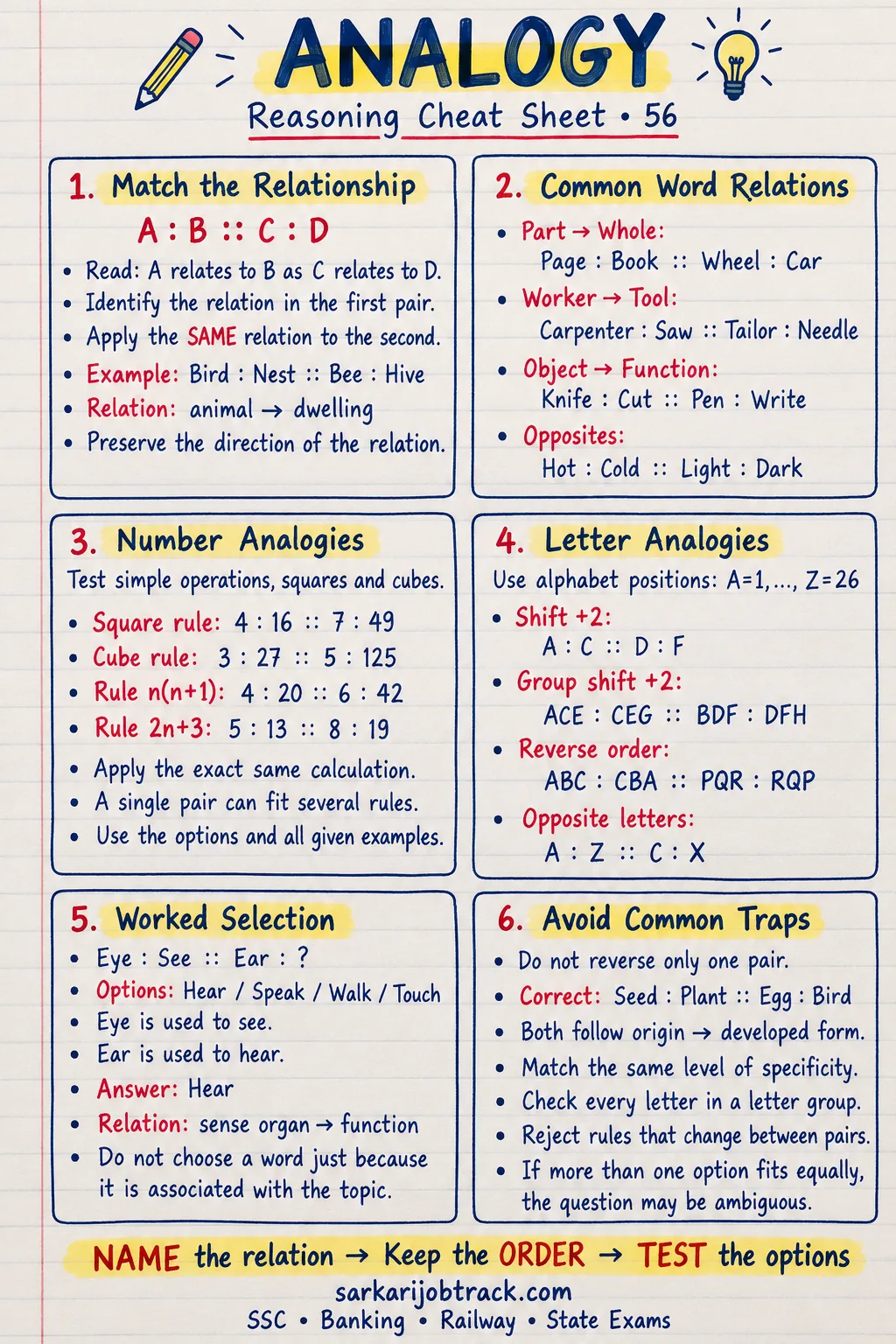
An analogy gives a related pair and asks you to complete a second pair by the same relationship. Classification (odd-one-out) gives several items and asks which does not belong. Both turn on naming the exact relationship.
The common relationships
| Relationship | Example pair |
|---|---|
| Synonym | Big : Large |
| Antonym | Up : Down |
| Part to whole | Wheel : Car |
| Worker to tool | Carpenter : Saw |
| Worker to product | Author : Book |
| Cause and effect | Fire : Smoke |
| Category (item : class) | Rose : Flower |
| Young one | Cow : Calf |
Completing an analogy
- State the relationship in the first pair as a sentence ("a calf is the young of a cow").
- Apply the same sentence to the second pair.
- If two options seem to fit, make the relationship more specific until only one does.
Worked example. Cow : Calf :: Dog : ?
- "A calf is the young of a cow"; the young of a dog is a puppy.
- Answer: Puppy.
Odd one out (classification)
- Find the property three (or more) items share.
- The one that lacks it is the answer.
- Beware of a trap option that shares a different property.
Worked example. Rose, Lotus, Lily, Mango — which is the odd one?
- Rose, Lotus and Lily are flowers; a Mango is a fruit.
- Answer: Mango.
Quick tips
- Say the relationship aloud as a full sentence — a vague link ("they go together") is what the trap option exploits.
- In classification, check the most specific shared property, not just "they are all living things".
Revise the full method in the Analogy and Classification lesson, then practise analogy questions or browse more reasoning revision sheets.
How this was made: Drafted with AI assistance; every formula and worked figure recomputed independently; every fact checked against the source it cites.