
Analogy and Classification for Beginners: Words, Numbers and Letters
Learn to name the relationship in a pair of words, numbers or letters and use it to complete an analogy, then find the odd one out in a group by the rule the other three share, through six worked examples, a checklist for any question and a revision list.
By the end of this lesson you will be able to name the relationship between two words, numbers or letter groups, use it to complete an analogy, and pick the odd one out from a group of four.
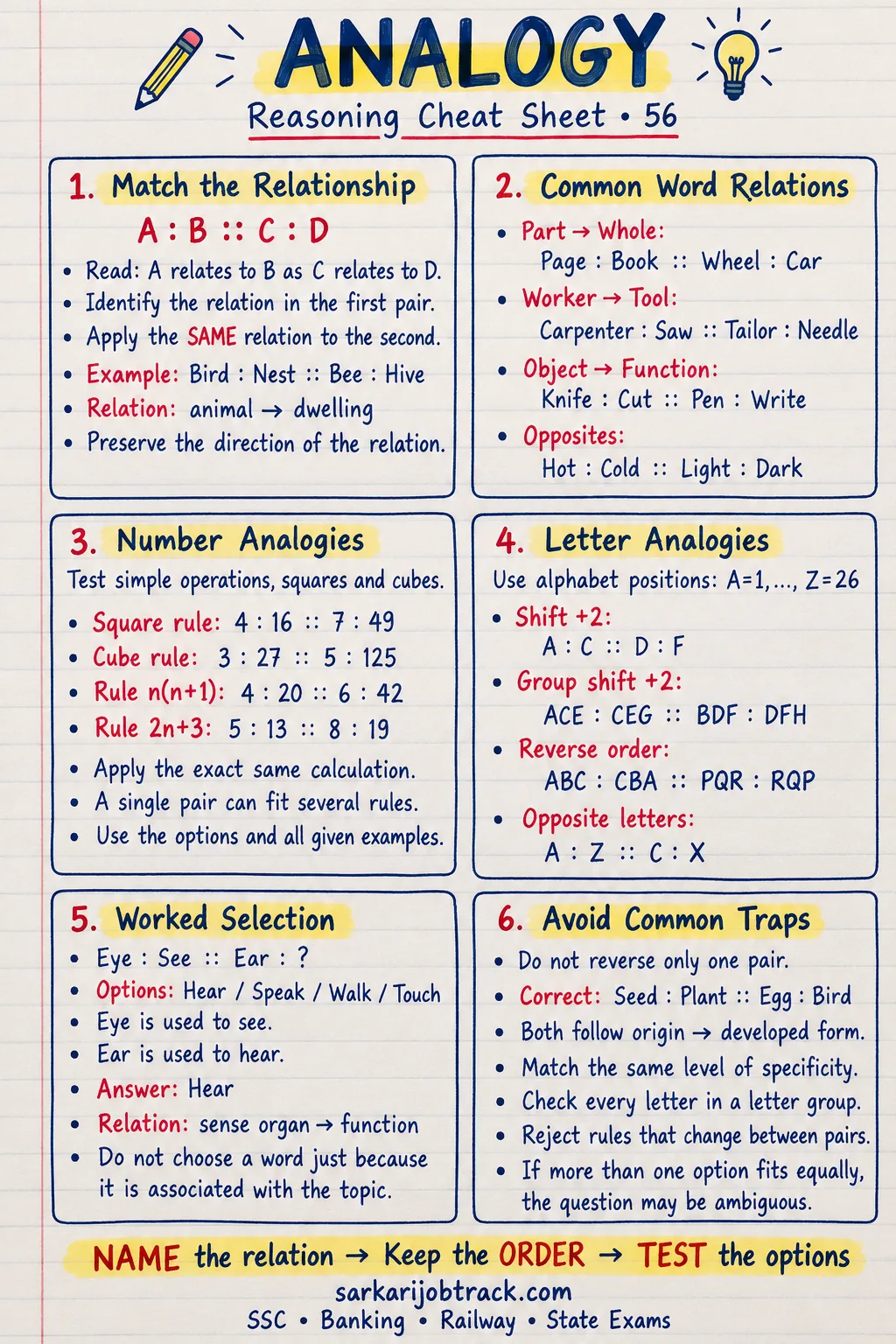
Already confident? Skip to practice: Analogy and Classification quiz
Before this: the letter questions use the alphabet positions from the Coding–Decoding lesson: A = 1, B = 2 … Z = 26, and the positions of a letter and its opposite letter always add up to 27 (A and Z, B and Y). Keep its table handy.
What these questions look like
An analogy compares two pairs. It is written like this:
Doctor : Hospital :: Teacher : ?
Read it as "Doctor is to Hospital as Teacher is to ?". The single colon (:) means "is to" and the double colon (::) means "as". The first pair shows a relationship. Your job is to find the word that has the same relationship with the third word. A doctor works in a hospital, so a teacher works in a school.
A classification question, also called "odd one out", gives four words, numbers or letter groups. Three of them share something and one does not. Your job is to find the one that does not belong.
For example: Happy, Glad, Cheerful, Angry. Happy, glad and cheerful all mean pleased; angry does not. The odd one out is Angry.
Both kinds come with words, numbers or letters. Questions with pictures (figure analogies and odd figure out) are not covered in this lesson.
Say the relationship first
The most useful habit in an analogy: before you look at the options, say the relationship of the first pair in a short sentence. Then put the third word into the same sentence.
Some relationships to look for in word analogies:
| Relationship | Example pair | The sentence |
|---|---|---|
| Worker and tool | Painter : Brush | A painter works with a brush. |
| Worker and workplace | Farmer : Field | A farmer works in a field. |
| Worker and what they make | Potter : Pot | A potter makes pots. |
| Part and whole | Petal : Flower | A petal is a part of a flower. |
| Thing and what it is made from | Shirt : Cloth | A shirt is made from cloth. |
| Animal and its young one | Cow : Calf | A calf is the young one of a cow. |
| Instrument and what it measures | Thermometer : Temperature | A thermometer measures temperature. |
| Thing and what it is used for | Scissors : Cut | Scissors are used to cut. |
| Same meaning | Begin : Start | Begin means the same as start. |
| Opposite meaning | Victory : Defeat | Victory is the opposite of defeat. |
Keep the order. The two pairs must point the same way. In Calf : Cow the young one comes first, so in Chick : ? the answer is the parent, Hen.
Worked examples
Read each example slowly. The first two show every step. In the later ones, some steps are left for you, with the answer just below.
Example 1: A word analogy
Question: Carpenter : Saw :: Tailor : ? The options are (a) Cloth (b) Needle (c) Shirt (d) Shop.
- Say the relationship before you look at the options. A first try: "A carpenter uses a saw."
- Put the third word into the sentence: "A tailor uses ___". Now look at the options. A tailor uses cloth, and a tailor uses a needle too. More than one option fits, so the sentence is too loose.
- Make it exact. A saw is not just something a carpenter uses: it is the tool a carpenter works with.
- "The tool a tailor works with is ___". Cloth is the material a tailor sews, a shirt is what a tailor makes and a shop is where a tailor works. Only a needle is a tool. The answer is (b) Needle.
The principle: say the relationship in a short sentence before you look at the options, and make it exact: "the tool a carpenter works with", not just "something a carpenter uses". If two options fit your sentence, make the sentence tighter.
Example 2: A number analogy
Question: The second number in each pair is made from the first number by the same rule. Find the missing number: 5 : 26 :: 8 : 65 :: 11 : ?
- Start with the first pair, 5 and 26. 26 is one more than 25, and 25 = 5 × 5, the square of 5. So a first guess is "square the number, then add 1".
- Test the guess on the second pair: 8 × 8 = 64, and 64 + 1 = 65. It fits.
- Apply it to 11: 11 × 11 = 121, and 121 + 1 = 122.
Why test the second pair? With 5 : 26 alone, other rules fit too. "Multiply by 5, then add 1" also gives 5 × 5 + 1 = 26. On the second pair it gives 8 × 5 + 1 = 41, not 65, so it is the wrong rule. When a question gives only one pair, more than one simple rule may fit it, so try each rule you find on the options: only one option should fit.
Keep the numbers small. A big multiplier and a big subtraction can be made to fit almost any pair: 5 : 26 is also 5 × 10 − 24 = 26. A rule like that proves nothing. With one pair, even "add a fixed number" always fits (5 + 21 = 26), so do not stop at the first rule that fits. Go down the whole table below, work out an answer with each rule that fits, and check which answer is among the options.
Rules to try, in this order:
| Rule | Example pair | Working |
|---|---|---|
| Square | 7 : 49 | 7 × 7 = 49 |
| Cube | 4 : 64 | 4 × 4 × 4 = 64 |
| Square plus or minus 1 | 6 : 35 | 6 × 6 − 1 = 35 |
| Cube plus or minus 1 | 4 : 63 | 4 × 4 × 4 − 1 = 63 |
| Add or subtract a fixed number | 12 : 19 | 12 + 7 = 19 |
| Multiply by a fixed number | 6 : 18 | 6 × 3 = 18 |
| Multiply by a small number, then add or subtract a small number | 4 : 13 | 4 × 3 + 1 = 13 |
| Add the digits | 47 : 11 | 4 + 7 = 11 |
It saves time to know the squares up to 25 × 25 = 625 and the cubes up to 10 × 10 × 10 = 1000.
The principle: find a simple rule from the first pair, test it on every other pair you are given, and only then apply it. If more than one rule fits, let the second pair or the options decide.
Example 3: Letter analogies
Use the positions from Coding–Decoding: A = 1 … Z = 26.
Part (a): FGH : JKL :: PQR : ?
- Write the positions: F = 6, G = 7, H = 8 and J = 10, K = 11, L = 12.
- Each letter has moved 4 places forward: F→J, G→K, H→L.
- Move P, Q and R 4 places forward: P→T, Q→U, R→V. The answer is TUV.
Part (b): CAT : XZG :: DOG : ?
- Check the moves first: C (3) → X (24) is +21, but A (1) → Z (26) is +25. The moves are not equal, so this is not a simple shift.
- Add the positions of each pair instead: C + X = 3 + 24 = 27, A + Z = 1 + 26 = 27, T + G = 20 + 7 = 27. Each letter has been replaced by its opposite letter.
- Your turn: write the opposite letters of D, O and G.
Check: D (4) → W (23), O (15) → L (12), G (7) → T (20). The answer is WLT.
Part (c): BDHK : KHDB :: DGLS : ?
- KHDB uses exactly the letters of BDHK, in reverse order: the group has been written backwards.
- Your turn: write DGLS backwards.
Check: the answer is SLGD.
Some letter analogies take two steps. If no single rule fits, write the first group backwards and find the moves again.
Part (d): LAMP : ROCN :: DUST : ?
- No single rule fits. The moves are not equal (L→R is +6, A→O is +14), the positions do not add up to 27 (L + R = 12 + 18 = 30), and ROCN does not use the letters of LAMP.
- Write LAMP backwards: PMAL. Now find the moves again: P→R, M→O, A→C, L→N. Every letter moves 2 places forward.
- Your turn: write DUST backwards, then move every letter 2 places forward.
Check: DUST backwards is TSUD, and T→V, S→U, U→W, D→F. The answer is VUWF.
The principle: write the positions and find the moves. Equal moves mean a shift. If the moves are not equal, check whether each pair of positions adds up to 27 (opposite letters), and whether the second group has the same letters in reverse order. If none of these fits, write the first group backwards and look at the moves again.
Example 4: Odd one out with words
Question: Which is the odd one out? Thermometer, Clock, Ruler, Pen
- Say what all four are: things people use. That is true of every option, so it cannot pick one out. You need a rule that only three share.
- Look at what each one does. A thermometer measures temperature, a clock measures time and a ruler measures length.
- Your turn: does a pen measure anything? Which is the odd one out?
Check: a pen is used to write, not to measure. The odd one out is Pen.
Some questions give word pairs instead, such as Needle : Sew. Then name the relationship in each pair, as in an analogy, and find the pair that is different. In Hot : Cold, Up : Down, Rich : Poor and Fast : Quick, the first three pairs are opposites, but fast and quick mean the same. The odd pair is Fast : Quick.
The principle: find a rule that exactly three options share and the fourth breaks. A rule that fits all four ("things people use") is too loose. Then check the others: no other option should stand out for a different, equally simple reason.
Example 5: Odd one out with numbers
Question: Which is the odd one out? 13, 19, 31, 91
- Check even or odd: all four are odd, so that does not help.
- Check prime numbers (numbers whose only factors are 1 and the number itself): 13, 19 and 31 are prime.
- Your turn: 91 looks prime. Try dividing it by 7.
Check: 91 = 7 × 13, so 91 is not prime. The odd one out is 91.
Properties to check, in this order:
- even or odd;
- prime or not prime;
- a perfect square (16, 25, 36 …) or a perfect cube (8, 27, 64 …). Sometimes the rule is about the number that was squared: 25 = 5 × 5 and 49 = 7 × 7 are squares of prime numbers;
- a multiple of the same number, such as all in the table of 7;
- the sum of the digits. A number is a multiple of 3 if its digits add up to a multiple of 3, and a multiple of 9 if they add up to a multiple of 9.
Check every property, not just the first one you notice. In 2, 3, 5, 9, the number 9 is the only one that is not prime, but 2 is the only even number, so that question would have two answers. A well-made question has only one option that stands out. Checking all the properties above shows you whether your answer is the only one.
Now try one on your own: which is the odd one out in 24, 48, 74, 96?
Check: all four are even, so look further. 24, 48 and 96 are in the table of 8 (8 × 3, 8 × 6 and 8 × 12), but 74 is not (8 × 9 = 72). The odd one out is 74.
The principle: test the simple properties one by one: even or odd, prime, square or cube, multiples, digit sum. The answer is the one number that breaks a property the other three share.
Example 6: Odd one out with letter groups
Question: Which is the odd one out? DFH, HJL, PRS, RTV
- Write the positions in each group: D 4, F 6, H 8; H 8, J 10, L 12; P 16, R 18, S 19; R 18, T 20, V 22.
- Find the moves inside each group: DFH is +2, +2; HJL is +2, +2; RTV is +2, +2.
- Your turn: what are the moves in PRS? Which group is the odd one out?
Check: P→R is +2 but R→S is only +1. The odd one out is PRS.
Other rules to check in letter groups: in two-letter groups, whether the two letters are opposites (positions adding up to 27); how many vowels (A, E, I, O, U) each group has; and whether the letters are in alphabetical order or in reverse order.
The principle: inside each group, write the positions and the moves from letter to letter. Three groups follow the same pattern; the odd one breaks it.
How to attack any analogy or classification question
- For an analogy, say the relationship of the first pair in a short sentence before you look at the options.
- Keep the order. If the first pair is "thing : what it is made from", the answer must be what the third word is made from.
- For numbers, try the square, the cube, square ± 1, cube ± 1, add a fixed number, multiply by a fixed number, multiply then add (small numbers only), and the digit sum. If two pairs are given, the rule must fit both.
- For letters, write the positions and the moves. Check for a shift, for opposite letters (positions adding up to 27) and for a group written backwards. If none of these fits, write the first group backwards and find the moves again.
- Test the rule on every option; if two options fit, the rule is too loose, so find a tighter one.
- For an odd one out, find the rule that exactly three options share. A rule that fits all four is too loose.
- Then check the other properties too: even or odd, prime, square, multiples and digit sum for numbers; moves, opposite pairs and vowels for letters. Only one option should stand out.
- For word pairs, name the relationship in each pair and pick the pair whose relationship is different.
Revision: the rules in one place
An analogy A : B :: C : ? reads "A is to B as C is to ?". Say how A and B are related, then find the option related to C in the same way, in the same order.
- Word relationships: worker and tool (Painter : Brush), worker and workplace (Farmer : Field), worker and what they make (Potter : Pot), part and whole (Petal : Flower), thing and what it is made from (Shirt : Cloth), animal and young one (Cow : Calf), instrument and what it measures (Thermometer : Temperature), thing and its use (Scissors : Cut), same meaning (Begin : Start), opposite meaning (Victory : Defeat).
- Number rules: square, cube, square ± 1, cube ± 1, add or subtract a fixed number, multiply by a fixed number, multiply by a small number then add or subtract a small number, digit sum. Test the rule on every pair you are given.
- Letter rules: a shift (every letter moves the same number of places), opposite letters (positions add up to 27), written backwards, or written backwards and then moved.
- Odd one out with words: three share a group, a use or a relationship; the fourth does not.
- Odd one out with numbers: even or odd, prime, square or cube, multiples of the same number, digit sum.
- Odd one out with letters: the moves inside each group, opposite pairs, vowels, alphabetical order.
Common mistakes
- Looking at the options first. The options can lead you to a loose rule. Say the relationship first.
- Using a loose sentence. "A carpenter uses a saw" lets cloth fit for a tailor. "The tool a carpenter works with" does not.
- Losing the direction of the pair. In Calf : Cow the young one comes first and the parent second, so Chick : ? needs the parent, Hen. Another young one, such as Lamb, matches the topic but not the direction.
- Testing a number rule on one pair only. 5 : 26 fits "multiply by 5, then add 1" as well as "square, then add 1"; only the second fits 8 : 65.
- Stopping at the first odd one you notice. Check every property; only one option should stand out.
- Counting the starting letter. C moved 2 places forward is E (D, E), not D.
Next
The next Reasoning topic is Number and Letter Series: finding the rule in a row of numbers or letters. It uses the same squares, cubes and letter positions as this lesson.
Ready to test this lesson? Take the Analogy and Classification quiz
How this was made: Drafted with AI assistance; spot-checked by the editor on 30 October 2026.