
Blood Relations Cheat Sheet
2 Nov 2026
Quick answer
A quick reasoning revision sheet for blood-relation questions — the key relationship terms, how to draw a family tree with symbols, the generation levels, and the method for the pointing and coded-relation puzzles — with a worked example, for fast SSC, Banking and Railway revision.
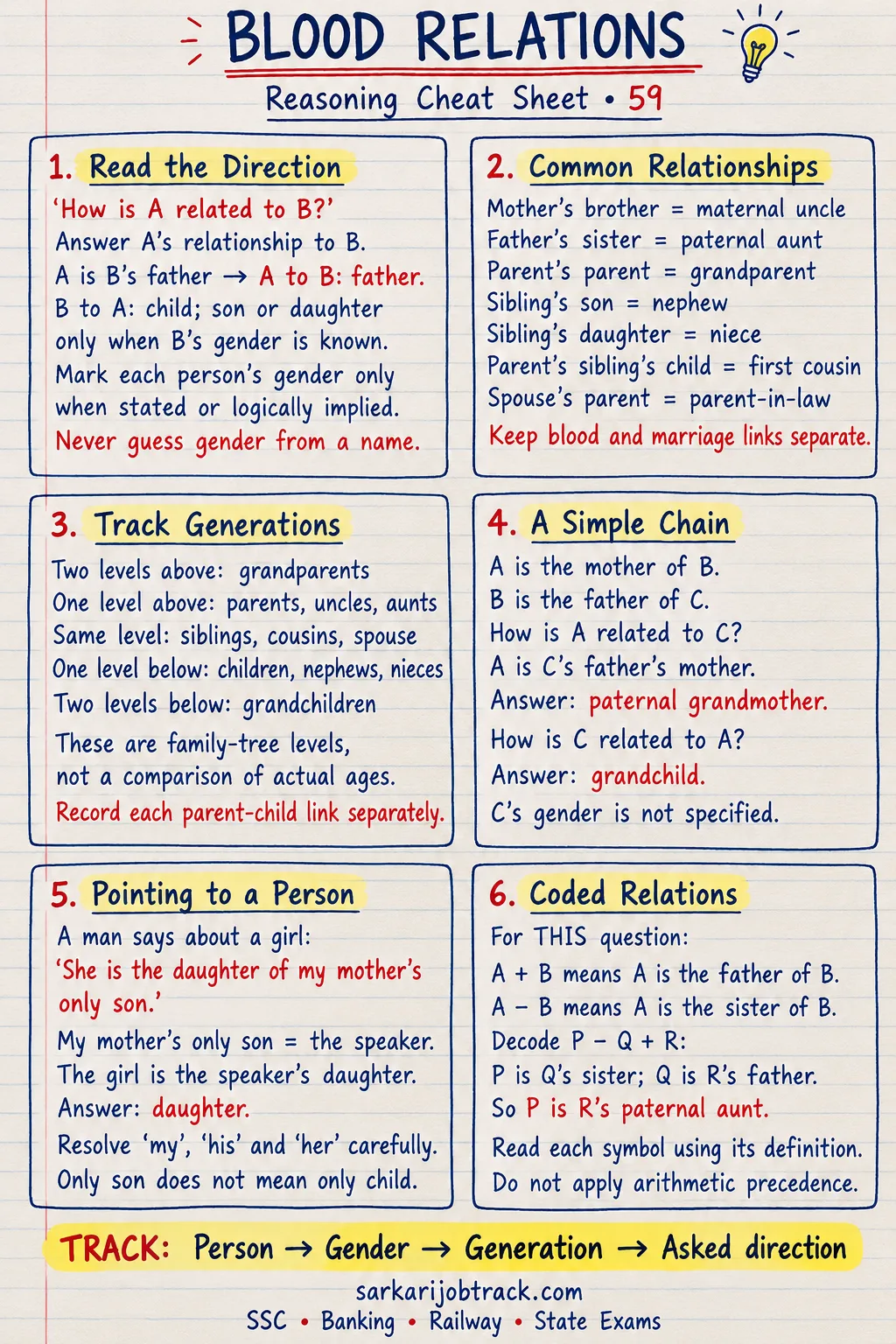
A blood-relation question describes a family in words and asks how two people are related. The reliable way to answer is to draw a small family tree rather than reason in your head.
Draw the tree with symbols
- Use + for male and − for female (or □ for male, ○ for female).
- Put people in the same row if they are the same generation (brothers, sisters, spouses), and in rows above/below for parents and children.
- Join a couple with a double line and a parent to a child with a vertical line.
The relationship terms
| Term | Means |
|---|---|
| Father's/mother's father | grandfather |
| Father's/mother's brother | uncle (paternal / maternal) |
| Father's/mother's sister | aunt |
| Brother's/sister's son | nephew |
| Brother's/sister's daughter | niece |
| Son's/daughter's child | grandchild |
| Wife's/husband's brother | brother-in-law |
| Father's only son | yourself (if the speaker is male), else your brother |
The method
- Read one clause at a time and place each person on the tree as you go.
- Work the relationship outwards from the known person named in the question.
- Watch the gender of the pronoun ("he", "she") — it fixes which person is meant.
- Read the final relationship from the asked person's side ("how is X related to Y" is answered from Y's viewpoint).
Worked example
Pointing to a man, a woman said, "He is the son of my grandfather's only son." How is the man related to the woman?
- "My grandfather's only son" = the woman's father (her grandfather's one son).
- "The son of my father" = the woman's brother.
- Answer: the man is the woman's brother.
Quick tips
- "Only son/daughter" is a strong clue — it collapses a generation to one person.
- Do not assume a spouse's relatives are blood relatives; mark in-laws separately.
Revise the full method in the Blood Relations lesson, then practise blood-relation questions or browse more reasoning revision sheets.
How this was made: Drafted with AI assistance; every formula and worked figure recomputed independently; every fact checked against the source it cites.