
Time and Work Cheat Sheet
31 Oct 2026
Quick answer
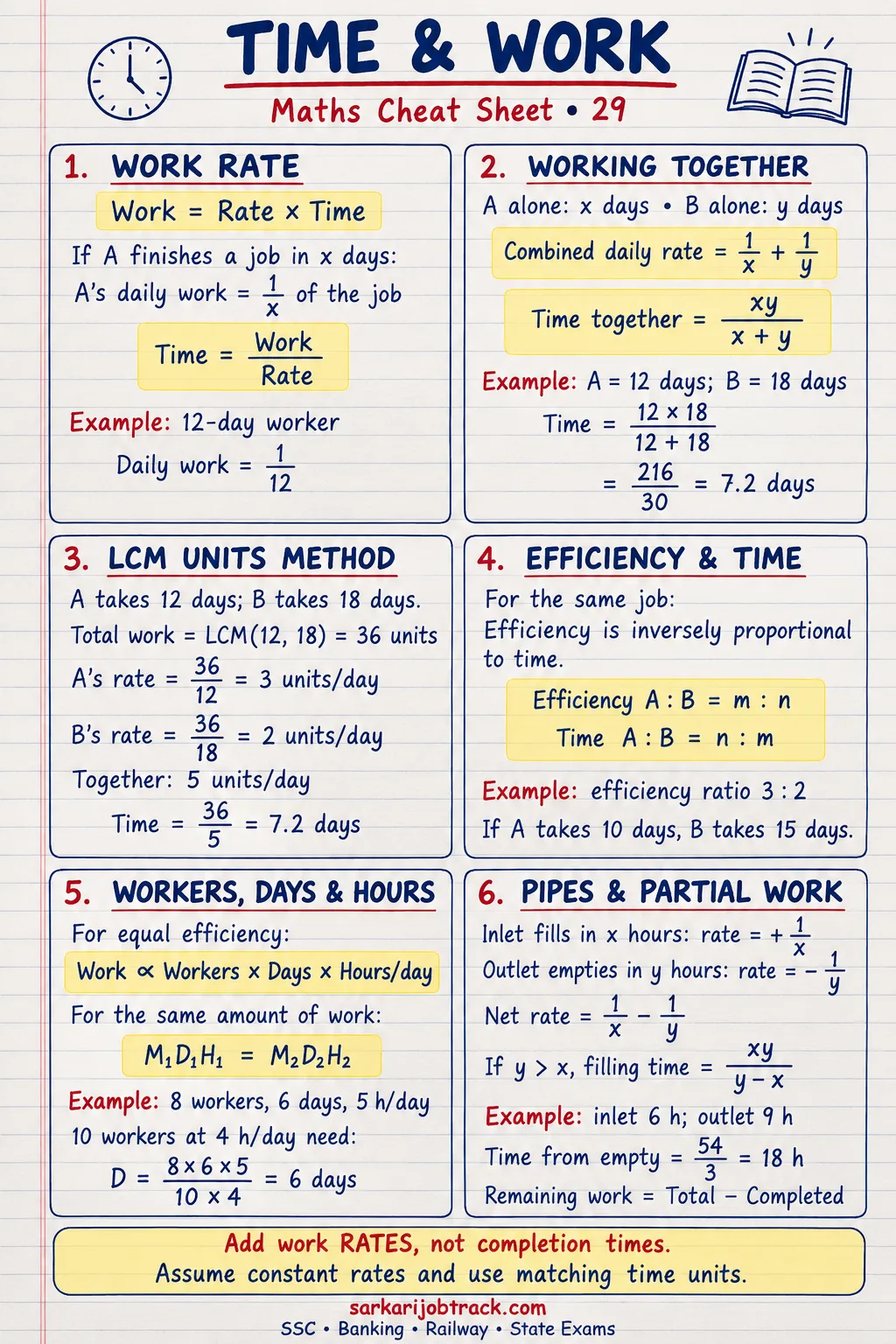
A quick revision cheat sheet on time and work for SSC, Banking, Railway and state exams. It covers the one-day-work idea, the combined-work formula, the efficiency and LCM methods, the men-days-hours relation, and how pipes and cisterns use the same rules, with worked examples.
Time and Work Cheat Sheet
Quick Revision
The key idea in time and work is the one-day work: if a person finishes a job in n days, then in one day they do 1/n of it.
Ready to practise? Take the Time and Work quiz
1. One-Day Work
- If A finishes a job in
adays, A's one-day work =1/a. - If A's one-day work is
1/a, A finishes the job inadays.
2. Working Together
If A takes a days and B takes b days, then in one day together they do 1/a + 1/b, so:
Time taken together = (a × b) / (a + b)Example
A does a job in 10 days, B in 15 days. Together:
= (10 × 15) / (10 + 15)
= 150 / 25
= 6 days
3. The LCM Method (fast)
Take the total work as the LCM of the given days; each worker's one-day work is then a whole number.
Example
A: 10 days, B: 15 days. Let total work = LCM(10, 15) = 30 units.
A's rate = 30/10 = 3 units/day
B's rate = 30/15 = 2 units/day
Together = 5 units/day → 30 / 5 = 6 days
4. Efficiency
Efficiency is inversely proportional to time.
- If A is twice as efficient as B, A takes half the time of B.
- If A : B efficiency = 2 : 1, then A : B time = 1 : 2.
5. Men–Days–Hours Relation
When the size of the workforce changes:
(M₁ × D₁ × H₁) / W₁ = (M₂ × D₂ × H₂) / W₂where M = men, D = days, H = hours per day, W = work done.
6. Pipes and Cisterns
Pipes use the same rules, with a sign for direction:
- An inlet pipe that fills in
ahours does+1/aper hour. - An outlet (drain) pipe that empties in
bhours does−1/bper hour. - Add the rates; a positive total fills the tank, a negative total empties it.
Example
Inlet fills in 6 h, outlet empties in 8 h. Net rate = 1/6 − 1/8 = 1/24, so the tank fills in 24 hours.
7. Exam Quick Tips
- Convert every worker to a one-day (or one-hour) rate, then add.
- The LCM method avoids fractions — use it whenever days are given.
- Efficiency and time are inverse: more efficient means less time.
- In pipes, treat an outlet as negative and add the rates.
Keep revising with the rest of the Maths section:
How this was made: Drafted with AI assistance; spot-checked by the editor on 31 October 2026.