
Blood Relations: Drawing the Family Tree
Learn to turn a tangle of family statements into a small diagram — a line notation for couples, siblings and parent-child links, with gender and generation marked — then read the answer off it, through worked examples of description chains, pointing-to-a-photograph sentences and coded relations, a checklist for any question and a revision list.
By the end of this lesson you will be able to turn a run of family statements into a small tree, mark each person's gender and generation, and read off exactly how any two people are related — in a description chain, a pointing-to-a-photograph sentence, or a coded scheme.
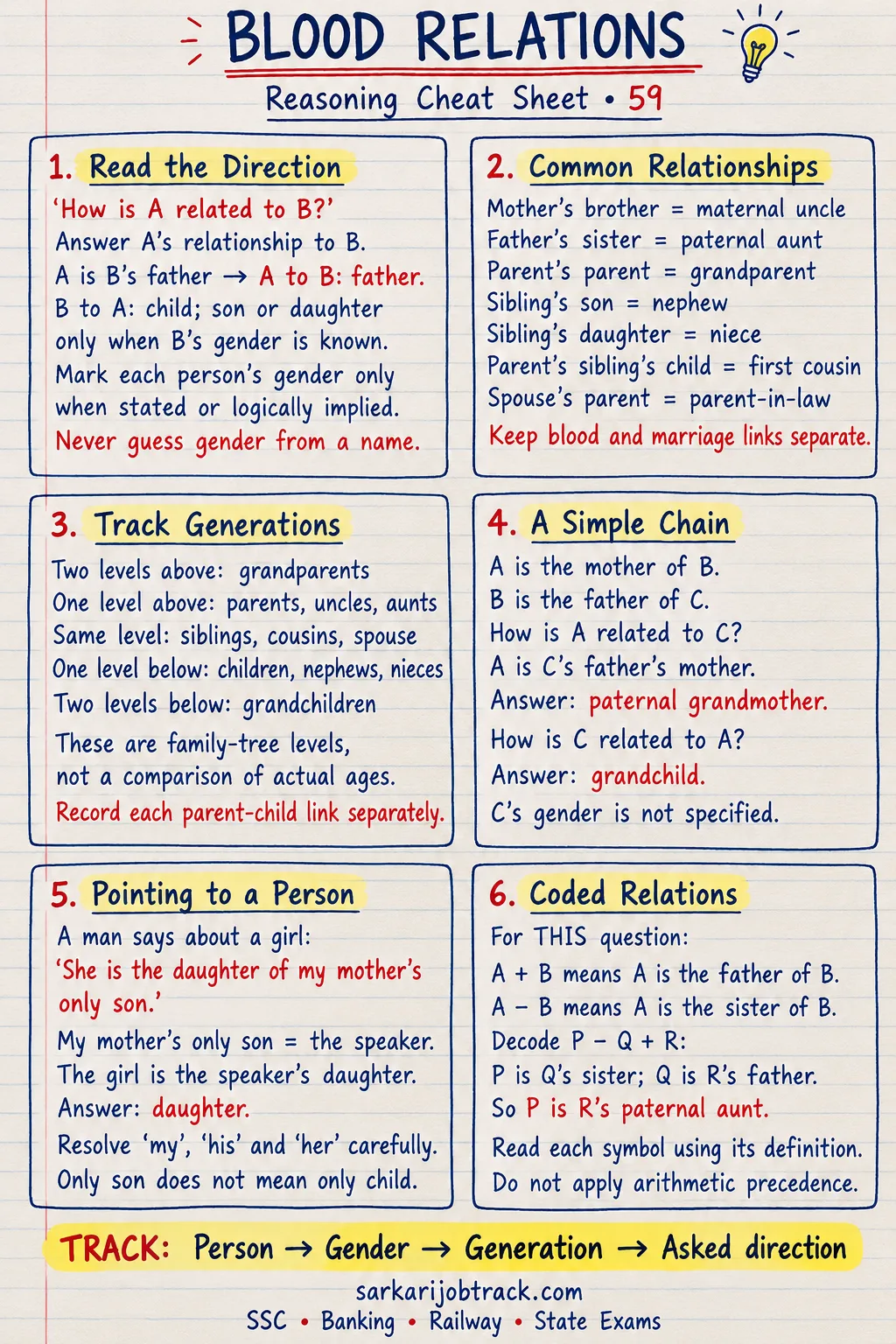
Already confident? Skip to practice: Blood Relations quiz
Before this: the coded-relation questions reuse the substitution habit from the Coding–Decoding lesson — you are handed symbols that stand for relationships ("+ means father of") and you swap each one back for its meaning before you reason. Keep that habit: translate first, think second.
What a blood-relations question looks like
You are given one or more statements about a family and asked how two people are related. The statements come in four shapes, and a paper usually mixes them:
- A description chain. "A is the son of B. B is the sister of C. How is C related to A?" A string of plain statements, each adding one link.
- Pointing to a photograph. "Pointing to a man, a woman said, 'His mother is the only daughter of my mother.' How is the woman related to the man?" One long sentence, built from the inside out, that you must unwind.
- A coded relation. "
A + Bmeans A is the father of B;A − Bmeans A is the wife of B …" — then a chain likeP + Q − Rto decode. - A generation or gender puzzle. Several people across two or three generations, and you must place each one and count the steps.
Every one of them yields to the same move: draw the family, mark gender and generation, then read the answer off the picture. Text-only — there are never figures to interpret, only a sentence to turn into one.
The notation: a tree you can draw in the margin
You do not need neat art. You need four marks, used the same way every time.
- A couple (husband and wife) — join them with a double line:
Ramesh = Sunita. - Siblings (brothers and sisters) — join them with a single horizontal line:
Suresh — Latha. - Parent and child — drop a vertical line from the parent (or the couple) down to the child. The parent is always on the row above, the child on the row below.
- Gender — write a small (+) for male and (−) for female beside each person as soon as you know it. If you do not yet know, leave it blank and come back.
Two habits make the picture do the work for you:
- Keep each generation on its own row. Grandparents on the top row, parents in the middle, children at the bottom. The moment two people sit on the same row you know they are of the same generation (a couple, or siblings, or cousins); the moment one sits a row below another, one is the elder.
- Read gender and generation off the final picture, not off the names. A name like "Kiran" or "Jyoti" tells you nothing — plenty of names fit either sex. Only a word in the statement ("son", "her", "wife", "brother") fixes a person's gender. This is the single commonest trap, and the examples lean on it.
The "only" shortcut
The words "only son" and "only daughter" are gifts, because they collapse a vague phrase to one exact person.
- "The only daughter of my mother" — your mother has exactly one daughter. If the speaker is female, that one daughter is the speaker herself. If the speaker is male, it is his sister.
- "The only son of my father" — the same, one row along: the speaker himself if male, otherwise his brother.
Whenever you see "only", stop and name the one person it can mean before reading on. Without "only" you cannot do this — "a daughter of my mother" could be the speaker, a sister, or any of several sisters, and the question would not be fully determined. The good questions always say "only" when they need you to land on one person.
Unwinding a pointing-to-a-photograph sentence
These sentences nest a phrase inside a phrase inside a phrase. Start at the innermost phrase and work outward, writing down who each piece lands on before you use it in the next piece. Never try to read the whole sentence in one breath.
The anchor is always the speaker — "my", "I". Build out from the speaker to the person in the photograph, one phrase at a time, and only at the very end ask how the speaker relates to that person (or the reverse, exactly as the question asks — they are not the same, so check which direction is wanted).
Decoding a coded relation
You are given symbols, each standing for a relationship, and a chain to read. Do it in two passes:
- Translate every symbol in the chain to its plain meaning, left to right, writing the chain out in words.
- Draw the result as a tree and read off the asked relation.
Keep the direction straight: "A ○ B means A is the brother of B" is a claim about A, not B. Write the words in the same order the symbols appear.
Worked examples
Read each example slowly. The first two show every step. In the later ones, some steps are left for you, with the answer just below.
Example 1: A description chain
Question: Ramesh is the father of Sunita. Sunita is the sister of Suresh. Suresh is the son of Latha. How is Latha related to Ramesh?
Build the tree one statement at a time:
- Ramesh is the father of Sunita → Ramesh (+) on the top row, a vertical line down to Sunita on the row below.
- Sunita is the sister of Suresh → Sunita (−, "sister") and Suresh sit on the same row, joined by a single line. "Sister" fixes Sunita as female; it says nothing yet about Suresh.
- Suresh is the son of Latha → "son" fixes Suresh as male (+), and Latha is a parent on the row above him — the same row as Ramesh.
- Now place Latha. Sunita and Suresh are children of Ramesh (father) and of Latha (a parent). A child has one father and one mother; Ramesh is the father, so Latha is the mother, and the two sit on the parents' row as a couple.
So Latha and Ramesh are the wife and husband. Latha is the wife of Ramesh.
The principle: add one statement at a time and let the rows do the thinking. When two people turn out to be the two parents of the same children and one is already the father, the other must be the mother — that fixes both her gender and the couple link.
Example 2: Pointing to a photograph
Question: Pointing to a girl in a photograph, Vikram said, "She is the daughter of the only sister of my father." How is the girl related to Vikram?
Unwind from the innermost phrase outward, anchored on Vikram:
- Innermost: "my father" → Vikram's father. Put Vikram (+) at the bottom, his father on the row above.
- Next: "the only sister of my father" → his father's one sister. She sits on the father's row, joined to him as a sibling — she is Vikram's aunt (his father's sister). "Only" means there is exactly one such person, so this is fully pinned down.
- Outermost: "the daughter of" that aunt → drop a line from the aunt to a girl on the bottom row, the same row as Vikram.
- The girl's mother (the aunt) is Vikram's father's sister. So the girl and Vikram are children of a brother and sister — they are cousins.
The girl is Vikram's cousin.
The principle: take one phrase at a time from the inside out, and write down the actual person each phrase lands on before using it in the next. The aunt sits on the parents' row; her child drops to Vikram's row, which is what makes the two cousins rather than anything closer.
Example 3: A coded relation
Question: In a certain code, P * Q means P is the father of Q, P × Q means P is the sister of Q, and P ÷ Q means P is the son of Q. In the expression G * H ÷ I, how is G related to I?
Translate the chain left to right, then draw it:
G * H→ G is the father of H. So G (+) is on the parents' row, H on the row below.H ÷ I→ H is the son of I. "Son" makes H male; I is a parent of H, on the parents' row.- H has a father (G) and a parent (I). Your turn: what is I, and so how does G relate to I?
Check: H's two parents are G (the father) and I; so I is H's mother, and G and I are the couple. G is the husband of I.
The principle: decode before you reason — write the chain out in words, keeping each symbol's direction, and only then draw it. Here the two statements hand you both parents of the same child, which forces I to be the mother and G her husband.
Example 4: A generation puzzle
Question: Ramesh and Deepa are a married couple. Suresh is the only son of Ramesh. Priya is the sister of Suresh. Anil is the son of Priya. How is Anil related to Deepa?
- Ramesh = Deepa on the parents' row. Deepa's gender: "couple" plus Ramesh being the husband makes Deepa (−) the wife.
- Suresh is the only son of Ramesh → Suresh (+) drops from the couple to the children's row.
- Priya is the sister of Suresh → Priya (−) joins Suresh's row as a sibling; she is also a child of Ramesh and Deepa.
- Anil is the son of Priya → Anil (+) drops one more row, a third generation.
- Count the rows between Anil and Deepa. Deepa is on the grandparents' row for Anil: Deepa → Priya (her daughter) → Anil (Priya's son). Your turn: name that two-step, down-the-tree relation.
Check: Anil is the son of Deepa's daughter, two generations down, so Anil is Deepa's grandson (he is male).
The principle: keep each generation on its own row and simply count the rows between the two people. Two rows down through a daughter is a grandchild; the gender word ("son") turns "grandchild" into "grandson".
Your turn
Try these two before reading the answers.
(a) Suresh is the brother of Latha. Latha is the mother of Anil. How is Suresh related to Anil?
(b) Pointing to a lady, Mohan said, "She is the sister of the father of my son." How is the lady related to Mohan?
(c) In a code, A □ B means A is the father of B and A ∆ B means A is the daughter of B. In X □ Y ∆ Z, how is X related to Z?
Answers. (a) Suresh (+, "brother") is on the same row as Latha, his sibling; Latha is Anil's mother, one row above Anil. Suresh is therefore the brother of Anil's mother — Anil's maternal uncle (uncle). Note he is the mother's brother, not the father's; the statement gives you Latha's side only. (b) Unwind from the inside: "my son" → Mohan's son; "the father of my son" → the father of Mohan's own son, which is Mohan himself; "the sister of" Mohan → the lady is Mohan's sister. The trap is to miss that "the father of my son" loops straight back to the speaker. (c) Translate:
X □ Y→ X is the father of Y;Y ∆ Z→ Y is the daughter of Z, so Z is a parent of Y. Y's two parents are X (the father) and Z, so Z is Y's mother and X is her husband. X is the husband of Z.
How to attack any blood-relations question
- Draw the tree as you read, one statement (or one phrase) at a time — never hold the whole chain in your head.
- Mark gender with (+)/(−) only from the words, not from names, and only when a word fixes it. Leave it blank until then.
- Keep each generation on its own row — grandparents, parents, children — so a glance tells you who is elder.
- For a pointing sentence, work from the innermost phrase outward, anchored on the speaker, naming each person before using them in the next phrase.
- For "only son/only daughter", name the single person it must be before reading on.
- For a coded relation, translate every symbol to words first, keeping its direction, then draw and read.
- Answer the direction actually asked. "How is X related to Y" and "how is Y related to X" have different answers; check which one the question wants.
At a glance: the rules in one place
Turn the words into a tree, mark gender and generation, read the answer off the picture.
- Couple: double line, same row (
Ramesh = Sunita). Siblings: single line, same row (Suresh — Latha). Parent → child: vertical line, parent on the row above. - Gender: (+) male, (−) female — set it only from a word in the statement ("son", "her", "wife"), never from a name.
- Generation = row. Same row means same generation; one row down is a child's generation, two rows down a grandchild's.
- Two parents, one child: if one parent is the father, the other is the mother — this fixes her gender and the couple link.
- "Only daughter of my mother" = the speaker herself if female, her sister if male. "Only son of my father" likewise. Without "only", the person is not pinned down.
- Pointing sentence: unwind innermost phrase first, build out from "my"/"I" to the photograph.
- Coded relation: translate symbols to words (keeping direction), then draw.
- Children of a brother and a sister (or any two siblings) are cousins; the sibling of a parent is an uncle or aunt, and which side depends on whether the statement names the mother's side or the father's.
Common mistakes
- Reading gender from a name. "Kiran", "Jyoti", "Anuj", "Pooja" — a name fixes nothing on its own. Only words like "son", "wife" or "her" do. Mark (+)/(−) from words alone.
- Mixing up the direction of the answer. The father of X is not the same as the son of X; re-read whether the question asks how A relates to B or B to A.
- Collapsing a phrase without "only". "A daughter of my uncle" could be any of several; only "the only daughter" lets you land on one person. Do not invent an "only" that is not there.
- Confusing the mother's side with the father's. "The brother of her father" is a paternal uncle; "the brother of her mother" is a maternal uncle. The relation name can turn on which parent the statement names.
- Reading a pointing sentence straight through. Always unwind from the innermost phrase; the middle of the sentence often loops back to the speaker ("the father of my son" = the speaker himself).
- Flattening the generations. A grandchild read as a child, or a cousin read as a sibling, comes from letting two rows collapse into one. Keep each generation on its own line and count the rows.
Next
The remaining Reasoning topics are Direction Sense, Puzzles and Seating Arrangement and Non-Verbal Reasoning. Seating-arrangement puzzles reuse the same habit you built here — turn the sentences into a picture and read the answer off it — so this lesson is good groundwork for them.
Ready to test this lesson? Take the Blood Relations quiz
How this was made: Drafted with AI assistance; every formula and worked figure recomputed independently; spot-checked by the editor on 30 October 2026.