
Compound Interest Cheat Sheet
31 Oct 2026
Quick answer
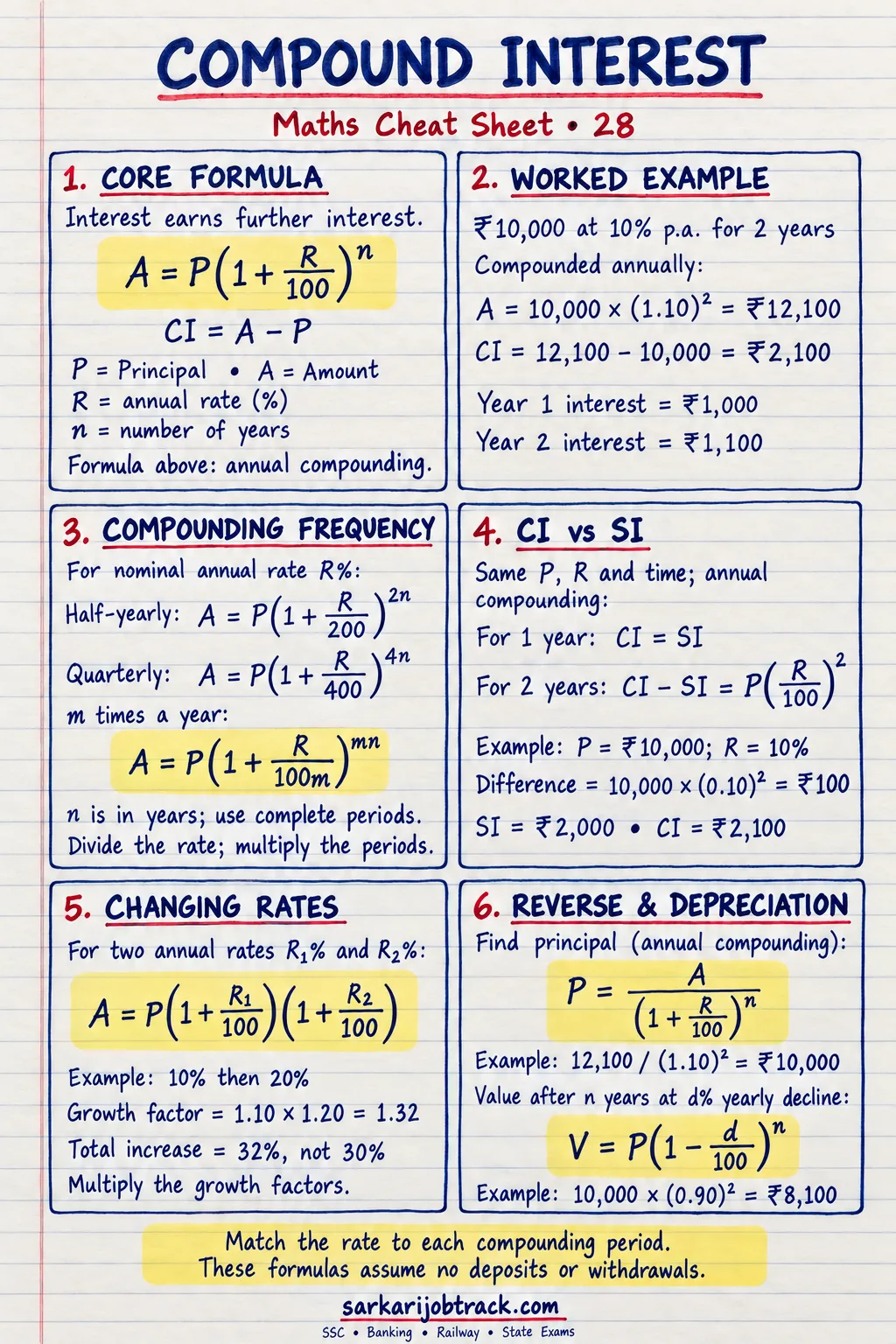
A quick revision cheat sheet on compound interest for SSC, Banking, Railway and state exams. It covers the amount and compound-interest formulas, half-yearly and quarterly compounding, how compound interest differs from simple interest, and the shortcut for the CI-minus-SI difference over two and three years, with worked examples.
Compound Interest Cheat Sheet
Quick Revision
Compound interest (CI) is interest charged on the principal and on the interest already added. Each period's interest becomes part of the principal for the next period.
Ready to practise? Take the Simple and Compound Interest quiz
1. The Core Formulas
For principal P, rate r% per year, and n years:
Amount, A = P × (1 + r/100)ⁿ
Compound Interest = A − P
2. Compounding More Than Once a Year
| Compounded | Rate used | Number of periods |
|---|---|---|
| Yearly | r | n |
| Half-yearly | r / 2 | 2n |
| Quarterly | r / 4 | 4n |
Example (half-yearly)
P = ₹8000, r = 10% per year, time = 1 year, compounded half-yearly:
A = 8000 × (1 + 5/100)² = 8000 × 1.1025 = ₹8820
CI = 8820 − 8000 = ₹820
3. CI vs SI
Simple interest uses the original principal every year: SI = PRT/100. Compound interest grows faster because it earns on the added interest. For the first year (compounded yearly) CI and SI are equal; from the second year CI is larger.
4. Difference Between CI and SI (shortcut)
For the same P, r and time:
2 years:  Difference = P × (r/100)²
3 years:  Difference = P × (r/100)² × (3 + r/100)
Example
P = ₹5000, r = 10%, 2 years:
Difference = 5000 × (10/100)² = 5000 × 0.01 = ₹505. Exam Quick Tips
- Learn
A = P(1 + r/100)ⁿ; CI is alwaysA − P. - For half-yearly, halve the rate and double the time; for quarterly, quarter the rate and quadruple the time.
- The 2-year CI−SI difference is
P(r/100)²— a very common one-line question. - CI equals SI only for the first year when compounded yearly.
Keep revising with the rest of the Maths section:
How this was made: Drafted with AI assistance; spot-checked by the editor on 31 October 2026.