
Simple and Compound Interest: Find the Interest, Amount, Rate and Time
Learn what principal, rate, time, interest and amount mean, find simple interest and rearrange the formula to get the rate, time or principal, work out compound interest year by year and with the formula, handle interest compounded half-yearly, use the shortcut for the gap between compound and simple interest, and solve an everyday loan question, through six worked examples and a revision block.
By the end of this lesson you will be able to find simple interest and the amount, rearrange the formula to find the rate, the time or the principal, work out compound interest year by year and with the formula, handle interest compounded half-yearly, use the shortcut for the gap between compound and simple interest, and solve an everyday loan question.
Already confident? Skip to practice: Simple and Compound Interest quiz
Before this: you should be able to find a percentage of an amount and increase an amount by a percentage using a multiplier (a 10% rise multiplies by 1.1, that is by 110/100). If that feels shaky, read the Percentage lesson first. Compound interest is just that multiplier used once for each year.
The words, and the conventions
- The principal (P) is the money borrowed or deposited at the start.
- The rate (R) is the interest charged for one year, written as a percentage. It is per annum (per year) unless the question says otherwise. "Per annum" is often shortened to "p.a."
- The time (T) is how long the money is lent or kept, counted in years.
- The interest is the extra money paid for the use of the principal.
- The amount (A) is the principal plus the interest: A = P + interest. A question may ask for the interest or for the amount, so read which one it wants.
Simple interest (SI) is worked out on the original principal every year, so the interest is the same each year. Compound interest (CI) is worked out each year on the principal plus the interest added so far, so the interest grows year by year.
Three conventions, unless the question says otherwise:
- The rate is per annum.
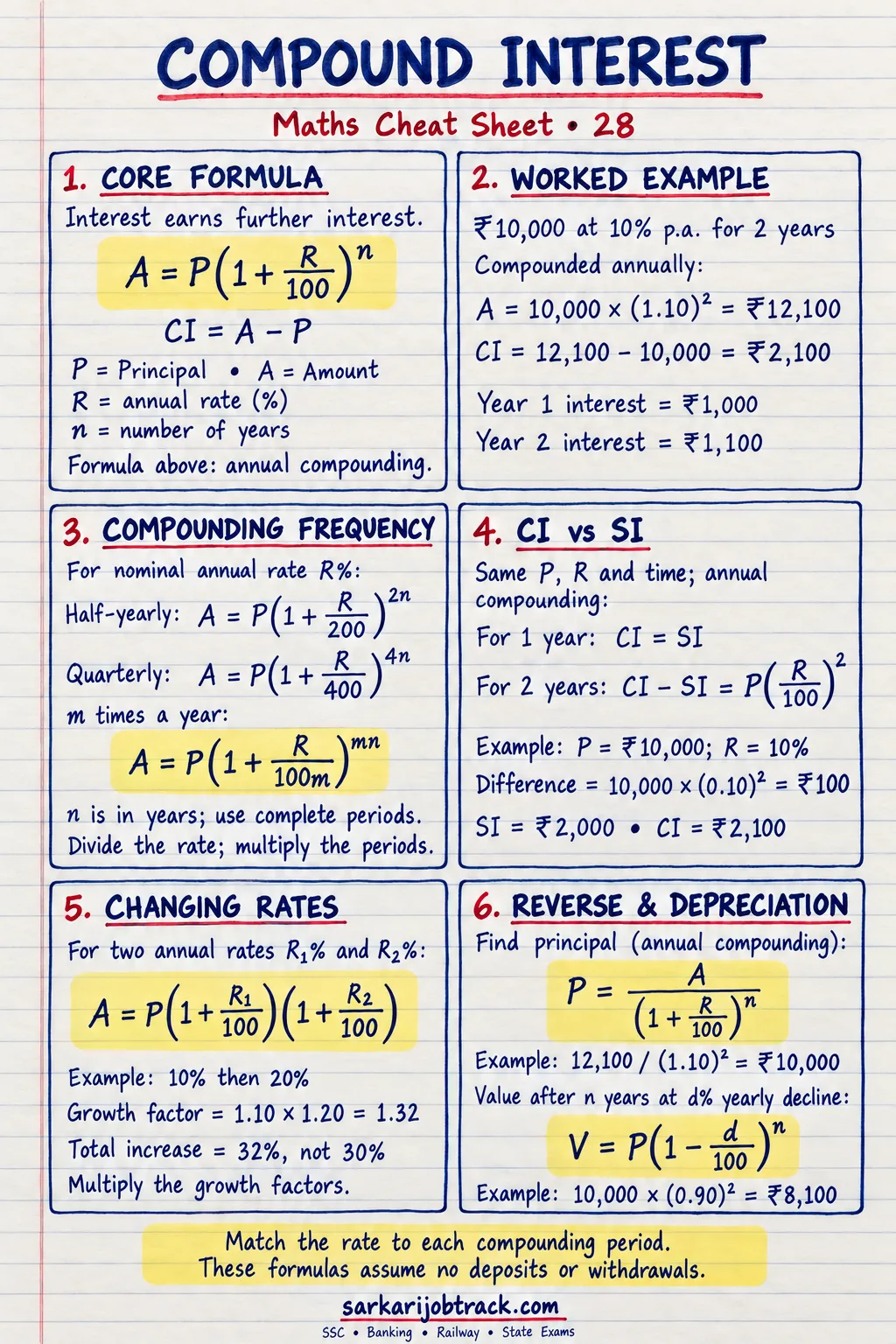
- Compound interest is compounded annually (interest is added once at the end of each year). If it is compounded half-yearly, the rate is halved and the number of periods is doubled; Example 4 shows this.
- The time is in years. For months, divide by 12: 6 months is 6/12 = 1/2 year, and 8 months is 8/12 = 2/3 year.
Worked examples
Read each example slowly. The first two show every step. In the later ones, some steps are left for you, with the answer just below.
Example 1: Simple interest, and the amount
Question: (a) Find the simple interest on ₹6,000 at 9% per annum for 4 years, and the amount at the end. (b) Find the simple interest on ₹9,600 at 5% per annum for 8 months.
Part (a): the interest and the amount
- Simple interest is principal times rate times time, divided by 100: SI = P × R × T ÷ 100.
- Put in the numbers: SI = 6,000 × 9 × 4 ÷ 100.
- Work the top first: 6,000 × 9 = 54,000, and 54,000 × 4 = 216,000.
- Divide by 100: 216,000 ÷ 100 = ₹2,160.
- The amount is the principal plus the interest: A = 6,000 + 2,160 = ₹8,160.
A quick check for simple interest: the interest is the same each year. One year's interest is 9% of ₹6,000 = ₹540, and 4 × 540 = ₹2,160.
Part (b): a time given in months
- The formula counts the time in years, so change 8 months to years first: 8 months = 8/12 = 2/3 of a year.
- SI = 9,600 × 5 × 2/3 ÷ 100.
- 9,600 × 5 = 48,000, and 48,000 × 2/3 = 32,000.
- Divide by 100: 32,000 ÷ 100 = ₹320.
The principle: SI = P × R × T ÷ 100, with the rate per annum and the time in years. The amount is P + SI. Change months to years (months ÷ 12) before using the formula.
Example 2: Rearranging the formula, and how long to double
Question: (a) At what rate per annum does ₹5,000 earn ₹1,500 as simple interest in 3 years? (b) In what time does ₹7,500 earn ₹1,800 as simple interest at 8% per annum? (c) What principal earns ₹1,920 as simple interest in 4 years at 6% per annum? (d) A sum of money doubles itself in 4 years at simple interest. At what rate? In how many years will it become four times itself?
Part (a): the rate
- Start from SI = P × R × T ÷ 100, and make R the subject: R = 100 × SI ÷ (P × T). The whole of P × T goes underneath.
- R = 100 × 1,500 ÷ (5,000 × 3) = 150,000 ÷ 15,000 = 10%.
- Check: 10% of ₹5,000 is ₹500 a year, and 3 × 500 = ₹1,500.
Part (b): the time
- Make T the subject: T = 100 × SI ÷ (P × R).
- T = 100 × 1,800 ÷ (7,500 × 8) = 180,000 ÷ 60,000 = 3 years.
- Check: 8% of ₹7,500 is ₹600 a year, and 3 × 600 = ₹1,800.
Part (c): the principal
- Make P the subject: P = 100 × SI ÷ (R × T).
- P = 100 × 1,920 ÷ (6 × 4) = 192,000 ÷ 24 = ₹8,000.
- Check: 6% of ₹8,000 is ₹480 a year, and 4 × 480 = ₹1,920.
Part (d): doubling and becoming four times
- To double, the interest earned must equal the principal itself (because amount = principal + interest = 2 × principal). So SI = P.
- Put SI = P into P × R × T ÷ 100 = P. The P on each side cancels, leaving R × T = 100.
- The time is 4 years, so R × 4 = 100, and R = 100 ÷ 4 = 25%.
- To become four times, the interest must be three times the principal (amount = 4P = P + 3P). Under simple interest the interest is the same each year, so three times the interest needs three times the time: to earn P takes 4 years, so to earn 3P takes 3 × 4 = 12 years.
The principle: rearrange SI = P × R × T ÷ 100 to get R = 100 × SI ÷ (P × T), T = 100 × SI ÷ (P × R), or P = 100 × SI ÷ (R × T); the two letters not wanted multiply together underneath. For a sum to become n times itself under simple interest, the interest must be (n − 1) times the principal, so R × T = 100 × (n − 1). Because simple interest is the same each year, the time scales with how much interest is needed.
Example 3: Compound interest, year by year and by formula
Question: (a) Find the compound interest on ₹10,000 at 10% per annum for 3 years, compounded annually, by working one year at a time. (b) Use the formula to find the amount on ₹15,000 at 20% per annum for 3 years, compounded annually.
Part (a): one year at a time
Each year the whole amount earns 10%, so each year is a 10% increase on the year before. From the Percentage lesson, a 10% increase multiplies by 1.1.
- Start: ₹10,000.
- After year 1: 10,000 × 1.1 = ₹11,000.
- After year 2: the 10% is now on ₹11,000, not on ₹10,000. 11,000 × 1.1 = ₹12,100.
- After year 3: 12,100 × 1.1 = ₹13,310.
- The compound interest is the amount at the end minus the principal: 13,310 − 10,000 = ₹3,310.
Compare simple interest on the same money: 10% of ₹10,000 is ₹1,000 a year, so 3 years of simple interest is only ₹3,000. Compound interest is more, because each year's interest also earns interest.
Part (b): the formula
Three 10% increases in a row multiply by 1.1 three times, that is by 1.1 × 1.1 × 1.1. In general, T years at R% compounded annually multiply the principal by (1 + R/100) once for each year:
- A = P × (1 + R/100) to the power T.
- Here R = 20, so 1 + R/100 = 1 + 20/100 = 1.2, and T = 3.
- A = 15,000 × 1.2 × 1.2 × 1.2. Build it up: 1.2 × 1.2 = 1.44, and 1.44 × 1.2 = 1.728.
- A = 15,000 × 1.728 = ₹25,920.
- Your turn: find the compound interest (the amount minus the principal).
Check: CI = 25,920 − 15,000 = ₹10,920.
The principle: compound interest adds each year's interest back to the principal, so it is a percentage increase repeated once for each year. The amount is A = P × (1 + R/100) to the power T, and the compound interest is A − P. Never just multiply one year's interest by the number of years; that is simple interest.
Example 4: Interest compounded half-yearly
When interest is compounded half-yearly, it is added twice a year. The yearly rate is shared equally between the two halves, so you use half the rate and twice as many periods.
Question: Find the compound interest on ₹10,000 at 20% per annum for 1 year, compounded half-yearly. How does it compare with the same money at 20% compounded annually?
- Half the yearly rate: 20% ÷ 2 = 10% for each half-year. Twice as many periods: 1 year has 2 half-years, so 2 periods.
- So the amount is 10,000 × 1.1 × 1.1 (a 10% increase for each half-year).
- 1.1 × 1.1 = 1.21, so A = 10,000 × 1.21 = ₹12,100.
- Your turn: find the compound interest.
Check: CI = 12,100 − 10,000 = ₹2,100.
Compounded annually instead, 1 year at 20% gives 10,000 × 1.2 = ₹12,000, an interest of ₹2,000. Compounding half-yearly earns ₹100 more, because the first half-year's interest starts earning interest in the second half.
Your turn: find the amount on the same ₹10,000 at 20% per annum for 1 year 6 months (that is 1.5 years), compounded half-yearly. (Hint: 1.5 years is 3 half-years, so 3 periods at 10%.)
Check: A = 10,000 × 1.1 × 1.1 × 1.1 = 10,000 × 1.331 = ₹13,310, so the compound interest is ₹3,310.
The principle: for interest compounded half-yearly, halve the yearly rate and double the number of years to get the number of periods, then use A = P × (1 + half-rate/100) to the power (2 × T). Compounded quarterly, use a quarter of the rate and four periods a year. More frequent compounding always earns a little more.
Example 5: The gap between compound and simple interest
Question: A sum of ₹20,000 is lent at 10% per annum. (a) Find the compound interest and the simple interest for 2 years, and the difference between them. (b) Find the difference for 3 years.
Part (a): 2 years
- Simple interest: 10% of ₹20,000 is ₹2,000 a year, so 2 years give 2 × 2,000 = ₹4,000.
- Compound interest: A = 20,000 × 1.1 × 1.1 = 20,000 × 1.21 = ₹24,200, so CI = 24,200 − 20,000 = ₹4,200.
- The difference is 4,200 − 4,000 = ₹200.
Where does the ₹200 come from? In year 1 both earn ₹2,000. In year 2, compound interest also charges 10% on the first year's ₹2,000, which is ₹200. So for 2 years the gap is 10% of one year's interest, which works out to the principal times the rate squared over a hundred: 20,000 × (10/100) × (10/100) = 20,000 × 1/100 = ₹200. In symbols, for 2 years:
- CI − SI = P × (R/100) × (R/100).
Part (b): 3 years
- Your turn: find the simple interest for 3 years, and the compound interest for 3 years (carry on from the ₹24,200 after 2 years: one more 10% increase).
Check: SI = 3 × 2,000 = ₹6,000. After year 3, A = 24,200 × 1.1 = ₹26,620, so CI = 26,620 − 20,000 = ₹6,620. The difference is 6,620 − 6,000 = ₹620.
The principle: for the same principal and rate, the 2-year difference between compound and simple interest is P × (R/100) × (R/100): it is the interest the first year's interest earns in the second year. The difference is taken on the principal, not on the amount. For 3 years the gap is larger, because there is more interest-on-interest; it is one of the commonest shortcuts in the exam, so it is worth knowing that for 2 years it is P × (R/100) squared.
Example 6: An everyday loan
Question: Sunita borrows ₹25,000 from a cooperative society at 12% per annum and repays it after 2 years. (a) How much does she repay if the society charges simple interest? (b) A bank would have charged 12% per annum compounded annually instead. How much more would she have repaid?
Part (a): simple interest
- Simple interest: 25,000 × 12 × 2 ÷ 100. One year is 12% of ₹25,000 = ₹3,000, so 2 years = ₹6,000.
- She repays the principal plus the interest: 25,000 + 6,000 = ₹31,000.
Part (b): compound interest
- Compounded annually at 12%, the amount is 25,000 × 1.12 × 1.12.
- 1.12 × 1.12 = 1.2544, so A = 25,000 × 1.2544 = ₹31,360.
- Your turn: how much more is this than the ₹31,000 she repays under simple interest?
Check: 31,360 − 31,000 = ₹360 more. This matches the 2-year shortcut from Example 5: P × (R/100) squared = 25,000 × (12/100) × (12/100) = 25,000 × 144/10,000 = ₹360.
The principle: read whether the question asks for the interest or for the total to repay (the amount), and whether the interest is simple or compound. For two years at the same rate, the extra that compound interest costs over simple interest is P × (R/100) squared.
Revision: the formulas in one place
In this table R is the yearly rate written as a plain number: for 10% per annum, R = 10; T is the time in years.
| To find | Formula |
|---|---|
| Simple interest (SI) | P × R × T ÷ 100 |
| Amount under simple interest | P + SI, that is P × (1 + R × T ÷ 100) |
| Rate, from the simple interest | 100 × SI ÷ (P × T) |
| Time, from the simple interest | 100 × SI ÷ (P × R) |
| Principal, from the simple interest | 100 × SI ÷ (R × T) |
| Time of m months, in years | m ÷ 12 |
| A sum becomes n times itself (simple interest) | R × T = 100 × (n − 1) |
| Amount under compound interest, compounded annually | P × (1 + R/100) to the power T |
| Compound interest | amount − P |
| Amount, compounded half-yearly | P × (1 + (R ÷ 2)/100) to the power (2 × T) |
| Amount, compounded quarterly | P × (1 + (R ÷ 4)/100) to the power (4 × T) |
| CI − SI for 2 years (same P and R) | P × (R/100) × (R/100) |
| CI − SI for 3 years (same P and R) | P × (R/100) × (R/100) × (3 + R/100) |
Revision: multipliers worth knowing
Compound interest is a percentage increase repeated once for each period, so the multipliers from the Percentage lesson do the work.
| Rate for one period | Multiply by, once per period |
|---|---|
| 5% | 1.05 |
| 10% | 1.1 |
| 12% | 1.12 |
| 15% | 1.15 |
| 20% | 1.2 |
| 25% | 1.25 (5/4) |
For 2 years at 10%, multiply by 1.1 twice (1.1 × 1.1 = 1.21). For 3 years, three times. For half-yearly compounding at 20% a year, use the 10% multiplier (1.1) twice a year.
Common mistakes
- Mixing up the interest and the amount. Simple interest is the extra money only; the amount is the principal plus the interest. If the question asks how much is repaid, that is the amount.
- Leaving the time in months. For 6 months, use T = 1/2, not T = 6. Change months to years (months ÷ 12) first.
- Treating compound interest like simple interest. Compound interest does not add the same amount each year. The second year's interest is worked out on the first year's amount, not on the original principal.
- Forgetting to adjust for half-yearly. Compounded half-yearly for 2 years at 10% is four periods at 5% (multiply by 1.05 four times), not two periods at 10%.
- Using the simple-interest doubling rule for compound interest. R × T = 100 doubles money under simple interest only. Under compound interest the time to double is different.
- Taking the CI − SI difference on the amount. For 2 years the gap is P × (R/100) squared, worked out on the principal, not on the final amount.
Next
Partnership, time and work, and time, speed and distance come next in the Maths series; they have no lesson yet, but you can read about them on their own pages later. For quick revision of this topic, keep the Simple Interest formula cheat sheet handy; it lists many more simple-interest shortcuts, such as splitting a sum across two rates.
Ready to test this lesson? Take the Simple and Compound Interest quiz </content>
How this was made: Drafted with AI assistance; every formula and worked figure recomputed independently; spot-checked by the editor on 24 October 2026.