
Error Spotting Cheat Sheet
31 Oct 2026
Quick answer
A quick revision cheat sheet for error spotting questions in SSC, Banking, Railway and state exams. It explains how the question is set out, the main grammar error categories to scan for — agreement, tense, nouns, pronouns, articles, prepositions, adjectives and conjunctions — and a reliable method for finding the one part that carries the mistake.
Error Spotting Cheat Sheet
Quick Revision
An error spotting question splits a sentence into parts (usually labelled A, B, C and D) and asks which part contains a grammatical error. If every part is correct, the answer is "No error".
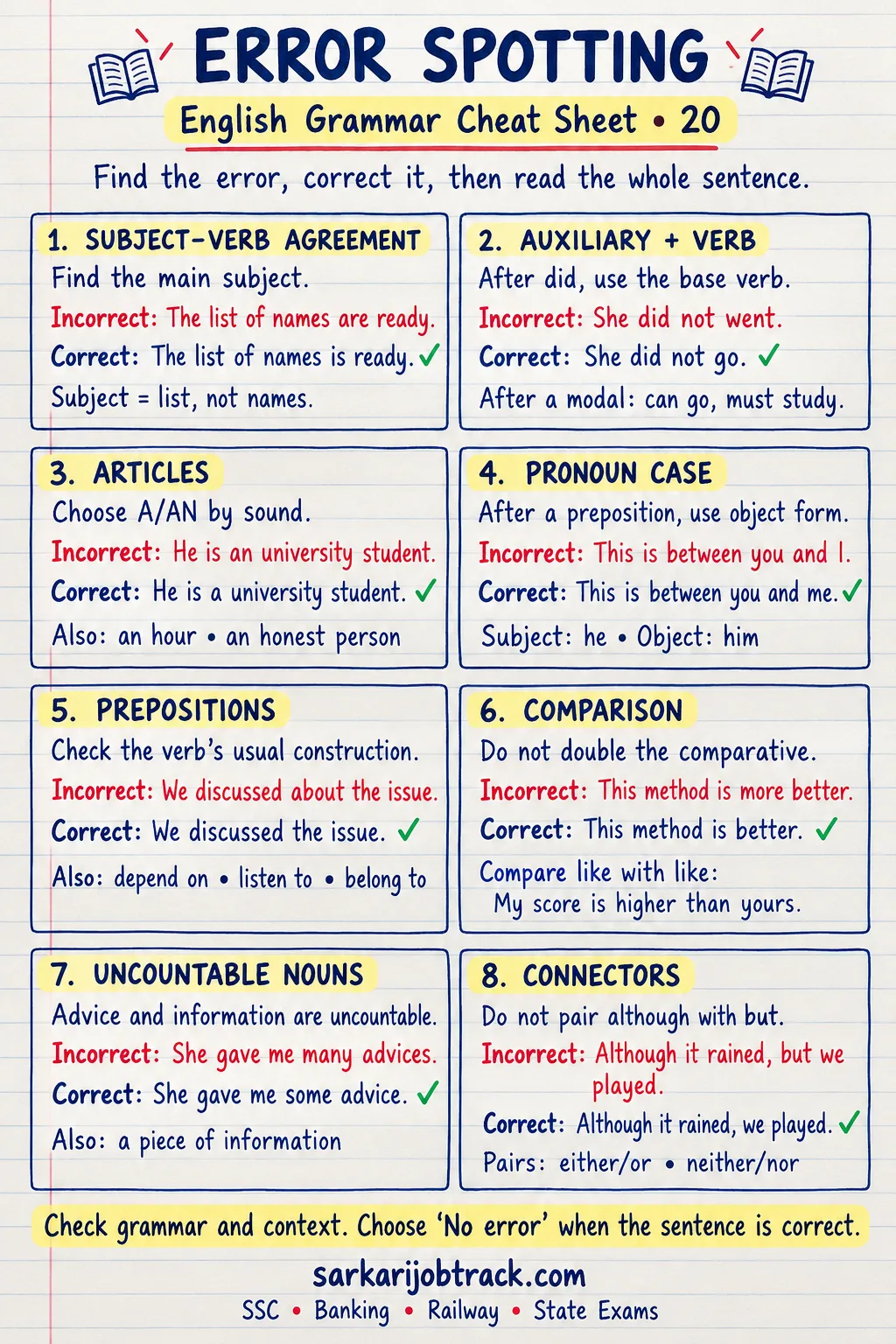
Ready to practise? Take the Error Spotting quiz
1. How to Approach the Question
- Read the whole sentence once for meaning.
- Check each part against one grammar rule at a time.
- Pay closest attention to the verb, the subject and the prepositions.
- Mark the first part that clearly breaks a rule.
- If no part breaks a rule, choose "No error".
2. Main Error Categories
| Category | What to check |
|---|---|
| Subject–verb agreement | Singular subject with a singular verb |
| Tense | The verb tense suits the time and the clauses |
| Noun / number | Correct singular or plural form |
| Pronoun | Agrees with its noun; correct case (he/him) |
| Article | Correct a, an, the, or none |
| Preposition | The right preposition for the word |
| Adjective / adverb | Adverb modifies a verb; correct degree |
| Conjunction | Correct pair (either…or, neither…nor, not only…but also) |
| Redundancy | No repeated or unnecessary words |
3. High-Frequency Rules
- Collective nouns (team, jury, committee) usually take a singular verb.
- "One of the + plural noun" takes a singular verb: "One of the boys is here".
- Uncountable nouns (information, furniture, advice) take no plural and no "a/an".
- Since is used with a point of time; for with a length of time.
- Neither…nor takes a verb that agrees with the nearer subject.
- Avoid double negatives and redundant words ("return back", "more better").
4. The "No Error" Option
Some sentences are fully correct. Do not force an error where none exists — choose "No error" when every part obeys the rules. Equally, never pick "No error" just because you are unsure; confirm each part first.
5. Exam Quick Tips
- Scan the verb and its subject first — most errors live there.
- Check prepositions and articles next; they are the next most common.
- Watch for conjunction pairs (either…or, neither…nor).
- Choose "No error" only after every part has passed a rule.
Keep revising with the rest of the English section:
How this was made: Drafted with AI assistance; spot-checked by the editor on 31 October 2026.