
Sentence Improvement Cheat Sheet
31 Oct 2026
Quick answer
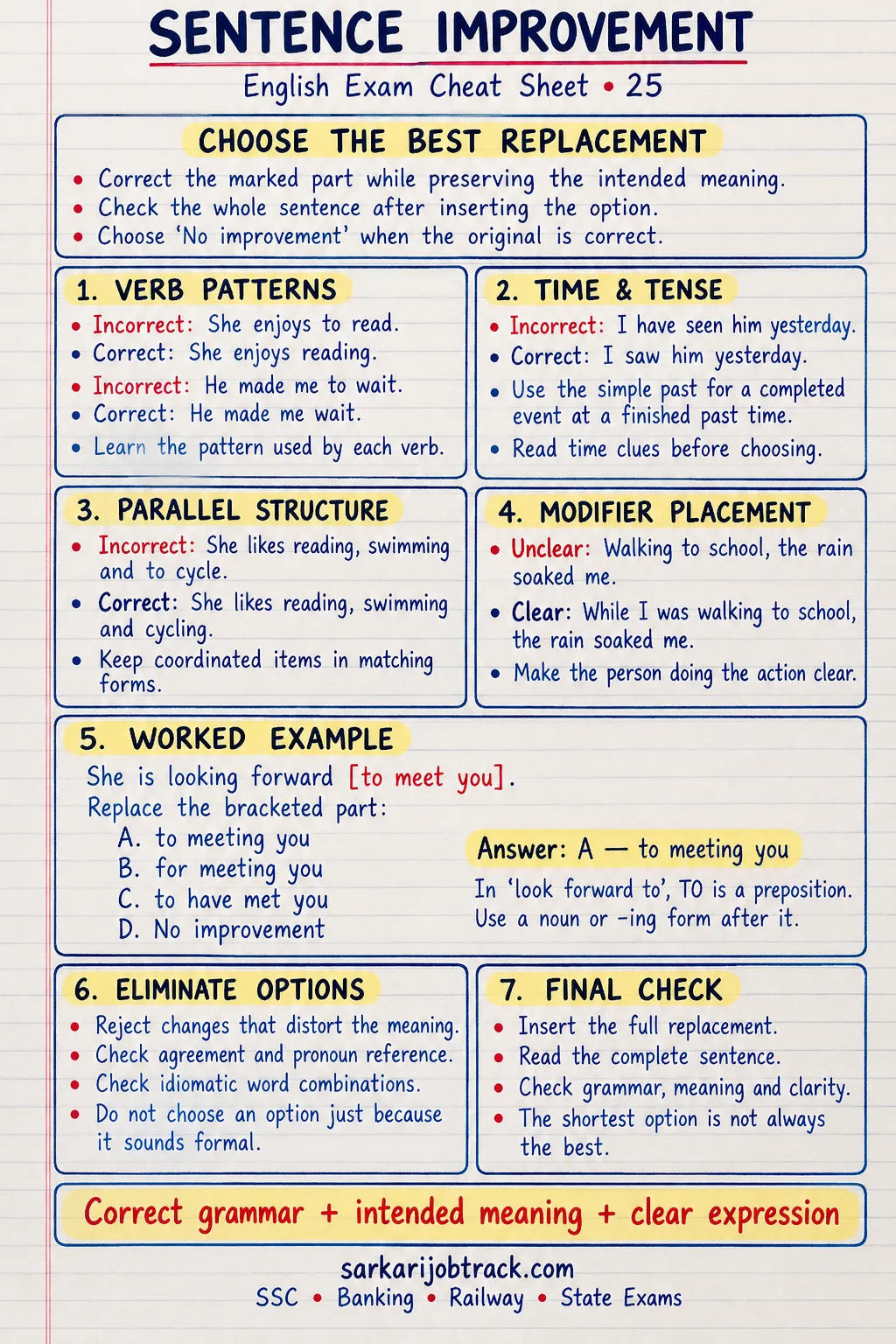
A quick revision cheat sheet for sentence improvement questions in SSC, Banking, Railway and state exams. It explains how the question works, the common error types that are tested — grammar agreement, tense, prepositions, articles, pronouns, modifiers, parallelism and redundancy — a step-by-step approach, and how to handle the "No improvement" option.
Sentence Improvement Cheat Sheet
Quick Revision
A sentence improvement (or sentence correction) question gives you a sentence with one part underlined and asks you to choose the best replacement for that part. One option is always "No improvement", which is correct when the sentence is already right.
Ready to practise? Take the Sentence Improvement quiz
1. How to Approach the Question
- Read the whole sentence first, not just the underlined part.
- Decide whether the underlined part actually has an error.
- If it is correct, choose "No improvement" — do not change a right answer.
- If it is wrong, find the option that fixes the error without adding a new one.
- Re-read the sentence with your chosen option to confirm it sounds right.
2. Common Error Types Tested
| Error type | What to check |
|---|---|
| Subject–verb agreement | A singular subject takes a singular verb |
| Tense | The tense matches the time and the other clauses |
| Preposition | The correct preposition follows the word |
| Article | Correct use of a, an and the |
| Pronoun | The pronoun agrees with its noun in number |
| Adjective / adverb | An adverb, not an adjective, modifies a verb |
| Degree of comparison | Correct use of comparative and superlative |
| Parallelism | Items in a list share the same grammatical form |
| Redundancy | No repeated or unnecessary words |
3. Frequently Tested Points
- Subject–verb agreement: "One of the students was absent" (not were).
- Preposition: "married to", "superior to", "composed of", "capable of".
- Redundancy: drop the extra word — "return back", "repeat again", "free gift".
- Comparison: "the most unique" is wrong; unique has no degrees.
- Parallelism: "She likes reading, writing and to paint" → "and painting".
4. The "No Improvement" Trap
Do not assume there is always an error. In many papers, a share of the answers are "No improvement". Change the sentence only when you can name the specific error. If every option introduces a new mistake, the original is probably correct.
5. Exam Quick Tips
- Read the full sentence before judging the underlined part.
- Name the exact error (tense, preposition, agreement…) before picking an option.
- Reject any option that fixes one error but adds another.
- Trust "No improvement" when you cannot find a clear mistake.
Keep revising with the rest of the English section:
How this was made: Drafted with AI assistance; spot-checked by the editor on 31 October 2026.