
Sentence Improvement: A Lesson on Choosing the Better Version
Learn how to attack the sentence-improvement question — read the underlined part, name the error if there is one, and test each option against the grammar rules for tense, agreement, prepositions, articles, redundancy and parallelism. Covers how to tell a real error from a correct sentence, the no-improvement trap, and the error types the exam reuses, with worked examples.
By the end of this lesson you will have a fixed method for the sentence-improvement question: find what the underlined part gets wrong, test the options against one named rule rather than by ear, and know when the right answer is "No improvement", so that you can answer a question like "He is senior than me — (a) senior from (b) senior to (c) senior of (d) No improvement" with a reason, not a guess.
Already confident? Skip to practice: Sentence Improvement quiz
Before this: this question tests the grammar you have already learnt, applied to one underlined part. It builds on Subject–Verb Agreement and Tenses; read those first if either feels shaky.
What the question asks
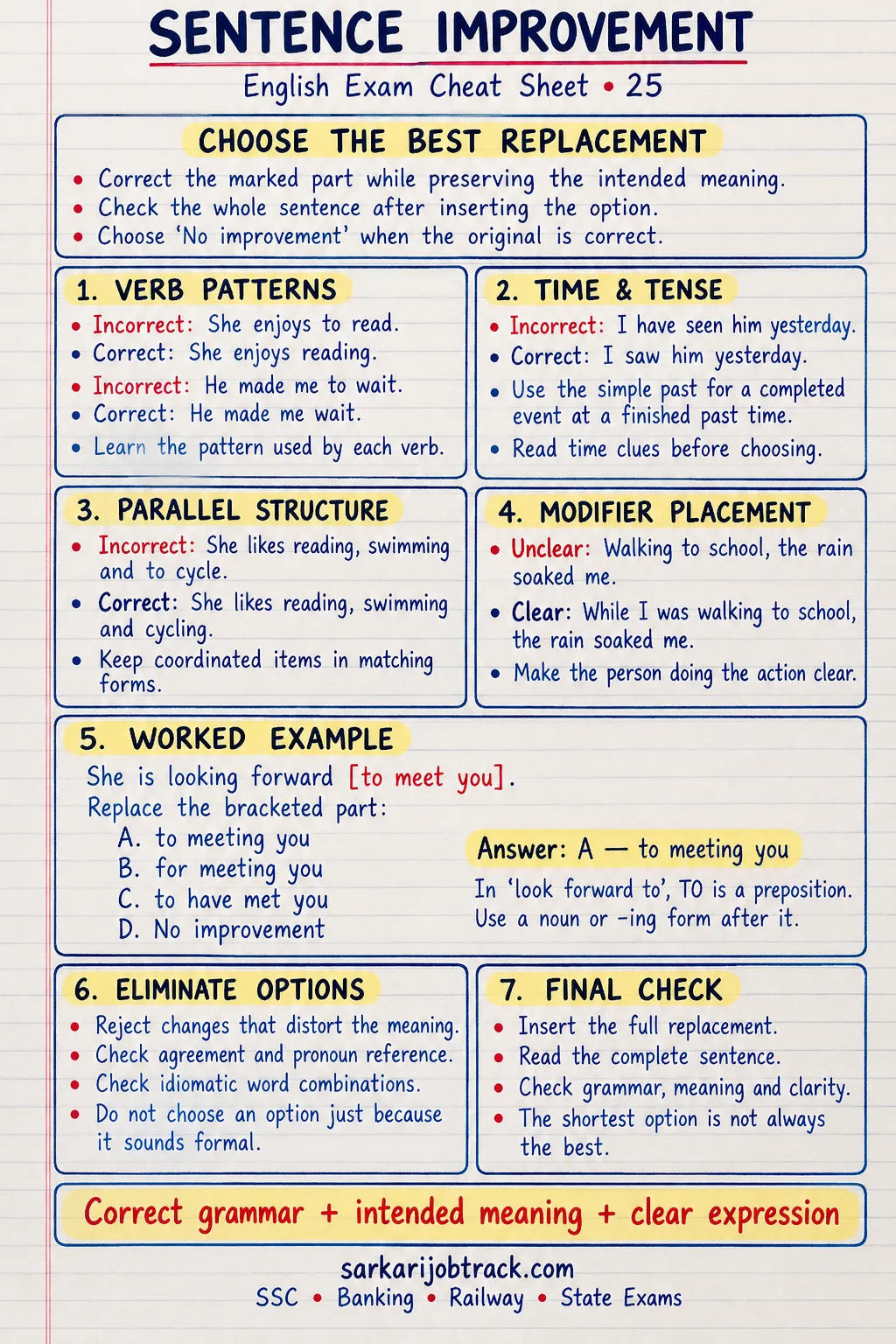
A sentence-improvement question gives you one sentence with a part underlined, and three or four replacements for that part. Your job is to choose the replacement that makes the sentence correct — or to choose "No improvement" when the underlined part is already right.
He is senior than me in the office. (a) is senior from (b) is senior to (c) is senior of (d) No improvement
Only the underlined part can change; the rest of the sentence is fixed and correct. So you never rewrite the whole sentence — you judge one small part against one grammar rule. Here senior takes to, so the answer is (b) is senior to.
The method: name the error, then test the options
Do not read the four options first and pick what "sounds right" — that is how the exam catches you. Work in this order every time.
- Read the full sentence once for meaning.
- Look only at the underlined part and ask: what rule could it break — tense, agreement, preposition, article, word form, redundancy, parallelism?
- Name the error in one word if there is one. If you cannot name an error, the answer may be "No improvement".
- Test each option against that one rule, and reject any option that breaks a different rule while fixing the first.
- Choose the option that is fully correct, not merely better than the original.
Naming the error is the step most students skip, and it is the one that turns a guess into an answer.
The error types the exam reuses
Sentence improvement draws from a fixed set of grammar points. These are the ones to scan for.
| Error type | What to check | Example of the fix |
|---|---|---|
| Tense | Does the verb match the time words and the other verbs? | "When he came, I am reading" → was reading |
| Subject–verb agreement | Singular subject with singular verb? | "One of the boys are absent" → is absent |
| Preposition | Is it the fixed pair? | "good in maths" → good at maths |
| Article | a / an / the used correctly? | "He is honest man" → an honest man |
| Degree of comparison | than vs to; double comparatives | "more better" → better |
| Redundancy | Two words saying the same thing | "return back" → return; "free gift" → gift |
| Parallelism | Items in a list in the same form | "reading, writing and to sing" → and singing |
| Word form | Adjective vs adverb, noun vs verb | "She sings beautiful" → beautifully |
For the preposition and agreement types, the full rules are in the Prepositions lesson and Subject–Verb Agreement lesson.
Redundancy: the quiet error
A large share of sentence-improvement questions test redundancy — a word that repeats a meaning already present. The fix is almost always to remove a word, so the shortest grammatical option is often right.
Common redundant pairs: return back (return), repeat again (repeat), free gift (gift), final conclusion (conclusion), each and every (each), close proximity (proximity), past history (history), advance planning (planning).
Check: "Please repeat it again." The underlined part is repeat it again. Repeat already means "say again", so again is redundant: the improvement is repeat it.
The "No improvement" trap
One option is always "No improvement" (or "No correction required"), and it is the correct answer often enough that you cannot treat it as a throwaway. If, after naming possible errors, the underlined part breaks no rule, choose it. Do not "improve" a sentence that is already correct — changing a correct sentence to a different correct-sounding one is the trap this option sets.
Check: "He has been living here since 2010." Scan the underlined part: since with a point in time (a year) after a present-perfect-continuous verb is correct. There is no error, so the answer is No improvement.
Solved example
She is one of the best player who have come here. (a) players who have (b) player who has (c) players who has (d) No improvement
Name the error. The phrase is one of the best + noun + who …. Two rules apply: after one of the best, the noun is plural (players), and the verb in the who clause agrees with that plural noun (who have). The underlined part has a singular player, which is wrong. Test the options: (b) fixes the noun but makes the verb singular (has) — wrong; (c) keeps has — wrong; (a) gives players who have, both plural — correct. The answer is (a).
Common mistakes to avoid
- Picking by ear — choosing the option that sounds smoothest without naming a rule. The exam writes a wrong option to sound smooth.
- Fixing one error and adding another — an option may correct the preposition but break the tense. Reject any option that is not correct in every way.
- Ignoring "No improvement" — treating it as never the answer. It is the answer whenever the underlined part is already correct.
- Over-correcting idiom — some phrases are fixed English even if they look odd; do not change a correct idiom to a "logical" version.
Quick revision table
| Step | What you do |
|---|---|
| 1 | Read the whole sentence for meaning |
| 2 | Look only at the underlined part |
| 3 | Name the error type (tense, agreement, preposition, article, redundancy, parallelism, word form) |
| 4 | Test each option against that rule; reject any that break another |
| 5 | Choose the fully correct option — or "No improvement" if none is needed |
Keep this method and the sentence improvement cheat sheet for revision. The same errors appear in the reverse direction in the Error Spotting lesson, which is worth doing next.
How this was made: Drafted with AI assistance; every answer re-solved by a separate check that had not seen the key; every fact checked against the source it cites.