
Direct and Indirect Speech: A Lesson on Reporting What Was Said
Learn how to turn direct speech into indirect — backshifting the tense one step into the past, changing the pronouns to match the new speaker, and changing the words for time and place — and how to report a statement, a question, a command and a request, each with its own reporting verb and pattern, through worked examples in the change-the-narration style.
By the end of this lesson you will be able to take a sentence in direct speech — the exact words inside quotation marks — and report it in indirect speech, changing the tense, the pronouns and the words for time and place correctly, so that you can answer "Change into indirect speech: He said, 'I am writing a letter'" without hesitation.
Already confident? Skip to practice: Direct and Indirect Speech quiz
Before this: reporting changes the tense of the verb one step, so you must be able to name a tense and its past form first. If that feels shaky, read the Tenses lesson before this one.
Direct and indirect: what changes
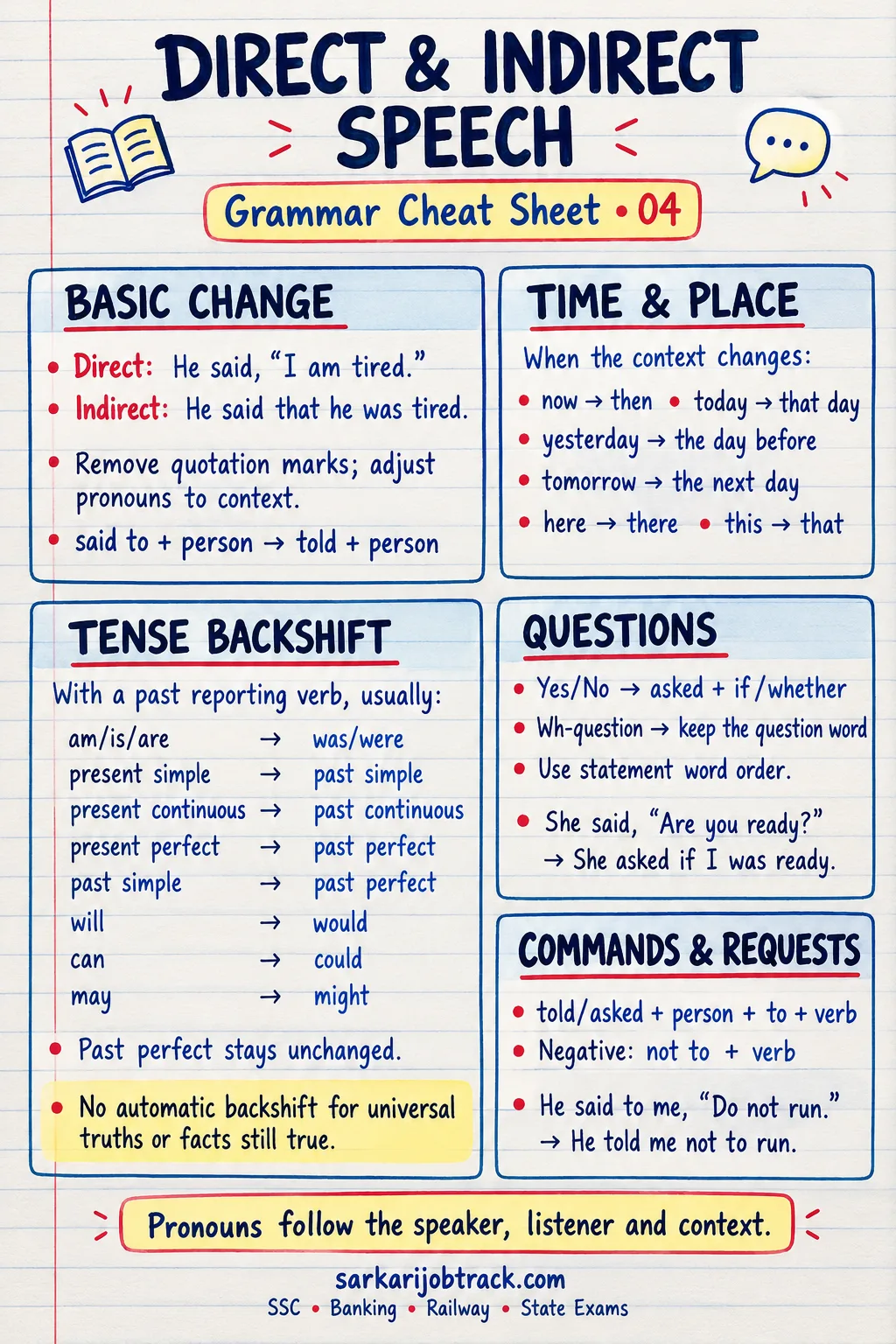
Direct speech gives the exact words a person said, inside quotation marks: He said, "I am tired." Indirect speech (also called reported speech) reports the same words without quoting them: He said that he was tired.
Three things change when you move from direct to indirect, and the whole task is doing all three:
- The tense of the reported verb shifts one step into the past (if the reporting verb is in the past).
- The pronouns change to match the new point of view.
- The words for time and place change (now → then, here → there).
The quotation marks and the comma disappear, and for a statement the word that joins the two halves.
Step 1: the tense backshift
When the reporting verb (said, told) is in the past, the verb inside moves one step back in time. Learn the table as pairs.
| Direct (present / future) | Indirect (one step back) |
|---|---|
| simple present (write) | simple past (wrote) |
| present continuous (am writing) | past continuous (was writing) |
| present perfect (have written) | past perfect (had written) |
| simple past (wrote) | past perfect (had written) |
| will | would |
| can | could |
| may | might |
| must | had to |
So He said, "I am writing a letter" becomes He said that he was writing a letter.
The exception worth knowing: a universal truth or a fact that is still true does not backshift. The teacher said, "The sun rises in the east" stays The teacher said that the sun rises in the east — because it is true whenever it is reported.
Check: report She said, "I have finished my work." Present perfect backshifts to past perfect, and I becomes she: She said that she had finished her work.
Step 2: the pronoun change
Pronouns change so the report makes sense from the reporter's side. The rule of thumb:
- The first person (I, we, my, our) changes to match the subject of the reporting verb.
- The second person (you, your) changes to match the object of the reporting verb (the listener).
- The third person (he, she, they) does not change.
So in He said to me, "You are my friend", you (the listener, me) becomes I, and my (the speaker, he) becomes his: He told me that I was his friend.
Step 3: words for time and place
These words shift because the report is made at a different time and place from the original speech.
| Direct | Indirect |
|---|---|
| now | then |
| today | that day |
| tomorrow | the next day |
| yesterday | the previous day |
| here | there |
| this | that |
| these | those |
| ago | before |
| last night | the previous night |
So He said, "I will come tomorrow" becomes He said that he would come the next day.
The four reporting patterns
The reporting verb and the joining word depend on what kind of sentence was spoken.
*1. A statement — use said / said that / told + object that. He said, "I am busy." → He said that he was busy. Note the difference: say takes no listener (he said that…); tell needs one (he told me that…*). "He told that…" with no listener is a common error.
*2. A question — use asked, drop the question mark, and make it a statement.*
- A yes/no question joins with if or whether: He said, "Are you ready?" → He asked if I was ready.
- A wh- question keeps the question word as the joiner: She said, "Where do you live?" → She asked where I lived.
In both, the word order becomes a statement's order (subject before verb), and the helping verb do/does/did disappears: "Where do you live?" → where I lived, not where did I live.
*3. A command or order — use ordered / told, and change the verb to to + verb. The officer said, "Stand up." → The officer ordered them to stand up. A negative command uses not to: "Do not talk" → ordered them not to talk.*
*4. A request — use requested, with the same to + verb pattern. He said, "Please help me." → He requested me to help him.*
Solved example
Change into indirect speech: Rahul said to Sita, "I will meet you here tomorrow."
Work the three changes in order. Tense: will → would. Pronouns: I (the speaker Rahul) → he; you (the listener Sita) → her. Time and place: here → there, tomorrow → the next day. Said to with a listener becomes told:
Rahul told Sita that he would meet her there the next day.
Common mistakes to avoid
- Keeping the question's helping verb — He asked where did I live is wrong. In indirect speech a question becomes a statement: He asked where I lived.
- *Using said with a listener — He said me that… is wrong. Use told when the listener is named: He told me that…*
- Backshifting a universal truth — The teacher said that the earth was round wrongly puts a permanent fact into the past. Keep it present: …that the earth is round.
- Forgetting the pronoun of the listener — in He said to me, "You are late", you must become I, not stay you.
Quick revision table
| Element | Direct | Indirect |
|---|---|---|
| Statement | said, "…" | said / told + object + that |
| Yes/no question | asked, "Are…?" | asked if / whether |
| Wh- question | asked, "Where…?" | asked where / when / why |
| Command | said, "Do…" | ordered / told + to + verb |
| Request | said, "Please…" | requested + to + verb |
| Tense | present / future | one step into the past |
| now / today / tomorrow | — | then / that day / the next day |
| here / this | — | there / that |
Keep this and the direct and indirect speech cheat sheet for revision. A changed tense or pronoun is a favourite planted error, so follow this with the Error Spotting lesson.
How this was made: Drafted with AI assistance; every answer re-solved by a separate check that had not seen the key; every fact checked against the source it cites.