
Idioms and Phrases: A Lesson on Reading the Figurative Meaning
Learn how to answer idiom questions — recognise that an idiom's meaning cannot be read from its literal words, use the sentence's context as a clue, and revise the high-frequency idioms as fixed units with their meanings. Worked through the exam's choose-the-meaning style, with a bank of common idioms and the mistakes to avoid.
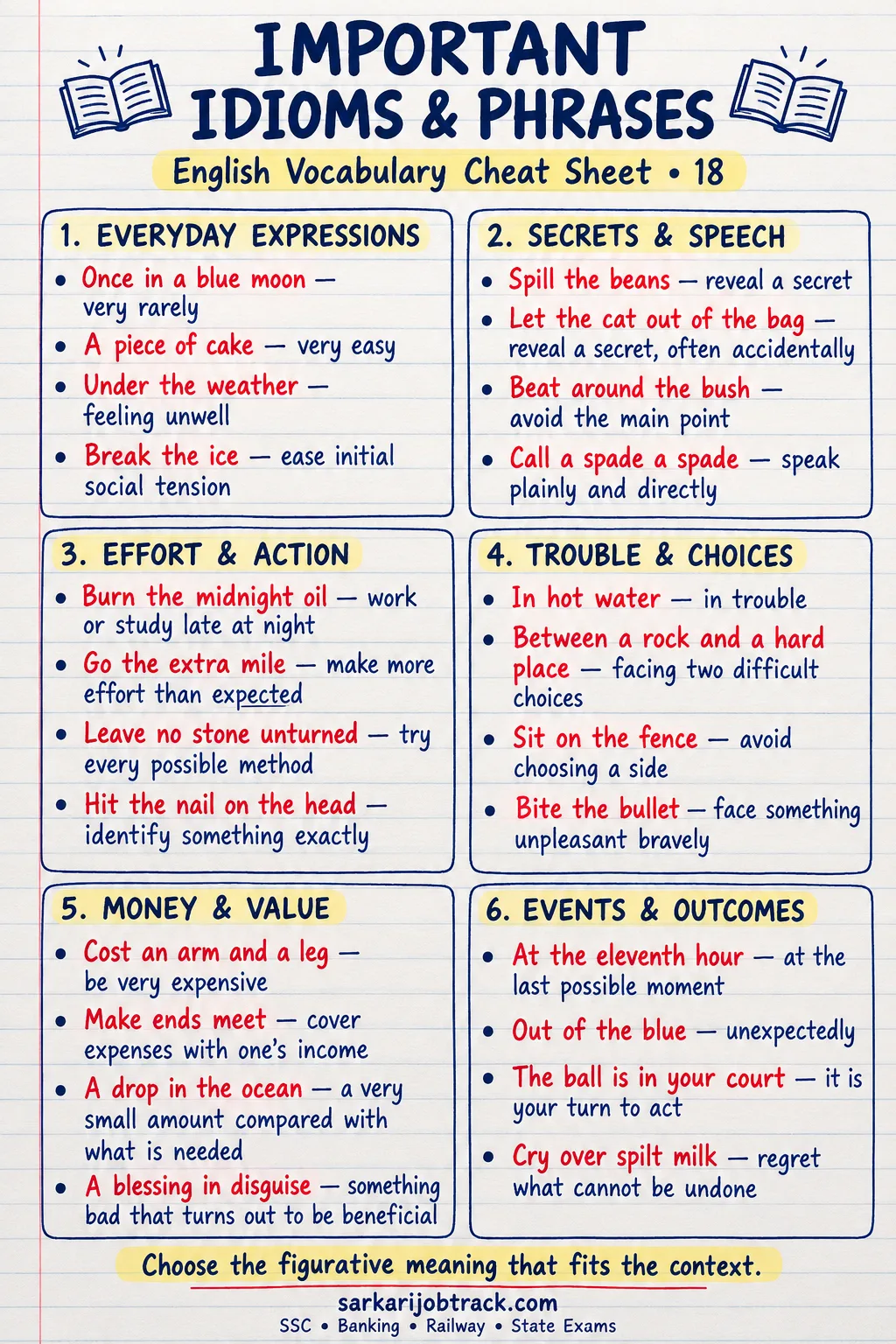
By the end of this lesson you will know how idiom questions work — that the meaning is figurative, never literal — and have a method for the ones you have not seen, so that you can answer "The meaning of to spill the beans" without being fooled by the literal words. For a bank to revise from, use the companion Idioms and Phrases revision list.
Already confident? Skip to practice: Idioms and Phrases quiz
Before this: idioms are pure recall — there is no rule to derive them — so the companion word list is where you build the stock; this lesson is how to handle them in the exam.
What an idiom is
An idiom is a group of words whose meaning cannot be worked out from the individual words. To spill the beans has nothing to do with beans — it means to reveal a secret. The exam gives an idiom and four meanings, and asks for the correct one.
He let the cat out of the bag. — (a) bought a cat (b) revealed a secret (c) made a mistake (d) ran away The idiom means (b) revealed a secret; the literal reading (a) is the trap.
Method 1: never read it literally
The wrong option is almost always the literal meaning of the words. For a piece of cake, the trap is "a dessert"; the idiom means very easy. Reject the literal option first.
Method 2: use the sentence's context
If the idiom is new, the sentence around it often points to the sense.
- "The exam was a piece of cake, so she finished early." — "finished early" signals it was easy.
- "He was under the weather and stayed home." — "stayed home" signals he was unwell.
A bank of common idioms
| Idiom | Meaning |
|---|---|
| Spill the beans | reveal a secret |
| Once in a blue moon | very rarely |
| A piece of cake | very easy |
| Bite the bullet | face a hard situation bravely |
| Hit the nail on the head | be exactly right |
| Under the weather | unwell |
| Cost an arm and a leg | be very expensive |
| Break the ice | start a conversation |
| Burn the midnight oil | work late into the night |
| Let the cat out of the bag | reveal a secret |
Worked example. She solved it once in a blue moon. The idiom once in a blue moon means very rarely — not "at night" and not "in bad weather".
Common mistakes to avoid
- Picking the literal meaning — it is always offered and always wrong for an idiom.
- Confusing similar idioms — break the ice (start a conversation) is not on thin ice (in a risky position); learn each as its own unit.
- Over-reading context — context narrows the choice, but the fixed meaning decides it; do not invent a sense the idiom does not have.
Quick revision table
| Step | What you do |
|---|---|
| 1 | Reject the literal meaning of the words |
| 2 | Use the surrounding sentence as a clue to the sense |
| 3 | Match to the idiom's fixed meaning from memory |
| 4 | Watch for look-alike idioms with different meanings |
Revise idioms from the Idioms and Phrases revision list, then practise idiom questions or build related vocabulary with the Synonyms and Antonyms lesson.
How this was made: Drafted with AI assistance; every fact checked against the source it cites.