
Synonyms and Antonyms: A Lesson on Choosing the Exact Word
Learn how to answer synonym and antonym questions by method rather than by guesswork — fixing a word's exact sense, using roots, prefixes and suffixes to decode an unfamiliar word, learning words in opposite pairs, and eliminating the near-miss options the exam plants. Worked through the exam's choose-the-closest style, with the mistakes to avoid.
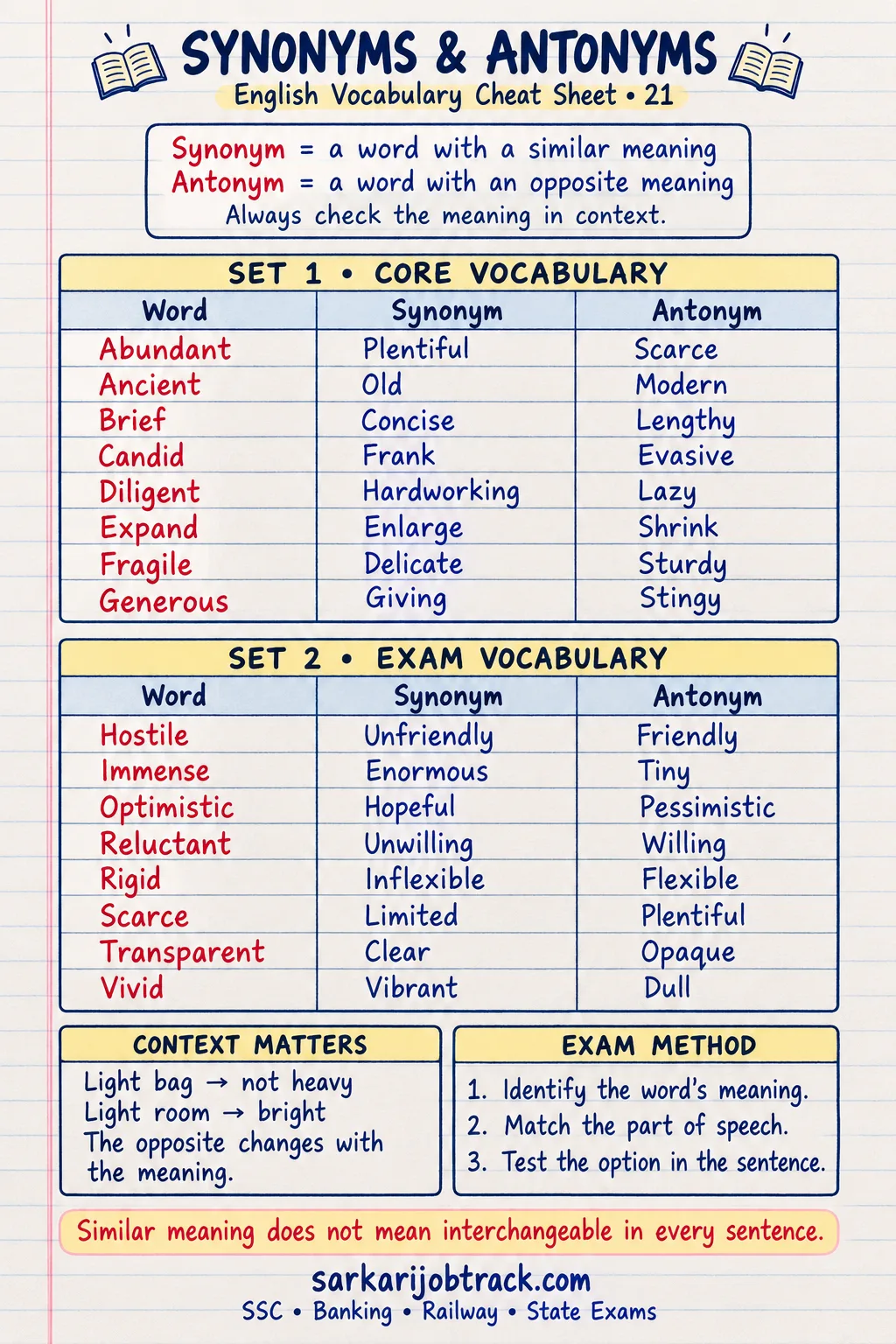
By the end of this lesson you will have a method for synonym and antonym questions — pin the word's exact sense, use its roots and prefixes when it is unfamiliar, and eliminate the close-but-wrong option — so that you can answer "Synonym of BENEVOLENT" or "Antonym of ABUNDANT" with a reason rather than a hunch. For a word bank to revise from, use the companion Synonyms and Antonyms revision list.
Already confident? Skip to practice: Synonyms and Antonyms quiz
Before this: these questions test single words, so no grammar is needed — only a way to work out a word's meaning. The companion word list is the place to build the vocabulary; this lesson is the method.
What the question asks
A synonym is the word closest in meaning to the given word; an antonym is its opposite. The options are usually all plausible, so the task is to choose the closest (or the truest opposite), not merely a related word.
Synonym of CANDID: (a) hidden (b) frank (c) clever (d) rude Candid means open and honest, so the synonym is (b) frank.
Method 1: fix the exact sense
Say the word in a short sentence you are sure of, then match that sense to an option.
- CANDID → "a candid opinion" (honest, straight) → frank.
- Reject options that are merely associated ("clever", "rude") rather than equal in meaning.
Method 2: use roots, prefixes and suffixes
When the word is unfamiliar, break it apart — the parts often reveal the meaning.
| Part | Meaning | Example |
|---|---|---|
| bene- | good, well | benevolent = well-meaning (kind) |
| mal- | bad, ill | malevolent = ill-meaning (cruel) |
| a-/an- | without | atheist = without belief in God |
| anti- | against | antipathy = feeling against (dislike) |
| -phobia | fear of | hydrophobia = fear of water |
| mis- | wrong | misjudge = judge wrongly |
So even if BENEVOLENT is new, bene- ("good") tells you the synonym is kind and the antonym is cruel (or malevolent).
Method 3: learn words in opposite pairs
A word is fixed in memory fastest with its opposite beside it, and the pair answers both a synonym and an antonym question.
| Word | Synonym | Antonym |
|---|---|---|
| Abundant | plentiful | scarce |
| Augment | increase | diminish |
| Benevolent | kind | cruel |
| Candid | frank | evasive |
| Transient | fleeting | permanent |
| Frugal | thrifty | wasteful |
Worked example. Antonym of ABUNDANT: the pair above gives the opposite of plentiful as scarce.
Common mistakes to avoid
- Choosing an associated word, not an equal one — for CANDID, "rude" is associated with blunt honesty but is not its meaning; "frank" is.
- Confusing the prefix direction — bene- is good and mal- is bad; mixing them flips the answer (benevolent is kind, not cruel).
- Answering the wrong question — read carefully whether a synonym or an antonym is asked; the options usually include both.
- Ignoring connotation — two words can share a sense but differ in tone (positive vs negative); pick the one matching the given word's tone.
Quick revision table
| Step | What you do |
|---|---|
| 1 | Put the word in a sure sentence to fix its exact sense |
| 2 | If unfamiliar, split off a root or prefix (bene-, mal-, a-, anti-) |
| 3 | Recall the word with its opposite pair |
| 4 | Eliminate associated-but-not-equal options; match the tone |
Revise words from the Synonyms and Antonyms revision list, then practise synonym and antonym questions. The same word-sense skill helps with the Error Spotting lesson.
How this was made: Drafted with AI assistance; every fact checked against the source it cites.