
One-Word Substitution: A Lesson on the Single Precise Word
Learn how to answer one-word-substitution questions — read the definition for its key idea, use word endings like -cide, -phobia, -logy and -vore to decode an unfamiliar option, and revise the recurring words by category. Worked through the exam's definition-to-word style, with a bank of common substitutions and the mistakes to avoid.
By the end of this lesson you will be able to turn a definition into its single precise word — using the word's ending to decode even an unfamiliar option — so that you can answer "One who studies birds" or "Government by the people" at once. For a bank to revise from, use the companion One-Word Substitution revision list.
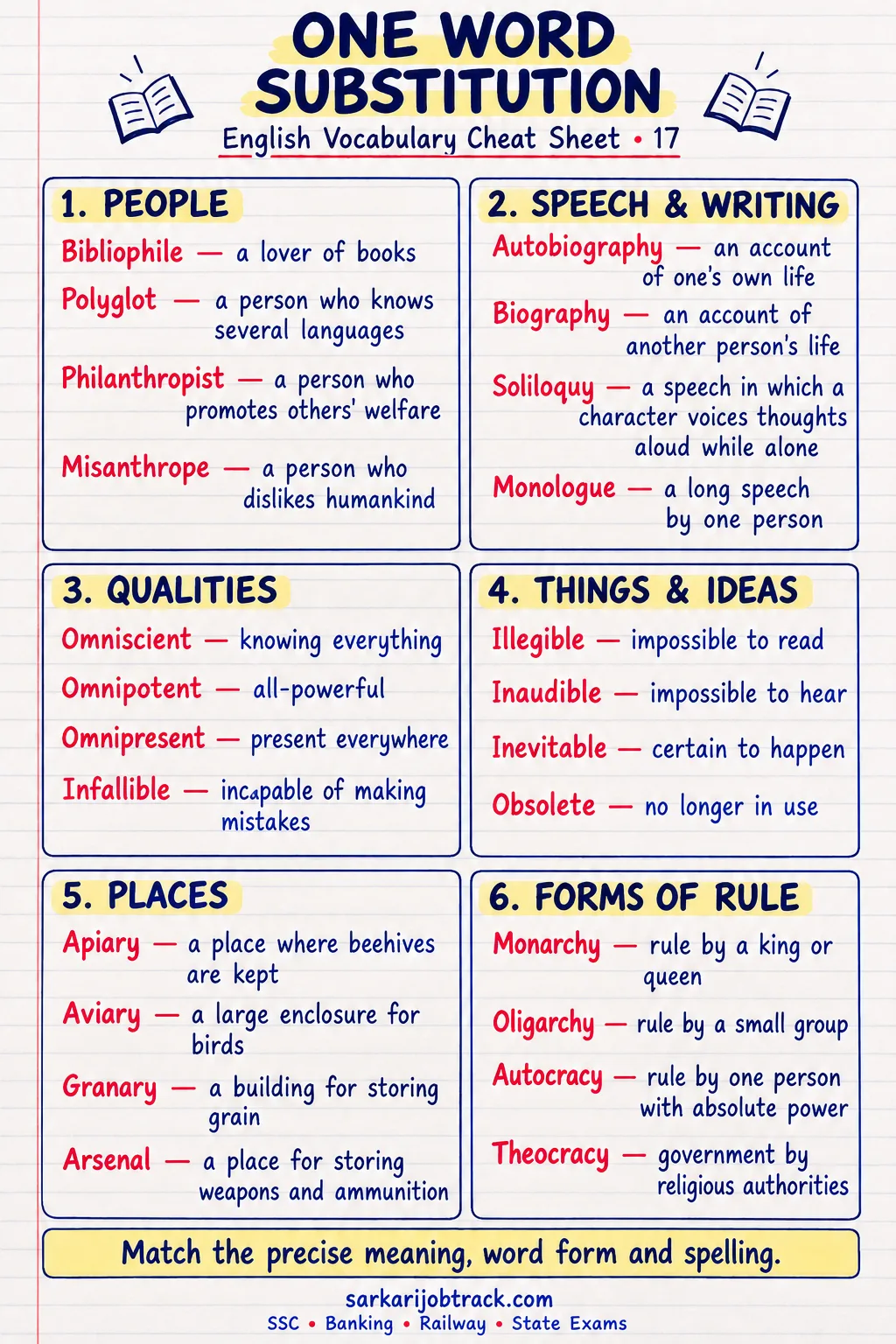
Already confident? Skip to practice: One-Word Substitution quiz
Before this: this is recognition-based recall, so no grammar is needed; the companion word list builds the stock and this lesson is the method.
What the question asks
You are given a phrase or definition and must choose the single word that means the same thing.
"A person who does not believe in the existence of God" — (a) atheist (b) agnostic (c) pagan (d) cynic The exact match is (a) atheist. ("Agnostic" is one who is unsure, a common trap.)
Method 1: find the key idea
Reduce the definition to its core — who or what, and the one distinguishing feature — then match.
- "One who studies birds" → the study ending is -logy/-ologist; birds give ornithologist.
- "Government by the people" → democracy.
Method 2: decode by the ending
Many answers are built from fixed endings; knowing them cracks an unfamiliar option.
| Ending | Meaning | Example |
|---|---|---|
| -cide | killing of | regicide = killing of a king |
| -phobia | fear of | hydrophobia = fear of water |
| -logy / -ologist | study of / one who studies | entomology = study of insects |
| -vore | one who eats | omnivore = one who eats everything |
| -phile | lover of | bibliophile = lover of books |
| -cracy | rule / government | democracy = rule by the people |
A bank of common substitutions
| Definition | Word |
|---|---|
| One who studies birds | ornithologist |
| One who does not believe in God | atheist |
| Fear of water | hydrophobia |
| One who eats everything | omnivore |
| A speech made without preparation | extempore |
| One who can speak many languages | polyglot |
| A place where birds are kept | aviary |
| One who loves books | bibliophile |
Worked example. "One who can speak many languages" — poly- (many) + -glot (tongue) gives polyglot.
Common mistakes to avoid
- Choosing a near-match — for "does not believe in God", agnostic (unsure) is the trap; atheist (denies) is exact.
- Ignoring the ending — -cide always means killing, -phobia always fear; the ending usually settles two close options.
- Overshooting the definition — pick the word that means exactly the phrase, not one that means more or less.
Quick revision table
| Step | What you do |
|---|---|
| 1 | Reduce the definition to its key idea (who/what + one feature) |
| 2 | Use the ending (-cide, -phobia, -logy, -vore, -phile, -cracy) to decode options |
| 3 | Match the word that means exactly the phrase |
| 4 | Reject the near-match trap (atheist vs agnostic) |
Revise words from the One-Word Substitution revision list, then practise these questions or build related vocabulary with the Synonyms and Antonyms lesson.
How this was made: Drafted with AI assistance; every fact checked against the source it cites.