
Mensuration: Area, Perimeter, Surface Area and Volume
Learn the perimeter and area of the rectangle, square, triangle, parallelogram, rhombus, trapezium and circle, how to work backwards from a perimeter, diagonal or area, the surface area and volume of the cube, cuboid, cylinder, cone, sphere and hemisphere, and how to answer a cutting-up or cost word problem, through six worked examples and a revision block.
By the end of this lesson you will be able to find the perimeter and area of the rectangle, square, triangle, parallelogram, rhombus, trapezium and circle, work backwards from a given perimeter, diagonal or area to a missing length, find the surface area and volume of the cube, cuboid, cylinder, cone, sphere and hemisphere, keep the slant height of a cone apart from its vertical height, and answer a cutting-up or cost word problem.
Already confident? Skip to practice: Mensuration quiz
Before this: you should be comfortable multiplying and squaring whole numbers and working with a fraction like 22/7 (so that 22/7 × 49 = 22 × 7 = 154). If fractions and decimals feel shaky, read the Fractions, Decimals and Percentages lesson first.
The four words, and the units that go with them
Every question in this topic measures one of four things. Keep them apart, because each has its own kind of unit.
- Perimeter is the distance all the way around a flat shape — the length of the fence around a field. It is a length, so it is measured in cm (or m, or km).
- Area is the amount of flat space inside the shape — the paint needed to cover it. It is measured in square cm (written sq cm), because it counts little 1 cm × 1 cm squares.
- Surface area is the area of the whole outside skin of a solid — the paper needed to wrap it. It too is measured in sq cm.
- Volume is the amount of space a solid fills — the water a tank holds. It is measured in cubic cm (cu cm), because it counts little 1 cm × 1 cm × 1 cm cubes.
Two habits save most of the marks:
- Put every length in the same unit first. You cannot mix cm and m in one formula. Change them to one unit, then compute.
- Carry the right unit to the end. A length comes out in cm, an area in sq cm, a volume in cubic cm. If you are asked for an area and your unit is cm, something is wrong.
Whenever a shape has a circle in it — a circle, a cylinder, a cone, a sphere — we need the number π ("pi"), which links a circle's distance around to its width. In these exams π is taken as 22/7 (and this lesson uses 22/7 throughout, as the stems do). Radii like 7, 14, 21 and 28 are chosen so the 7 on the bottom cancels and the arithmetic stays whole.
Worked examples
Read each example slowly. The first two show every step. In the later ones, some steps are left for you, with the answer just below.
Example 1: Rectangle and square, forwards and backwards
The flat facts. A rectangle of length and breadth has area = l × b and perimeter = 2 × (l + b). A square is a rectangle with all sides equal, so a square of side has area = a × a and perimeter = 4 × a.
Question: (a) A rectangle is 28 cm long and 15 cm wide. Find its area and its perimeter. (b) The perimeter of a square is 44 cm. Find its area. (c) The diagonal of a square is 10 cm. Find its area.
Part (a): straight from the formulas
- Area = length × breadth = 28 × 15 = 420 sq cm.
- Perimeter = 2 × (length + breadth) = 2 × (28 + 15) = 2 × 43 = 86 cm.
Part (b): work back from the perimeter
- The perimeter of a square is 4 × side, so the side = perimeter ÷ 4 = 44 ÷ 4 = 11 cm.
- The area is the side squared: 11 × 11 = 121 sq cm.
Part (c): the diagonal of a square
- A diagonal cuts the square into two right-angled triangles, and the diagonal is related to the area by a short rule: area of a square = half the square of the diagonal, that is .
- So the area = = 100 ÷ 2 = 50 sq cm. (This saves finding the side, which here is not a whole number.)
Your turn: a rectangle is twice as long as it is wide, and its perimeter is 78 cm. Find its area. (Hint: write the breadth as and the length as , so the perimeter is .)
Check: the perimeter is 6b = 78, so b = 13 cm and the length is 2 × 13 = 26 cm. The area is 26 × 13 = 338 sq cm.
The principle: for a rectangle, area = l × b and perimeter = 2(l + b); for a square, area = a² and perimeter = 4a, and from the diagonal the area is d² ÷ 2. When a length is not given, read it back from the perimeter, the diagonal or a relation between the sides first, then find the area.
Example 2: Triangle, parallelogram, rhombus and trapezium
Four flat shapes share one idea: their area is built from a base and the straight-line height across to it (never the slanting side).
| Shape | Area |
|---|---|
| Triangle | ½ × base × height |
| Parallelogram | base × height |
| Rhombus | ½ × (one diagonal) × (the other diagonal) |
| Trapezium | ½ × (sum of the two parallel sides) × (distance between them) |
Question: (a) A triangle has base 20 cm and height 7 cm. Find its area. (b) A parallelogram has base 15 cm and height 6 cm. Find its area. (c) The two diagonals of a rhombus are 16 cm and 10 cm. Find its area.
Part (a): the triangle
- Area = ½ × base × height = ½ × 20 × 7.
- Take half of 20 first: ½ × 20 = 10, then 10 × 7 = 70 sq cm.
Part (b): the parallelogram
- A parallelogram has no "half": area = base × height = 15 × 6 = 90 sq cm.
- Notice it is exactly twice the triangle on the same base and height — two equal triangles make one parallelogram.
Part (c): the rhombus from its diagonals
- A rhombus is a slanted square; its area is half the product of its two diagonals: ½ × 16 × 10.
- Half of 16 is 8, and 8 × 10 = 80 sq cm.
Your turn: a trapezium has parallel sides of 16 cm and 9 cm, and the distance between them is 8 cm. Find its area.
Check: area = ½ × (sum of the parallel sides) × (distance) = ½ × (16 + 9) × 8 = ½ × 25 × 8 = 25 × 4 = 100 sq cm.
The principle: these areas all use the straight height, not a slanting edge. Triangle is ½ × base × height, parallelogram is base × height, rhombus is ½ × (product of the diagonals), and trapezium is ½ × (sum of the parallel sides) × height.
Example 3: The circle, and working back from its area (π = 22/7)
A circle of radius (the distance from the centre to the edge) has area = π × r × r and circumference (the distance around) = 2 × π × r. The diameter, straight across through the centre, is twice the radius.
Question: (a) Find the area of a circle of radius 28 cm. (b) Find its circumference. (c) The area of a circle is 1,386 sq cm. Find its radius. (d) Find the perimeter of a semicircle (a half circle) of radius 35 cm, counting the curved edge and the straight diameter together.
Part (a): the area
- Area = π × r × r = 22/7 × 28 × 28.
- Cancel the 7 into a 28: 28 ÷ 7 = 4, so this is 22 × 4 × 28 = 88 × 28 = 2,464 sq cm.
Part (b): the circumference
- Circumference = 2 × π × r = 2 × 22/7 × 28.
- Again 28 ÷ 7 = 4, so this is 2 × 22 × 4 = 176 cm.
Part (c): work back from the area
- Area = π × r × r, so r × r = area ÷ π = 1,386 ÷ (22/7) = 1,386 × 7 ÷ 22.
- 1,386 ÷ 22 = 63, and 63 × 7 = 441. So r × r = 441.
- The radius is the number that times itself is 441: since 21 × 21 = 441, the radius is 21 cm.
Part (d): the perimeter of a semicircle
- A semicircle's edge is made of two parts: the curved half, which is half the circumference, π × r; and the straight diameter across the flat side, which is 2 × r. Add them.
- Curved half = π × r = 22/7 × 35 = 22 × 5 = 110 cm (since 35 ÷ 7 = 5). Diameter = 2 × 35 = 70 cm.
- Perimeter = 110 + 70 = 180 cm. (Do not forget the straight side — the curve alone is not the full way around.)
Your turn: a circular ground has a radius of 63 m. Find the length of fencing needed to go once around it (its circumference), taking π as 22/7.
Check: circumference = 2 × π × r = 2 × 22/7 × 63 = 2 × 22 × 9 = 396 m (since 63 ÷ 7 = 9).
The principle: for a circle, area = π r² and circumference = 2 π r, with π = 22/7. To find the radius from the area, divide by π and take the number that times itself gives the result. A semicircle's perimeter is the curved half (π r) plus the diameter (2 r), not just the curve.
Example 4: Cube and cuboid — surface area and volume
A cuboid (a box) of length , breadth and height has volume = l × b × h and total surface area = 2 × (lb + bh + hl) — the six rectangular faces in three matching pairs. A cube is a cuboid with all edges equal to , so its volume = a × a × a () and its total surface area = 6 × a × a (), the six equal square faces.
Question: (a) Find the total surface area and the volume of a cube of edge 7 cm. (b) Find the volume and the total surface area of a cuboid 10 cm by 6 cm by 5 cm. (c) The volume of a cube is 729 cubic cm. Find its edge.
Part (a): the cube
- Total surface area = 6 × a × a = 6 × 7 × 7 = 6 × 49 = 294 sq cm.
- Volume = a × a × a = 7 × 7 × 7 = 343 cubic cm. (Note the units: the surface area is in sq cm, the volume in cubic cm.)
Part (b): the cuboid
- Volume = l × b × h = 10 × 6 × 5 = 300 cubic cm.
- Total surface area = 2 × (lb + bh + hl) = 2 × (10×6 + 6×5 + 5×10) = 2 × (60 + 30 + 50) = 2 × 140 = 280 sq cm.
Part (c): work back from the volume
- For a cube, volume = edge × edge × edge, so the edge is the number that, multiplied by itself three times, gives 729.
- Try a few: 8 × 8 × 8 = 512, and 9 × 9 × 9 = 729. So the edge is 9 cm.
Your turn: the volume of a cube is 512 cubic cm. Find its edge, and then its total surface area.
Check: the edge is the number whose cube is 512, and 8 × 8 × 8 = 512, so the edge is 8 cm. The total surface area is 6 × 8 × 8 = 384 sq cm.
The principle: a cuboid has volume l × b × h and surface area 2(lb + bh + hl); a cube has volume a³ and surface area 6a². To go back from a cube's volume to its edge, find the number whose cube is that volume. Keep lengths in cm, areas in sq cm, volumes in cubic cm.
Example 5: Cylinder and cone, and slant versus vertical height (π = 22/7)
A cylinder (a tin) of radius and height has volume = π × r × r × h and curved surface area = 2 × π × r × h (the label wrapped around it). A cone (an ice-cream cone) of radius has two different "heights": the slant height , measured along the sloping side, and the vertical height , straight up the middle. Its curved surface area = π × r × l uses the slant height, while its volume = ⅓ × π × r × r × h uses the vertical height. The two are linked by .
Question: (a) Find the volume and the curved surface area of a cylinder of radius 14 cm and height 6 cm. (b) Find the curved surface area and the total surface area of a cone of radius 21 cm and slant height 10 cm. (c) Find the volume of a cone of radius 7 cm and vertical height 6 cm.
Part (a): the cylinder
- Volume = π × r × r × h = 22/7 × 14 × 14 × 6. Cancel 14 ÷ 7 = 2, so this is 22 × 2 × 14 × 6 = 22 × 168 = 3,696 cubic cm.
- Curved surface area = 2 × π × r × h = 2 × 22/7 × 14 × 6 = 2 × 22 × 2 × 6 = 528 sq cm.
Part (b): the cone, with the slant height
- The curved surface area uses the slant height: π × r × l = 22/7 × 21 × 10. Cancel 21 ÷ 7 = 3, so this is 22 × 3 × 10 = 660 sq cm.
- The total surface area adds the flat circular base (π × r × r): total = π × r × (l + r) = 22/7 × 21 × (10 + 21) = 22 × 3 × 31 = 2,046 sq cm.
Part (c): the cone's volume, with the vertical height
- The volume uses the vertical height, not the slant: ⅓ × π × r × r × h = ⅓ × 22/7 × 7 × 7 × 6.
- Cancel 7 ÷ 7 = 1: this is ⅓ × 22 × 7 × 6 = ⅓ × 924 = 308 cubic cm.
Your turn: find the curved surface area of a cone of radius 14 cm and slant height 10 cm, taking π as 22/7.
Check: curved surface area = π × r × l = 22/7 × 14 × 10 = 22 × 2 × 10 = 440 sq cm (since 14 ÷ 7 = 2).
The principle: a cylinder has volume π r² h and curved surface area 2 π r h. A cone's curved surface area is π r l (slant height), and its volume is ⅓ π r² h (vertical height); when only one height is given, the other comes from . Read the stem carefully to see which height it gives.
Example 6: Sphere, hemisphere, and an everyday word problem
A sphere (a ball) of radius has surface area = 4 × π × r × r and volume = 4/3 × π × r × r × r. Cut it in half and you get a hemisphere (a bowl). Its curved part is half the sphere's skin, 2 × π × r × r, and it also has a flat circular face, π × r × r, so its total surface area = 3 × π × r × r.
Question: (a) Find the surface area and the volume of a sphere of radius 21 cm. (b) Find the total surface area of a hemisphere of radius 14 cm. (c) A solid cube of edge 12 cm is cut into small cubes of edge 3 cm. How many small cubes are formed?
Part (a): the sphere
- Surface area = 4 × π × r × r = 4 × 22/7 × 21 × 21. Cancel 21 ÷ 7 = 3, so this is 4 × 22 × 3 × 21 = 4 × 1,386 = 5,544 sq cm.
- Volume = 4/3 × π × r × r × r = 4/3 × 22/7 × 21 × 21 × 21 = 4/3 × 22 × 3 × 441 = 4 × 22 × 441 = 38,808 cubic cm.
Part (b): the hemisphere
- A hemisphere's total surface area is the curved half plus the flat face, which is 3 × π × r × r.
- So total = 3 × 22/7 × 14 × 14 = 3 × 22 × 2 × 14 = 1,848 sq cm (cancelling 14 ÷ 7 = 2).
Part (c): how many small cubes
- Cutting does not change the total material, so the number of small cubes is the big volume divided by the small volume. Big cube: 12 × 12 × 12 = 1,728 cubic cm; small cube: 3 × 3 × 3 = 27 cubic cm; 1,728 ÷ 27 = 64.
- A quicker way: along each edge, 12 ÷ 3 = 4 small cubes fit, so there are 4 × 4 × 4 = 64 small cubes. The two ways agree.
Your turn: the floor of a rectangular hall is 20 m long and 15 m wide. Find the cost of tiling it at ₹50 per square metre.
Check: the area of the floor is 20 × 15 = 300 sq m. At ₹50 for each square metre, the cost is 300 × 50 = ₹15,000. (A "cost" question is an area or surface-area question with a price stuck on the end: find the area first, then multiply by the rate.)
The principle: a sphere has surface area 4 π r² and volume 4/3 π r³; a hemisphere's total surface area is 3 π r² (curved 2 π r² plus the flat face π r²). For a cutting-up problem, divide the whole volume by the small volume; for a cost problem, find the area or surface area first, then multiply by the rate.
Common mistakes
- Mixing up perimeter, area, surface area and volume. They answer different questions and carry different units: a length in cm, an area or surface area in sq cm, a volume in cubic cm. If the unit at the end does not match what was asked, re-read the question.
- Using a slanting side as the height. For a triangle, parallelogram, rhombus or trapezium the area uses the straight-line height across to the base, never the sloping edge.
- Confusing a cone's slant height with its vertical height. Curved surface area uses the slant height (π r l); volume uses the vertical height (⅓ π r² h). The slant height is the hypotenuse of the right-angled triangle made by the radius and the vertical height, so : it is always the longest of the three, longer than both the radius and the vertical height for any real cone. Never put the vertical height in place of the slant height.
- Forgetting part of a surface. A hemisphere has a flat face as well as a curved one, so its total surface is 3 π r², not 2 π r². A semicircle's perimeter includes the straight diameter, not just the curve.
- Mixing units in one formula. Change every length to the same unit before you compute. 1 m 20 cm is 120 cm, not 1.20 anything-you-like in the middle of a sum.
- Squaring or cubing the wrong thing. For a cube's surface area it is 6 × (edge × edge); for its volume, edge × edge × edge. Write the formula down first, then put the numbers in.
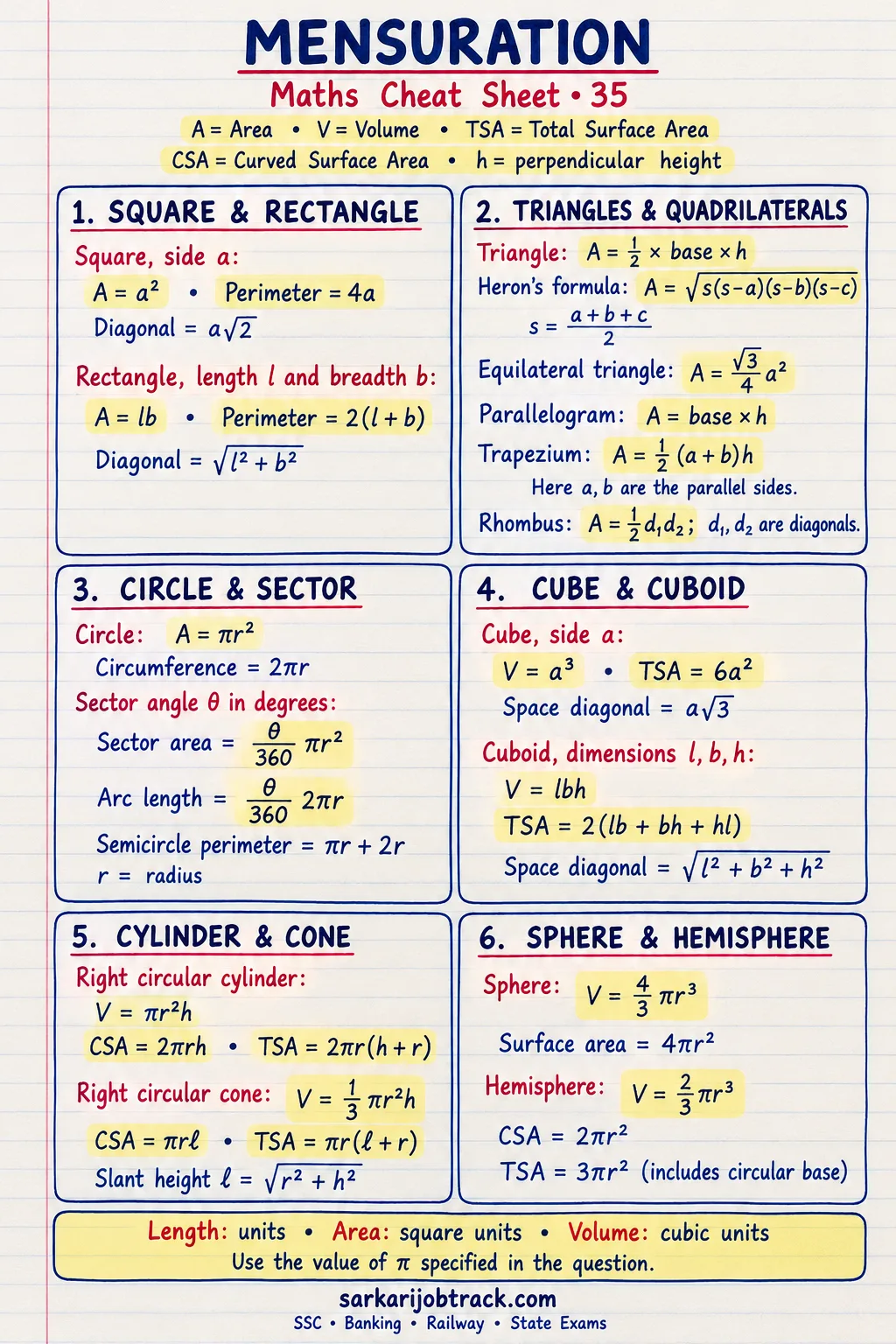
Mensuration: the formulas in one place
Here , , , are lengths, is a radius, a diagonal, (for a cone) the slant height, and π = 22/7.
| Shape | Formula | Worked numbers |
|---|---|---|
| Rectangle | area = l × b; perimeter = 2(l + b) | 28 × 15: area 420, perimeter 86 |
| Square | area = a²; perimeter = 4a; area = d² ÷ 2 | perimeter 44 → side 11 → area 121; diagonal 10 → 50 |
| Triangle | area = ½ × base × height | base 20, height 7: 70 |
| Equilateral triangle | area = | side 6: sq cm |
| Parallelogram | area = base × height | base 15, height 6: 90 |
| Rhombus | area = ½ × diagonal × diagonal | diagonals 16 and 10: 80 |
| Trapezium | area = ½ × (sum of parallel sides) × height | sides 16 and 9, height 8: 100 |
| Circle | area = π r²; circumference = 2 π r | radius 28: area 2,464, circumference 176 |
| Semicircle | perimeter = π r + 2 r | radius 35: 110 + 70 = 180 |
| Cuboid | volume = l b h; surface = 2(lb + bh + hl) | 10×6×5: volume 300, surface 280 |
| Cube | volume = a³; surface = 6 a² | edge 7: volume 343, surface 294 |
| Cylinder | volume = π r² h; curved surface = 2 π r h | r 14, h 6: volume 3,696, curved 528 |
| Cone | curved surface = π r l; volume = ⅓ π r² h; l² = r² + h² | r 21, slant 10: curved 660 |
| Sphere | surface = 4 π r²; volume = 4/3 π r³ | radius 21: surface 5,544, volume 38,808 |
| Hemisphere | total surface = 3 π r² (curved 2 π r² + flat π r²) | radius 14: 1,848 |
Next
The natural next topic is Trigonometry, which measures the same triangles by their angles rather than their areas, and uses the right-angled triangle you met in the cone and the square's diagonal: when you are ready, try the Trigonometry quiz. Mensuration also joins hands with Data Interpretation, where areas and volumes turn up inside word problems, and that topic will get its own quiz once the bank has questions for it. For now, make the formulas above second nature.
Ready to test this lesson? Take the Mensuration quiz
How this was made: Drafted with AI assistance; every formula and worked figure recomputed independently; spot-checked by the editor on 27 October 2026.