
Trigonometry: A Lesson on Ratios, the Standard Table and Identities
Learn the six trigonometric ratios, the standard-angle table for 0, 30, 45, 60 and 90 degrees, the three Pythagorean identities, the complementary-angle rule, and how to use the tangent ratio in height-and-distance questions. Worked step by step with the values the exam expects on sight and the mistakes to avoid.
By the end of this lesson you will know the six ratios, recall the standard-angle table without hesitation, use the three Pythagorean identities, apply the complementary-angle rule, and set up a height-and-distance problem with the tangent ratio, so that you can evaluate "sin 30° + cos 60°" or find a tower's height from its angle of elevation at once.
Already confident? Skip to practice: Trigonometry quiz
Before this: trigonometry is the study of the angles and sides of a right triangle, so you should know the Pythagoras theorem first. If that feels shaky, read the Geometry lesson before this one.
The six ratios
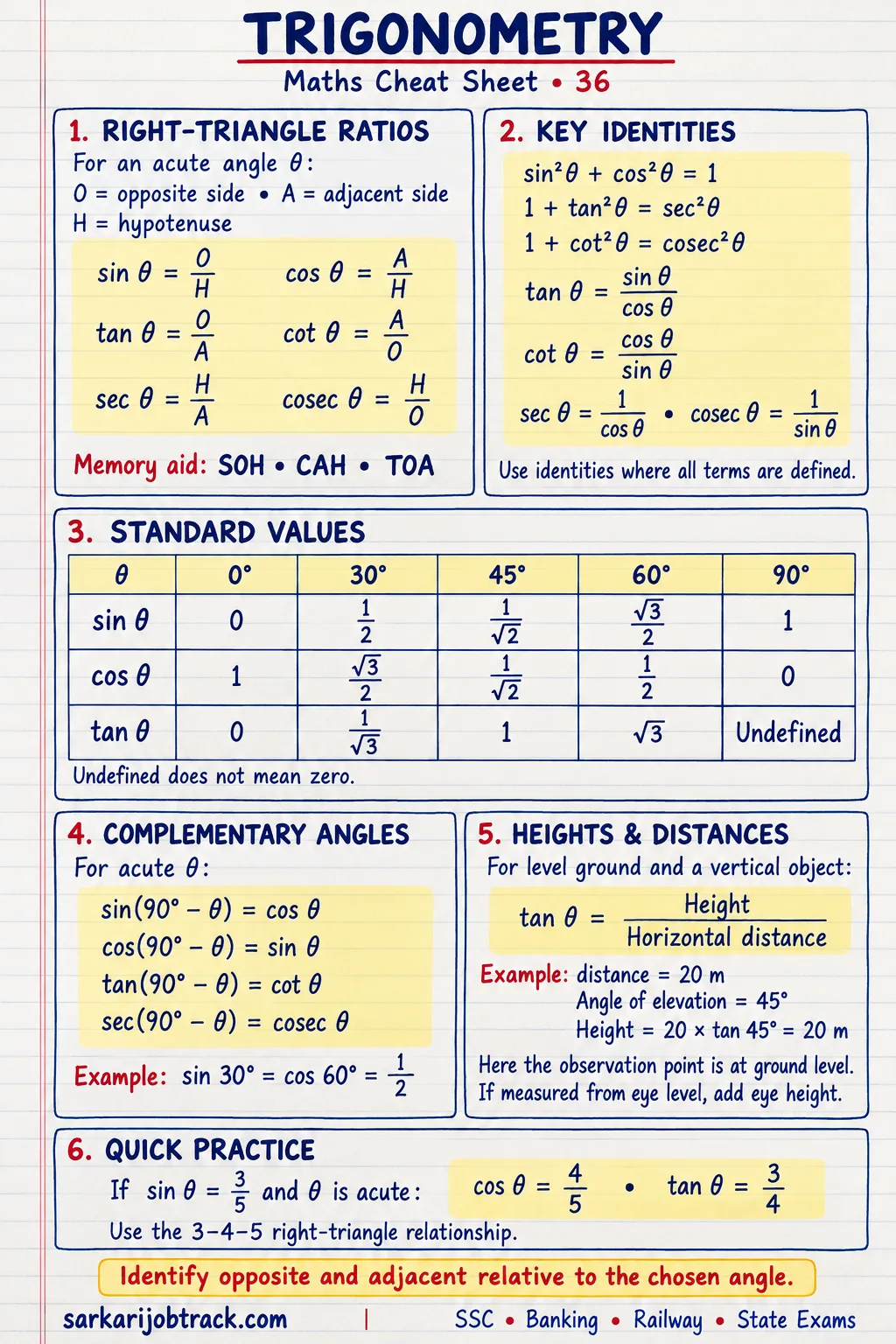
In a right-angled triangle, for an angle θ (not the right angle), label the sides: opposite (facing θ), adjacent (beside θ), and hypotenuse (the longest, facing the right angle). The three main ratios are:
- sin θ = opposite / hypotenuse
- cos θ = adjacent / hypotenuse
- tan θ = opposite / adjacent
The other three are their reciprocals: cosec θ = 1/sin θ, sec θ = 1/cos θ, cot θ = 1/tan θ. Also useful: tan θ = sin θ / cos θ.
The standard-angle table
This table must be instant recall; almost every trigonometry question uses it.
| θ | 0° | 30° | 45° | 60° | 90° |
|---|---|---|---|---|---|
| sin | 0 | 1/2 | 1/√2 | √3/2 | 1 |
| cos | 1 | √3/2 | 1/√2 | 1/2 | 0 |
| tan | 0 | 1/√3 | 1 | √3 | not defined |
Read cos as sin backwards, and tan = sin ÷ cos, so you really only memorise one row.
Worked example. Evaluate sin 30° + cos 60°.
- sin 30° = 1/2, cos 60° = 1/2.
- 1/2 + 1/2 = 1.
Worked example. Evaluate tan 60° ÷ tan 30°.
- tan 60° = √3, tan 30° = 1/√3.
- √3 ÷ (1/√3) = √3 × √3 = 3.
The three identities
These hold for every angle and turn a messy expression into a number.
sin²θ + cos²θ = 1 1 + tan²θ = sec²θ 1 + cot²θ = cosec²θ
Worked example. Show sin²30° + cos²30° = 1.
- sin 30° = 1/2 → sin²30° = 1/4; cos 30° = √3/2 → cos²30° = 3/4.
- 1/4 + 3/4 = 1. ✓ (as the first identity promises for any angle)
Complementary angles
Two angles that add to 90° are complementary, and the ratios swap in pairs:
sin(90° − θ) = cos θ, tan(90° − θ) = cot θ, sec(90° − θ) = cosec θ
Worked example. Find sin 35° ÷ cos 55°.
- 55° = 90° − 35°, so cos 55° = cos(90° − 35°) = sin 35°.
- sin 35° ÷ sin 35° = 1.
This is why questions pair angles like 35° and 55°, or 20° and 70° — the complementary rule collapses them.
Heights and distances
A real-world question gives an angle of elevation (looking up) or depression (looking down) and one distance, and asks for a height. Set it up as a right triangle and use tan = height / base.
Worked example. From a point 20 m from the foot of a tower, the top is seen at an angle of elevation of 45°. Find the height.
- tan 45° = height / 20, and tan 45° = 1.
- height = 20 × 1 = 20 m.
Worked example. From the same 20 m, the angle of elevation is 60° instead. Find the height.
- height = 20 × tan 60° = 20√3 ≈ 34.64 m.
Common mistakes to avoid
- Swapping sin and cos at 30° and 60° — sin 30° = 1/2 and sin 60° = √3/2 (not the reverse). Check against the table.
- Reading tan 90° as a number — it is not defined (cos 90° = 0, so you would divide by zero).
- Mixing opposite and adjacent — "opposite" faces the angle; "adjacent" is beside it. tan uses opposite over adjacent.
- Using the wrong ratio for heights — with the base distance and the height, the ratio is tan (opposite over adjacent), not sin.
Quick revision table
| Item | Value / rule |
|---|---|
| sin, cos, tan | opp/hyp, adj/hyp, opp/adj |
| cosec, sec, cot | 1/sin, 1/cos, 1/tan |
| sin 0/30/45/60/90 | 0, 1/2, 1/√2, √3/2, 1 |
| cos 0/30/45/60/90 | 1, √3/2, 1/√2, 1/2, 0 |
| tan 0/30/45/60/90 | 0, 1/√3, 1, √3, not defined |
| Identities | sin²+cos²=1; 1+tan²=sec²; 1+cot²=cosec² |
| Complementary | sin(90−θ)=cos θ, tan(90−θ)=cot θ |
| Heights | tan(angle) = height / base distance |
Keep this and the trigonometry cheat sheet for revision. The identities are algebraic manipulation at heart, so revise Algebra alongside, and Geometry for the right triangles trigonometry rests on.
How this was made: Drafted with AI assistance; every formula and worked figure recomputed independently.