
Geometry: A Lesson on Triangles, Circles and Their Angle Rules
Learn the geometry the exam actually tests — the angle rules of a triangle, the Pythagoras theorem and its common triples, similar triangles and the basic proportionality theorem, the centroid's two-to-one split, and the circle theorems for angles, semicircles, cyclic quadrilaterals and tangents. Worked step by step with the figures the exam reuses and the mistakes to avoid.
By the end of this lesson you will know the angle rules of triangles and circles that the exam leans on, use the Pythagoras theorem and its common triples on sight, and apply similar triangles and the main circle theorems, so that you can answer "The angle at the centre is 80°; what is the angle at the circumference on the same arc?" in one step.
Already confident? Skip to practice: Geometry quiz
Before this: this lesson is about the angle and length rules of shapes; their areas and volumes are a separate topic. For those, see the Mensuration lesson. You only need basic arithmetic here.
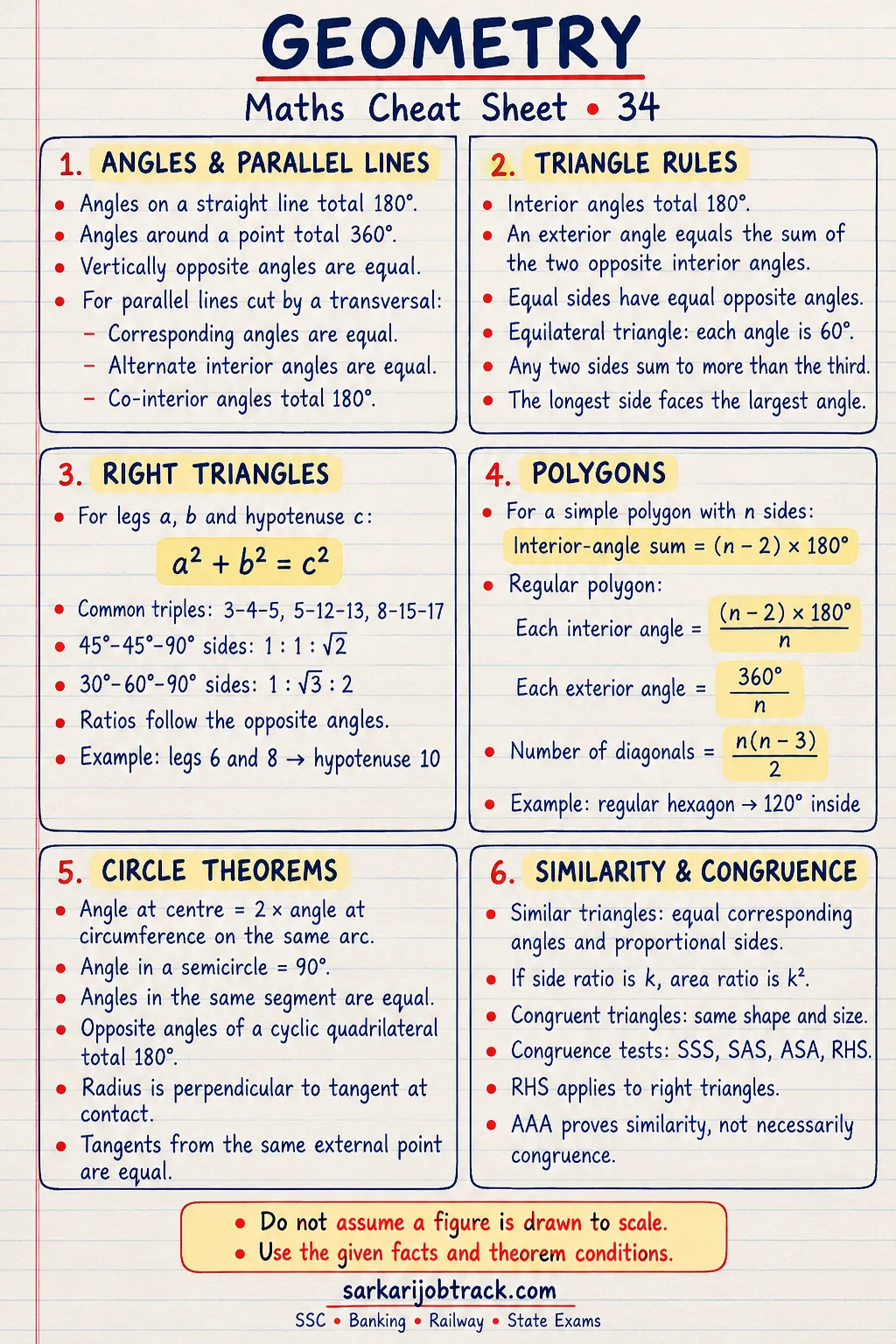
Angles in a triangle
Two rules cover most triangle-angle questions.
- The three angles of a triangle add to 180°.
- An exterior angle equals the sum of the two opposite interior angles. If a triangle has interior angles of 50° and 60°, the exterior angle at the third vertex is 50° + 60° = 110°.
Worked example. Two angles of a triangle are 65° and 75°. Find the third.
- Third angle = 180 − (65 + 75) = 180 − 140 = 40°.
A triangle's longest side is opposite its largest angle, and the sum of any two sides is greater than the third (the triangle inequality) — a quick way to reject an impossible set of sides.
Pythagoras and the common triples
In a right-angled triangle, the square on the hypotenuse equals the sum of the squares on the other two sides:
hypotenuse² = base² + height²
Memorise the triples the exam reuses so you never compute them: 3-4-5, 5-12-13, 8-15-17, 7-24-25, and their multiples (6-8-10, 9-12-15, …).
Worked example. A right triangle has legs 9 and 12. Find the hypotenuse.
- 9-12 is 3 × (3-4), so the triple is 3 × (3-4-5): hypotenuse = 3 × 5 = 15.
- Check: 9² + 12² = 81 + 144 = 225 = 15². ✓
Similar triangles and the basic proportionality theorem
Two triangles are similar when their angles are equal; then their corresponding sides are in the same ratio. This is what lets you find an unknown length from a matching one.
The basic proportionality theorem (Thales): a line drawn parallel to one side of a triangle cuts the other two sides in the same ratio.
Worked example. In a triangle, a line parallel to the base divides one side into 3 cm and 6 cm. On the other side the upper part is 4 cm. Find the lower part.
- The parts are in the same ratio: 3 : 6 = 4 : x, so x = 6 × 4 ÷ 3 = 8 cm.
- Check: 3 : 6 = 1 : 2 and 4 : 8 = 1 : 2. ✓
The centroid and medians
A median joins a vertex to the midpoint of the opposite side; the three medians meet at the centroid, which divides each median in the ratio 2 : 1 from the vertex.
Worked example. A median is 18 cm long. How far is the centroid from the vertex?
- The vertex side is 2 of the 3 parts: 18 × 2/3 = 12 cm (and 6 cm from the midpoint).
Circle theorems
These four are the ones the exam tests most.
- Angle at the centre = twice the angle at the circumference on the same arc.
- Angle in a semicircle = 90° (the angle subtended by a diameter).
- Opposite angles of a cyclic quadrilateral add to 180°.
- A tangent is perpendicular to the radius at the point of contact, and the two tangents drawn from an external point are equal in length.
Worked example. The angle subtended by an arc at the centre is 80°. What is the angle it subtends at the circumference (same arc)?
- Angle at circumference = 80 ÷ 2 = 40°.
Worked example. One angle of a cyclic quadrilateral is 85°. Find its opposite angle.
- Opposite angle = 180 − 85 = 95°.
Common mistakes to avoid
- Halving the wrong way — the angle at the centre is the larger one (twice the circumference angle), not the other way round.
- Assuming similarity gives equal sides — similar triangles have sides in the same ratio, not equal lengths; only congruent triangles have equal sides.
- Splitting the median 1 : 2 from the vertex — it is 2 : 1 from the vertex (the longer part touches the vertex).
- Forgetting the triangle inequality — sides like 2, 3, 6 cannot form a triangle because 2 + 3 < 6.
Quick revision table
| Rule | Statement |
|---|---|
| Triangle angle sum | three angles add to 180° |
| Exterior angle | = sum of the two opposite interior angles |
| Pythagoras | hyp² = base² + height²; triples 3-4-5, 5-12-13, 8-15-17, 7-24-25 |
| Basic proportionality | a line ∥ to a side cuts the other two in the same ratio |
| Centroid | divides each median 2 : 1 from the vertex |
| Angle at centre | = 2 × angle at circumference (same arc) |
| Semicircle | angle in a semicircle = 90° |
| Cyclic quadrilateral | opposite angles add to 180° |
| Tangent | ⟂ radius at contact; two tangents from a point are equal |
Keep this and the geometry cheat sheet for revision. For the areas and volumes of these shapes, go to Mensuration; for the angle ratios of a right triangle, see Trigonometry.
How this was made: Drafted with AI assistance; every formula and worked figure recomputed independently.