
Partnership: A Lesson on Sharing Profit by Capital and Time
Learn how partners share a profit — in the ratio of each person's capital when they invest for the same time, and in the ratio of capital multiplied by time when the periods differ. Covers simple and compound partnership, three partners, and a working partner's salary, worked step by step in the exam's profit-sharing style, with the mistakes to avoid.
By the end of this lesson you will be able to split a profit between partners correctly — using the ratio of their capitals when the time is the same, and the ratio of capital × time when it is not — so that you can answer "A invests ₹8,000 for a year and B ₹12,000 for six months; divide a ₹7,000 profit" with confidence.
Already confident? Skip to practice: Partnership quiz
Before this: partnership is an application of sharing a quantity in a ratio, so you must be able to divide an amount in a given ratio first. If that feels shaky, read the Ratio and Proportion lesson before this one.
The one rule
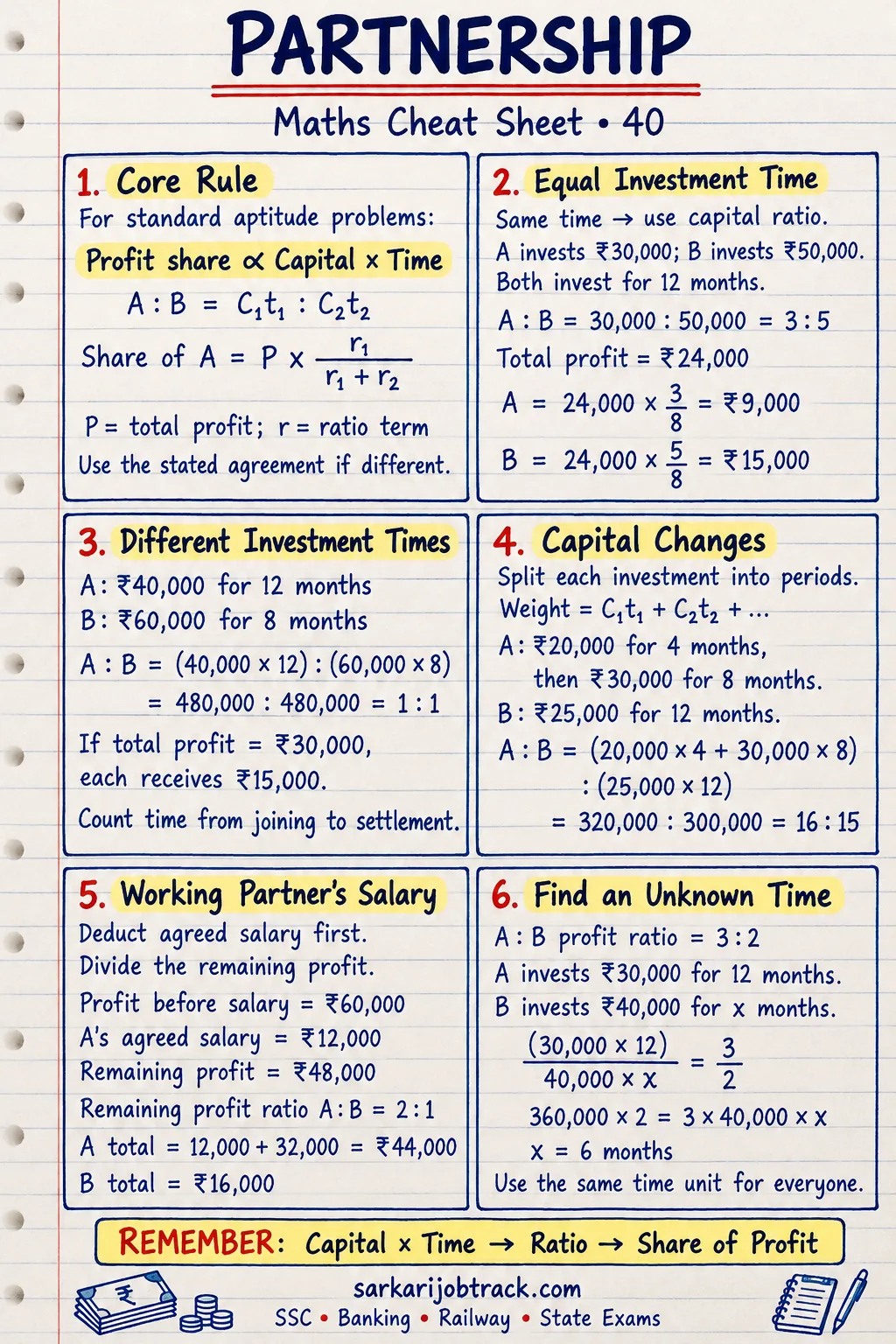
In a partnership, the profit is shared in the ratio of each partner's contribution, and a contribution is capital × time:
Profit share ∝ capital × time invested
Everything else follows from this single line. Two cases come out of it.
Simple partnership: same time
When all partners invest for the same period, the time is common to everyone, so it cancels and the profit splits in the ratio of capital alone.
Worked example. A invests ₹5,000 and B invests ₹7,000 for one year. The profit is ₹6,000.
- Capital ratio A : B = 5,000 : 7,000 = 5 : 7. Total parts = 12.
- A's share = 6,000 × 5/12 = ₹2,500.
- B's share = 6,000 × 7/12 = ₹3,500.
- Check: 2,500 + 3,500 = 6,000. ✓
Compound partnership: different time
When partners invest for different periods, time no longer cancels, so you use capital × time for each — the figure often called the monthly equivalent capital.
Worked example. A invests ₹8,000 for 12 months; B invests ₹12,000 for 6 months. The profit is ₹7,000.
- A's contribution = 8,000 × 12 = 96,000.
- B's contribution = 12,000 × 6 = 72,000.
- Ratio = 96,000 : 72,000 = 4 : 3. Total parts = 7.
- A's share = 7,000 × 4/7 = ₹4,000; B's share = 7,000 × 3/7 = ₹3,000.
- Check: 4,000 + 3,000 = 7,000. ✓
Notice B invested more money but for half the time, and ends up with the smaller share — because the contribution is money and time together.
Three partners
The rule extends unchanged: take capital × time for each, reduce to a ratio, and share.
Worked example. A puts in ₹4,000 for 6 months, B ₹5,000 for 4 months, C ₹6,000 for 3 months. The profit is ₹6,200.
- Contributions: A = 4,000 × 6 = 24,000; B = 5,000 × 4 = 20,000; C = 6,000 × 3 = 18,000.
- Ratio = 24,000 : 20,000 : 18,000 = 12 : 10 : 9. Total parts = 31.
- One part = 6,200 ÷ 31 = ₹200.
- A = 12 × 200 = ₹2,400; B = 10 × 200 = ₹2,000; C = 9 × 200 = ₹1,800.
- Check: 2,400 + 2,000 + 1,800 = 6,200. ✓
A working partner's salary
Sometimes one partner manages the business and is paid a salary or a share for managing before the rest is divided. Take that amount off the top first, then split the remainder by the contribution ratio.
Worked example. A and B invest equal capital for the same time, so their capital ratio is 1 : 1. The total profit is ₹10,000. A is the working partner and receives 10% of the profit for managing.
- A's management share = 10% of 10,000 = ₹1,000, taken off first.
- Remaining = 10,000 − 1,000 = ₹9,000, split 1 : 1 → ₹4,500 each.
- A's total = 1,000 + 4,500 = ₹5,500; B's total = ₹4,500.
- Check: 5,500 + 4,500 = 10,000. ✓
Common mistakes to avoid
- Using capital alone when the times differ — if the periods are not equal, you must multiply by time. Capital ratio on its own is only correct for the same-time case.
- Forgetting to take the salary off first — a working partner's salary or management share comes out before the capital-ratio split, not after.
- Mixing units of time — convert everything to the same unit (all months, or all years) before multiplying.
- Not checking the shares add to the profit — the shares must total the amount divided; if they do not, the ratio or the arithmetic is wrong.
Quick revision table
| Situation | Share in the ratio of |
|---|---|
| Same time, different capital | capital |
| Different time and capital | capital × time |
| Working partner | salary / management share first, then capital-time ratio on the rest |
| Check | the shares must add back to the total profit |
Keep this and the partnership cheat sheet for revision. Partnership shares the method of Profit and Loss, which is worth revising alongside it.
How this was made: Drafted with AI assistance; every formula and worked figure recomputed independently.