
Puzzles and Seating Arrangement: A Lesson on Drawing the Set-up
Learn the reliable way to solve seating and arrangement puzzles — draw the layout, place the fixed clues first, add the relative clues by elimination, and handle the facing-direction twist in circular arrangements. Worked through a linear seating example step by step, with the puzzle types the exam reuses and the mistakes to avoid.
By the end of this lesson you will have a dependable method for seating and arrangement puzzles — draw the layout, pin the definite clues first, then place the rest by elimination — so that a set of clues about who sits where resolves into one diagram you can read every answer from.
Already confident? Practise reasoning questions
Before this: these puzzles need no formula, only a careful diagram and step-by-step elimination. Keep a pencil and paper beside you.
The puzzle types
| Type | Set-up |
|---|---|
| Linear | people in a single row, all facing the same way (or two rows facing each other) |
| Circular | people around a table, facing the centre or facing outward |
| Floor / building | people on numbered floors, lowest to highest |
| Scheduling | items matched to days, months or slots |
All of them yield to the same method: a drawing and ordered placement.
The method
- Draw the empty layout — a row of blanks, a circle of seats, a stack of floors.
- Place the definite clues first — "C is at the extreme left", "R is third" — these pin exact positions.
- Add the relative clues by elimination — "B is between A and D", "U is immediately right of R" — each narrows the remaining blanks.
- Fill the last blank by what is left, then read every answer off the finished diagram.
Worked example (linear)
Six people — P, Q, R, S, T, U — sit in a row, positions 1 to 6 from the left. Given:
- R is third from the left.
- P is at the extreme left.
- U is immediately to the right of R.
- S is at the extreme right.
- Q is between P and R.
Place step by step:
- R third → position 3. P extreme left → position 1. S extreme right → position 6.
- U immediately right of R (position 3) → position 4.
- Q between P (1) and R (3) → position 2.
- The only blank left is position 5, so T → position 5.
Final row: P, Q, R, U, T, S. Now any question reads straight off it — for example, "Who sits between U and S?" is position 5 = T.
The circular twist: facing direction
Around a table, "left" and "right" depend on which way a person faces. Fix the rule once and reuse it:
- Facing the centre: a person's right is the anticlockwise direction and their left is clockwise, as you view the diagram from outside. (Check: someone at the 6 o'clock seat facing in points their right hand towards the 3 o'clock seat, which is anticlockwise from 6.)
- Facing outward: it reverses — their right is clockwise and their left is anticlockwise.
When a clue says "to the immediate right of X", take it from X's point of view after noting which way X faces — not from your own side of the diagram.
Common mistakes to avoid
- Starting with the relative clues — place the fixed positions first; a relative clue is useless until it has an anchor.
- Reading left/right from your own side in a circular puzzle — use the seated person's facing direction, not yours.
- Not re-reading every clue at the end — confirm the finished diagram satisfies all of them; one unused clue means a mistake.
- Assuming a gap — "B is near A" does not mean immediately next to A unless the clue says so.
Quick revision table
| Step | What you do |
|---|---|
| 1 | Draw the empty layout (row, circle, floors) |
| 2 | Place the definite clues (exact positions) first |
| 3 | Add relative clues by elimination |
| 4 | Fill the last blank by what remains; verify all clues |
| Circular | take left/right from the seated person's facing, not yours |
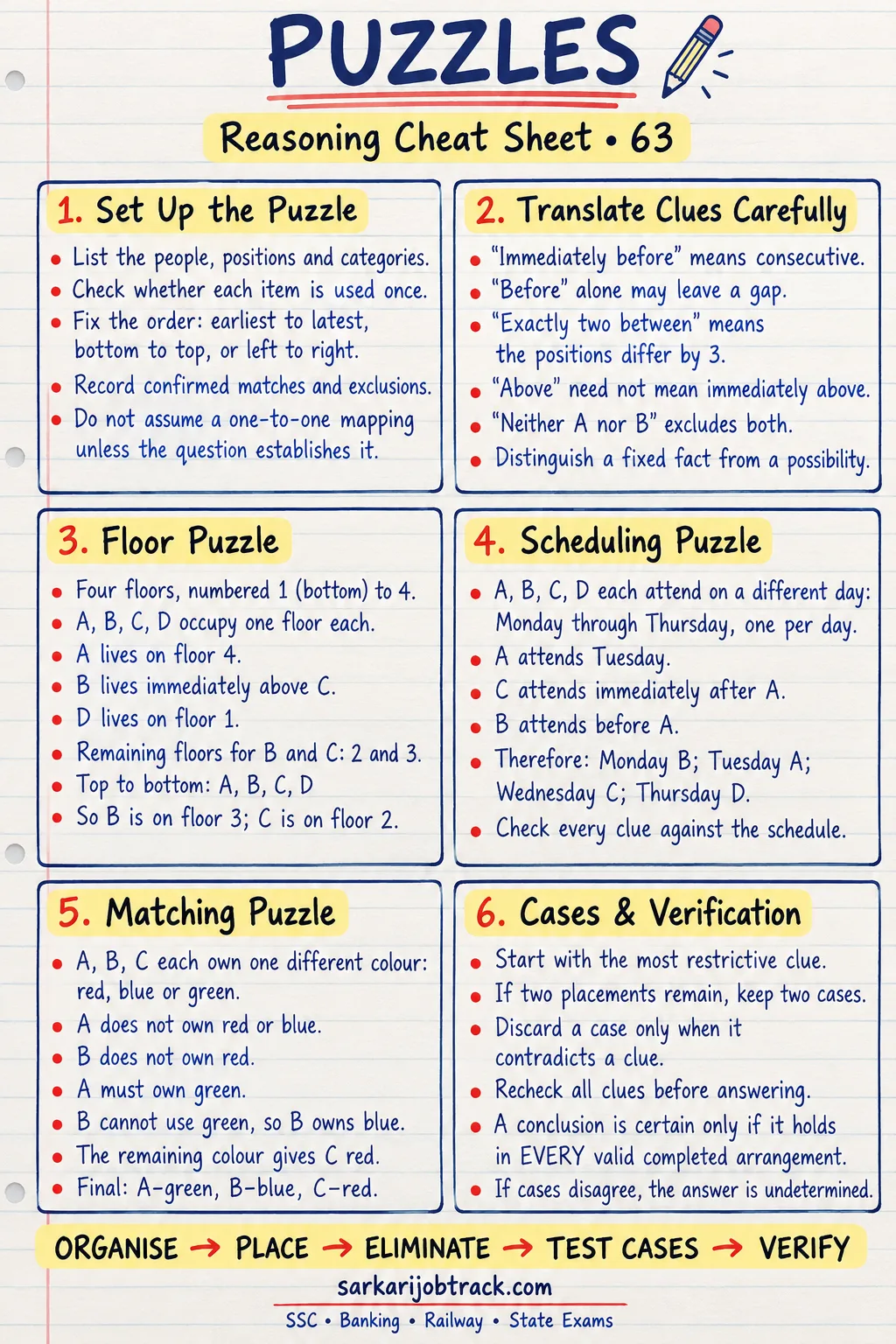
Keep this method and the seating arrangement cheat sheet for revision, then practise reasoning questions. Puzzles that mix in family clues also draw on the Blood Relations lesson.
How this was made: Drafted with AI assistance; every formula and worked figure recomputed independently; every fact checked against the source it cites.