
Mixture and Alligation Cheat Sheet
31 Oct 2026
Quick answer
A quick revision cheat sheet on mixture and alligation for SSC, Banking, Railway and state exams. It explains the rule of alligation and its cross diagram, how to find the ratio in which two ingredients are mixed, the mean-price idea, and the repeated-replacement formula for dilution, with worked examples.
Mixture and Alligation Cheat Sheet
Quick Revision
Alligation is a fast rule for problems that mix two things of different values (prices, strengths or speeds) to reach a given average, called the mean price.
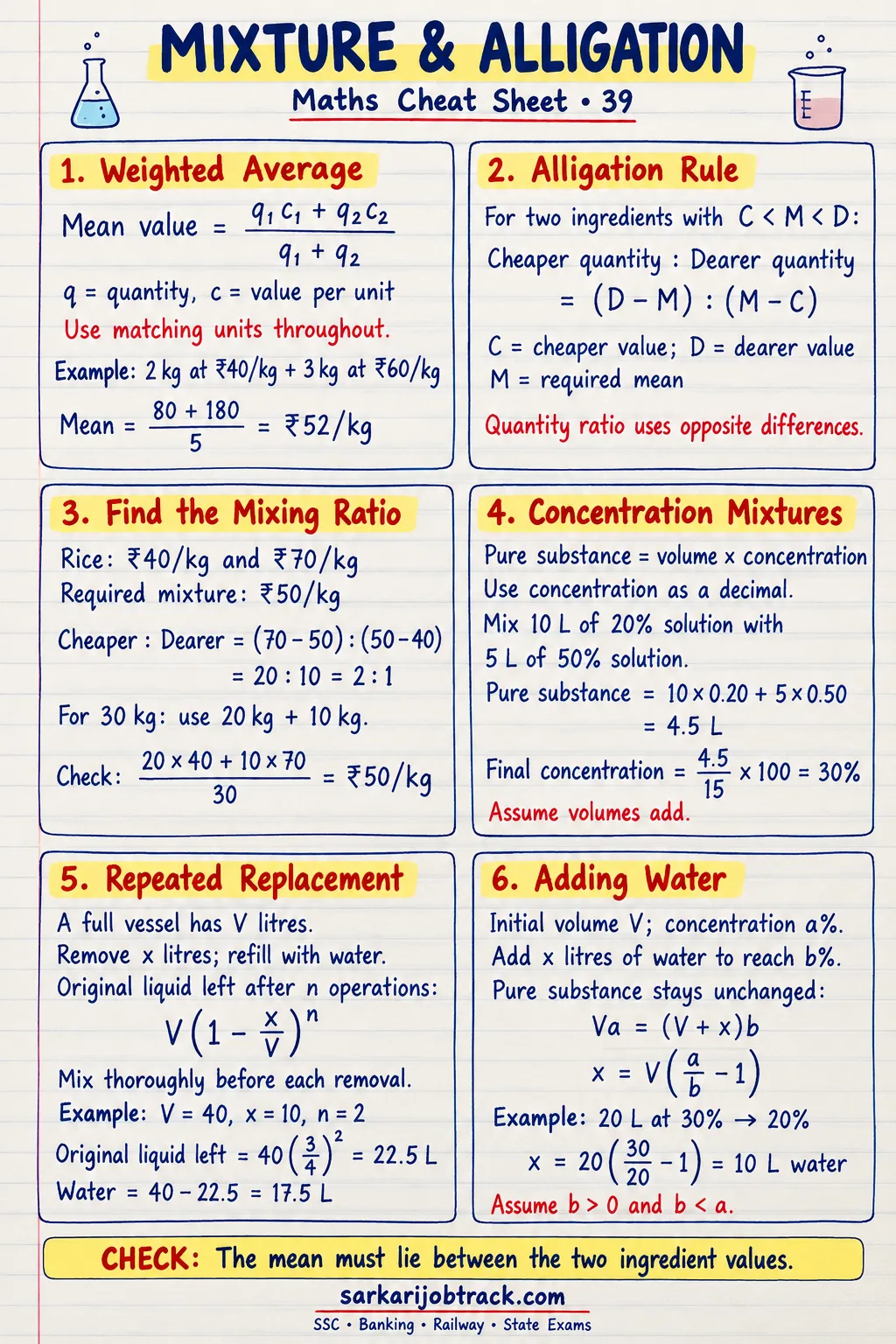
1. The Rule of Alligation
When two ingredients are mixed, the ratio of their quantities is:
Cheaper quantity     Dearer price − Mean price
----------------  =  -------------------------
Dearer quantity      Mean price − Cheaper price
In words: each quantity is proportional to the difference on the opposite side of the mean.
2. The Cross Diagram
Cheaper (C)           Dearer (D)
        \             /
         \           /
          Mean (M)
         /           \
        /             \
 (D − M)               (M − C)
So Cheaper : Dearer = (D − M) : (M − C).
Example
Rice at ₹20/kg is mixed with rice at ₹30/kg to sell at ₹24/kg.
Cheaper : Dearer = (30 − 24) : (24 − 20) = 6 : 4 = 3 : 23. Mean Price
The mean price is the cost of one unit of the final mixture:
Mean price = Total cost of ingredients / Total quantity4. Repeated Replacement (dilution)
If a container holds V units of liquid and x units are drawn out and replaced with water, done n times, the pure liquid left is:
Pure liquid left = V × (1 − x/V)ⁿExample
16 litres of milk; 4 litres are replaced with water twice:
= 16 × (1 − 4/16)² = 16 × (3/4)² = 16 × 9/16 = 9 litres of milk5. Exam Quick Tips
- Alligation gives a ratio, not a quantity — scale it to the total afterwards.
- The differences go on the opposite sides (cross), a common slip.
- Alligation also works for average speed, percentages and strengths, not just price.
- For dilution, use
V(1 − x/V)ⁿfor the pure liquid remaining.
Keep revising with the rest of the Maths section:
How this was made: Drafted with AI assistance; spot-checked by the editor on 31 October 2026.