
Mixture and Alligation: A Lesson on the Rule and Replacement
Learn the rule of alligation — the ratio in which two things at different prices or strengths are mixed to reach a given mean is (dearer minus mean) to (mean minus cheaper) — and the repeated-replacement formula for a quantity removed and topped up with water. Worked step by step in the exam's mixture style, with milk-and-water problems and the mistakes to avoid.
By the end of this lesson you will be able to find the ratio in which two things are mixed to hit a target average using the rule of alligation, and work out how much of a liquid is left after some is removed and replaced with water, so that you can answer "In what ratio must rice at ₹20/kg be mixed with rice at ₹30/kg to get a mixture worth ₹24/kg?" in one line.
Already confident? Practise maths questions
Before this: the mean price in a mixture is a weighted average, and alligation gives you a ratio, so you should be comfortable with both first. If either feels shaky, read the Average lesson and the Ratio and Proportion lesson before this one.
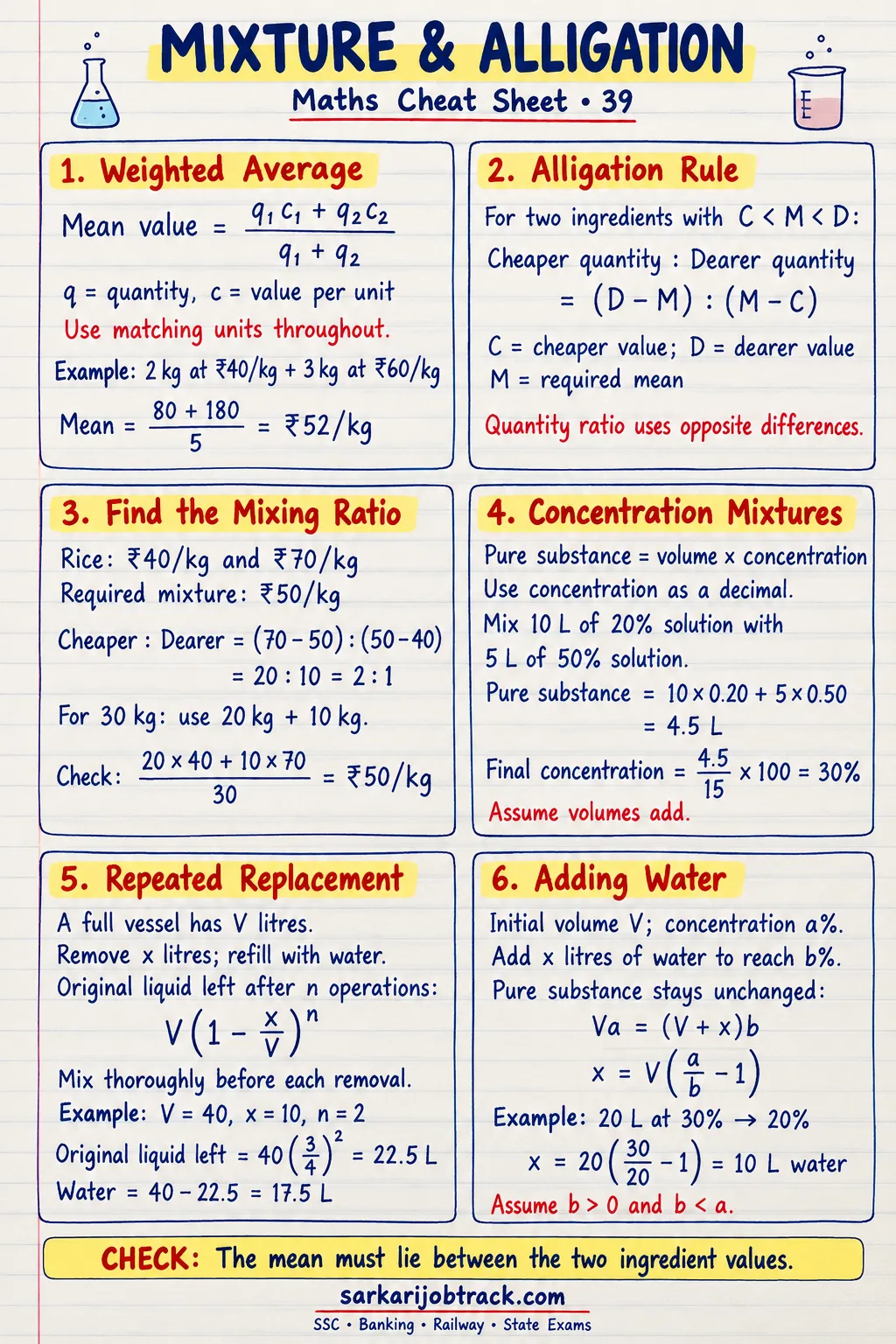
The rule of alligation
When two ingredients at different prices (or strengths) are mixed to reach a mean value, the rule of alligation gives the ratio in which they are mixed:
quantity of cheaper : quantity of dearer = (dearer − mean) : (mean − cheaper)
It is easiest to draw as a cross: put the two prices on the left, the mean in the middle, and take each diagonal difference.
Worked example. In what ratio must rice at ₹20/kg be mixed with rice at ₹30/kg to make a mixture worth ₹24/kg?
- Cheaper = 20, dearer = 30, mean = 24.
- Ratio cheaper : dearer = (30 − 24) : (24 − 20) = 6 : 4 = 3 : 2.
- Check: (3 × 20 + 2 × 30) ÷ 5 = (60 + 60) ÷ 5 = 120 ÷ 5 = 24. ✓
So three parts of the ₹20 rice to two parts of the ₹30 rice gives the ₹24 mixture.
A second price example
Worked example. Tea worth ₹60/kg is mixed with tea worth ₹65/kg to sell at ₹62/kg. Find the ratio.
- Ratio cheaper : dearer = (65 − 62) : (62 − 60) = 3 : 2.
- Check: (3 × 60 + 2 × 65) ÷ 5 = (180 + 130) ÷ 5 = 310 ÷ 5 = 62. ✓
The mean always lies between the two prices, so both differences are positive — if one comes out negative, the mean has been placed outside the range and something is wrong.
Mixing with water (a free ingredient)
Water costs nothing, so in a milk-and-water problem the "price" of water is 0. The rest is the same alligation.
Worked example. At what ratio should water be added to milk costing ₹20/L so the mixture costs ₹16/L?
- Cheaper (water) = 0, dearer (milk) = 20, mean = 16.
- Ratio water : milk = (20 − 16) : (16 − 0) = 4 : 16 = 1 : 4.
- Check: one litre of water (₹0) with four litres of milk (₹80) is ₹80 for 5 L = ₹16/L. ✓
Repeated replacement
A different mixture question removes some liquid and tops the vessel back up with water, often more than once. After each replacement the milk left follows a fixed formula:
milk left = initial amount × (1 − amount removed ÷ total)ⁿ
where n is the number of times the removal-and-top-up is done.
Worked example. A vessel holds 40 litres of pure milk. 4 litres are drawn off and replaced with water; this is done a second time. How much milk is left?
- milk left = 40 × (1 − 4/40)² = 40 × (36/40)² = 40 × (9/10)² = 40 × 81/100 = 32.4 litres.
- So the vessel now holds 32.4 L milk and 7.6 L water.
The key is that the fraction removed (4/40 = 1/10) is taken of the whole vessel each time, and the power is the number of replacements.
Common mistakes to avoid
- Flipping the ratio — the difference taken across from the cheaper price gives the quantity of the cheaper ingredient. Label the cross carefully; mixing up which difference belongs to which side inverts the answer.
- Forgetting water is free — in a milk-and-water or dilution problem the added water has price (or strength) 0, not the milk's price.
- Using the wrong power in replacement — n is how many times the removal is repeated, not the litres removed.
- Putting the mean outside the range — the mean price must lie between the two ingredient prices; if it does not, re-read the question.
Quick revision table
| Situation | Method |
|---|---|
| Mix two prices to a mean | cheaper : dearer = (dearer − mean) : (mean − cheaper) |
| Add water to cut the price | treat water's price as 0, then alligation |
| Remove and top up with water, n times | milk left = initial × (1 − removed/total)ⁿ |
| Check | the weighted mean of the parts must equal the target mean |
Keep this and the mixture and alligation cheat sheet for revision. Alligation is really a fast way to find a ratio, so revise it alongside Ratio and Proportion.
How this was made: Drafted with AI assistance; every formula and worked figure recomputed independently.