
Probability Cheat Sheet
31 Oct 2026
Quick answer
A quick revision cheat sheet on probability for SSC, Banking, Railway and state exams. It covers the basic probability formula, the addition and multiplication rules, the complement rule, and the standard sample spaces for coins, dice and a pack of cards, with worked examples to revise quickly before the exam.
Probability Cheat Sheet
Quick Revision
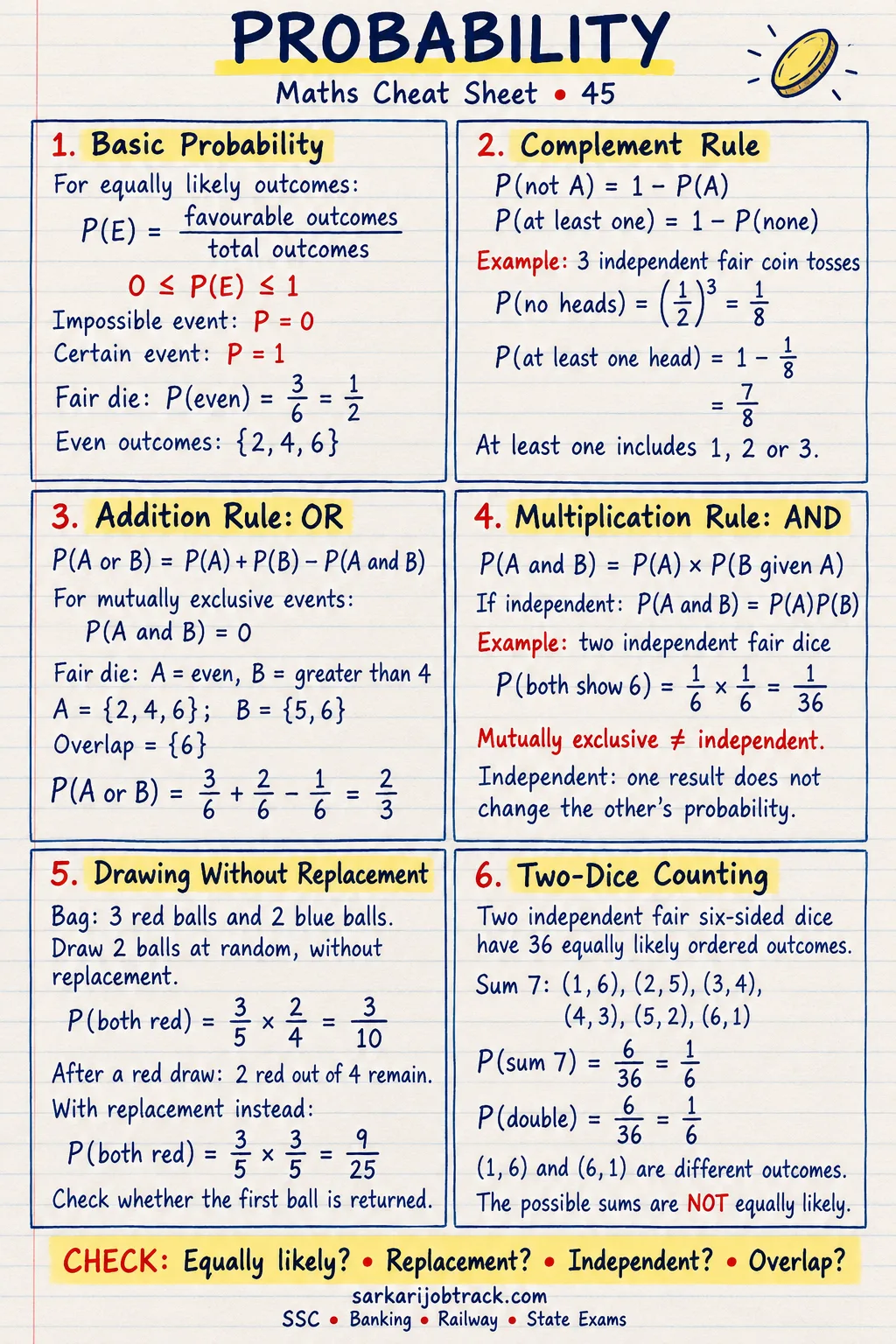
Probability measures how likely an event is, on a scale from 0 (impossible) to 1 (certain). It is the number of favourable outcomes divided by the total number of outcomes.
1. The Basic Formula
P(event) = Favourable outcomes / Total outcomesProbability always lies between 0 and 1: 0 ≤ P ≤ 1.
2. The Complement Rule
P(not A) = 1 − P(A)Often it is easier to find the probability of the event not happening.
3. Addition and Multiplication
P(A or B)  = P(A) + P(B) − P(A and B)
P(A or B)  = P(A) + P(B)           (mutually exclusive events)
P(A and B) = P(A) × P(B)           (independent events)
Mutually exclusive events cannot happen together; independent events do not affect each other.
4. Standard Sample Spaces
| Experiment | Total outcomes |
|---|---|
| One coin | 2 (H, T) |
| n coins | 2ⁿ |
| One die | 6 |
| Two dice | 36 |
| A pack of cards | 52 |
A pack of 52 cards: 26 red + 26 black; 4 suits of 13; 12 face cards (J, Q, K × 4); 4 aces.
5. Worked Example
The probability of drawing a king from a pack of 52 cards:
P(king) = 4 / 52 = 1 / 13The probability of a number greater than 4 on a die:
Favourable = {5, 6} → P = 2 / 6 = 1 / 36. Exam Quick Tips
- Probability is always between 0 and 1 — an answer outside that range is wrong.
- Use the complement
1 − P(A)when "at least one" appears. - For independent events, multiply; for mutually exclusive, add.
- Learn the card facts: 12 face cards, 4 aces, 13 per suit.
Keep revising with the rest of the Maths section:
How this was made: Drafted with AI assistance; spot-checked by the editor on 31 October 2026.