
Time and Work: Working Together, the LCM Units Method and Men-Days
Learn to turn "finishes in n days" into a daily share of the work, add the shares when people work together, find one person's time from the pair, use the quicker LCM units method, solve men-days questions where the number of workers or hours changes, handle work that starts and stops partway, and fill a tank with an inlet and an outlet, through six worked examples and a revision block.
By the end of this lesson you will be able to turn "finishes in n days" into a share of the work done each day, add the shares when people work together, find one worker's time from the pair, use the quicker LCM units method, solve men-days questions where the number of workers or the hours change, handle work that starts or stops partway, and fill a tank with an inlet and an outlet pipe.
Already confident? Skip to practice: Time and Work quiz
Before this: you should be comfortable adding and subtracting fractions (1/10 + 1/15 = 1/6), and happy with the unitary idea of finding one unit first, then many. If that feels shaky, read the Ratio and Proportion lesson first; sharing work in the ratio of how fast people are is the same idea.
The one idea behind the whole topic
In every question the work is one whole job: one wall, one tank of water, one field dug. We never need to know how big the job is. What matters is how much of it a worker does in one day (or one hour, or one minute). That is the worker's rate.
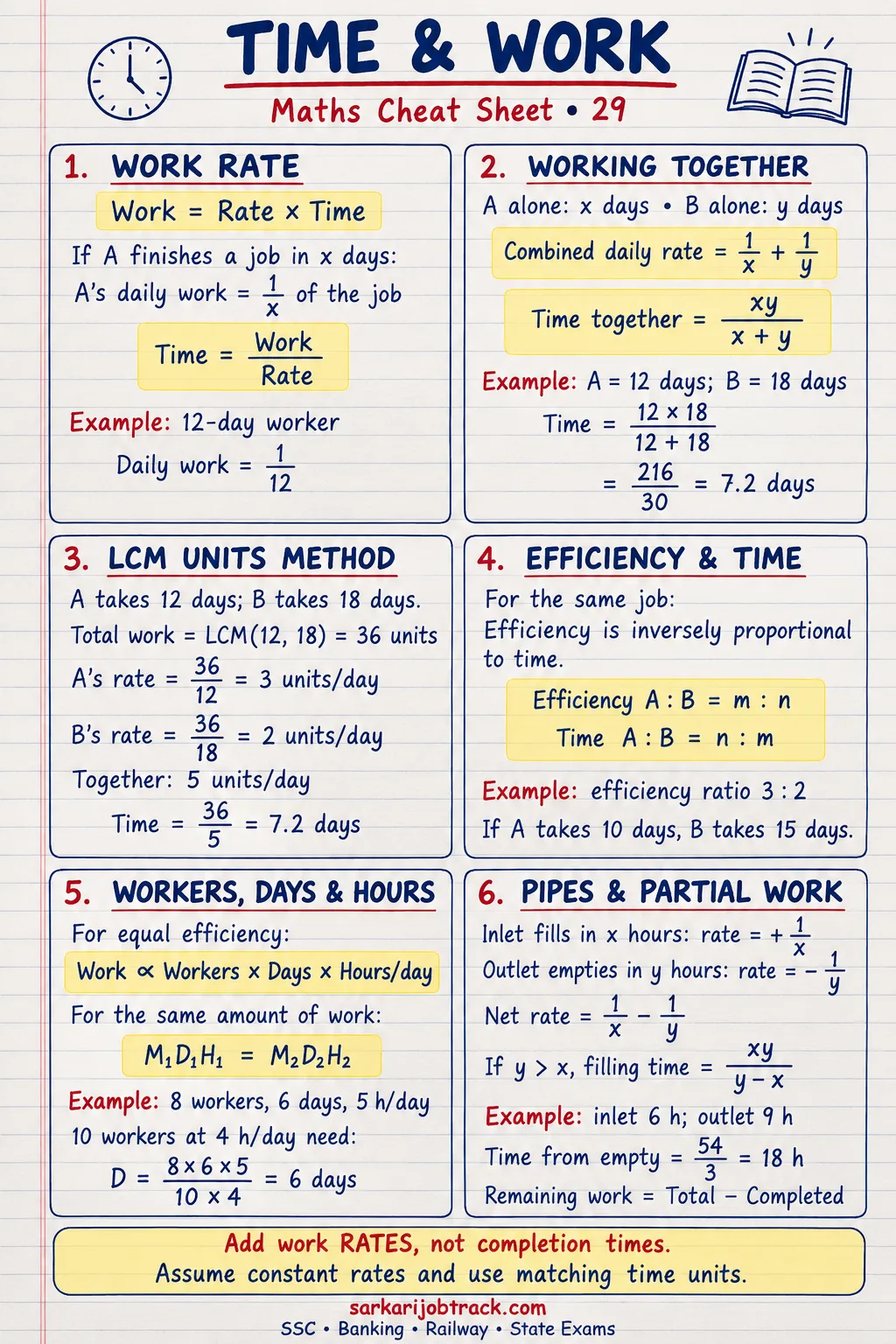
If a worker finishes the whole job in n days, then in one day the worker does 1/n of it. So someone who finishes in 8 days does 1/8 of the job each day; someone who finishes in 12 days does 1/12 each day. The faster worker has the bigger daily share.
Two words used below:
- Rate (or one day's work): the fraction of the whole job a worker does in one day. A 10-day worker has a rate of 1/10 per day.
- Working together: unless a question says otherwise, people who work together do not get in each other's way, so their daily shares simply add.
The two things you turn between, all lesson: days to rate is "flip it" (10 days means 1/10 a day), and rate back to days is "flip it" again (a rate of 1/6 a day means 6 days for the whole job). A rate of 5/36 a day means 36/5 = 7.2 days for the whole job.
Two methods, and they always agree
There are two standard ways to handle these questions. Learn both; then pick whichever is tidier for the numbers in front of you.
- The fraction method: write each worker's rate as a fraction (1/n), add or subtract the rates, then flip the final rate to get the time. It is quick for two workers.
- The LCM units method: instead of a fraction of one job, call the whole job a number of units equal to the LCM of the given days. Then each worker's daily units come out as whole numbers, which are easier to add, subtract and track. It is tidier for three workers, or when people join and leave.
Example 1 does the same question both ways so you can see they give the same answer.
Worked examples
Read each example slowly. The first two show every step. In the later ones, some steps are left for you, with the answer just below.
Example 1: Two people working together, both methods
Question: A can do a piece of work in 12 days, and B can do the same work in 24 days. Working together, in how many days will they finish it?
The fraction method
- A finishes in 12 days, so A does 1/12 of the work in one day. B finishes in 24 days, so B does 1/24 in one day.
- Together, in one day they do 1/12 + 1/24. Use the common denominator 24: 1/12 = 2/24, so 2/24 + 1/24 = 3/24 = 1/8 of the work each day.
- If they do 1/8 of the work each day, the whole job takes 8 days. (Flip 1/8 to get 8.)
- So together they finish in 8 days.
The LCM units method
- Call the whole job a number of units equal to the LCM of 12 and 24. The LCM of 12 and 24 is 24, so let the job be 24 units.
- A finishes 24 units in 12 days, so A does 24 ÷ 12 = 2 units a day. B finishes 24 units in 24 days, so B does 24 ÷ 24 = 1 unit a day.
- Together they do 2 + 1 = 3 units a day.
- The job is 24 units at 3 units a day: 24 ÷ 3 = 8 days. The same answer.
Notice the whole job (24 units, or "1 job") cancels out either way. That is why we never need its real size.
Your turn: A can do a work in 20 days and B in 30 days. Find how long they take together, by whichever method you like.
Check: Fractions: 1/20 + 1/30 = 3/60 + 2/60 = 5/60 = 1/12, so 12 days. Units: LCM of 20 and 30 is 60; A does 3 units a day and B does 2, together 5 units a day, and 60 ÷ 5 = 12 days.
The principle: turn each worker's days into a daily rate (1/n), add the rates for people working together, then flip the total rate to get the time. Or set the job to the LCM of the days in units, add the whole-number daily units, and divide. The two methods always agree.
Example 2: Finding one worker's time from the pair
Question: (a) A and B together can finish a work in 8 days, and A alone can do it in 12 days. In how many days can B alone do it? (b) A is twice as good a workman as B, and working together they finish a job in 10 days. How long would B alone take?
Part (a): subtract the rates
- Together they do 1/8 of the work a day. A alone does 1/12 a day.
- B's daily share is what is left when A's share is taken out of the pair's share: B's rate = 1/8 − 1/12.
- Use the common denominator 24: 1/8 = 3/24 and 1/12 = 2/24, so B's rate = 3/24 − 2/24 = 1/24 a day.
- Flip it: B alone takes 24 days.
Part (b): a faster worker as units
- "A is twice as good a workman as B" means A works twice as fast, so in the same day A does twice as much. Let B do 1 unit a day; then A does 2 units a day.
- Together they do 2 + 1 = 3 units a day.
- They finish the job in 10 days, so the whole job is 3 units a day for 10 days = 30 units.
- B alone does 1 unit a day, so B alone takes 30 ÷ 1 = 30 days. (A alone would take 30 ÷ 2 = 15 days.)
The principle: the pair's rate is the sum of the two single rates, so one single rate is the pair's rate minus the other. When a question compares speeds ("twice as good", "thrice as fast"), give the workers units in that ratio, add them, and share out the job.
Example 3: Three together, and how much is left partway
Question: (a) A, B and C can finish a work in 10, 15 and 30 days on their own. Working together, how long will they take? (b) Two workers together do 1/8 of a job each day. If they work together for 3 days, what fraction of the job is still left?
Part (a): three rates add too
- Rates: A does 1/10 a day, B does 1/15, C does 1/30.
- The units method is tidier for three. LCM of 10, 15 and 30 is 30, so let the job be 30 units. Then A does 30 ÷ 10 = 3 units a day, B does 30 ÷ 15 = 2, and C does 30 ÷ 30 = 1.
- Together they do 3 + 2 + 1 = 6 units a day.
- The job is 30 units: 30 ÷ 6 = 5 days. (By fractions: 1/10 + 1/15 + 1/30 = 3/30 + 2/30 + 1/30 = 6/30 = 1/5, so 5 days.)
Part (b): work done is rate times days
- The work done is the daily rate times the number of days: 1/8 × 3 = 3/8 of the job is done.
- The fraction left is the whole job minus the part done: 1 − 3/8 = 5/8.
Your turn: two workers can do a job in 8 days and 12 days on their own. If they work together for 2 days, what fraction is left?
Check: Together they do 1/8 + 1/12 = 3/24 + 2/24 = 5/24 of the job a day. In 2 days they do 2 × 5/24 = 10/24 = 5/12. So the fraction left is 1 − 5/12 = 7/12.
The principle: rates add for any number of workers. Work done in a stretch of time is the rate multiplied by the time; the fraction still left is 1 minus the fraction done. Read carefully whether the question asks for the part done or the part left.
Example 4: Men, days, hours and wages
When the workers are identical "men" (or women, or machines) and we only count how many there are, the total work is a fixed number of man-days: the number of workers times the number of days. The same job always needs the same number of man-days, so more workers means fewer days.
Question: (a) 16 men can build a wall in 18 days. How many days will 24 men take to build the same wall? (b) 10 men working 6 hours a day finish a job in 12 days. How many days will 8 men working 9 hours a day take? (c) If 8 men earn ₹2,400 in 6 days, how much will 5 men earn in 9 days at the same rate of pay?
Part (a): men and days
- The wall is 16 × 18 = 288 man-days of work.
- Share that among 24 men: 288 ÷ 24 = 12 days.
- The rule in symbols is M1 × D1 = M2 × D2 (men times days is the same job both times): 16 × 18 = 24 × 12 = 288.
Part (b): bring in the hours
- Now count man-hours, not just man-days: workers × days × hours a day. The job is 10 × 12 × 6 = 720 man-hours.
- 8 men working 9 hours a day do 8 × 9 = 72 man-hours a day, so the days needed are 720 ÷ 72 = 10 days.
- In symbols, M1 × D1 × H1 = M2 × D2 × H2 when the job is the same. (If the two jobs are different sizes W1 and W2, divide each side by its own work: M1 × D1 × H1 ÷ W1 = M2 × D2 × H2 ÷ W2.)
Part (c): wages follow the man-days
- Pay is shared in the ratio of the work done, and the work is counted in man-days. The first job is 8 × 6 = 48 man-days for ₹2,400, so one man-day of work earns 2,400 ÷ 48 = ₹50.
- The second lot is 5 men for 9 days = 45 man-days.
- Your turn: find what 45 man-days earn at ₹50 each.
Check: 45 × 50 = ₹2,250. (The wage is not split "per man" or "per day" alone; it follows the man-days, so both the change in men and the change in days matter.)
The principle: for identical workers the same job is a fixed number of man-days (or man-hours). Count it one way, then re-share it the other way: M1 × D1 = M2 × D2, and M1 × D1 × H1 = M2 × D2 × H2 with hours. Wages are shared in the ratio of the man-days worked.
Example 5: Work that starts or stops partway
Question: (a) A can do a work in 18 days. A works for 6 days and then leaves, and B finishes the rest in 8 days. In how many days could B alone do the whole work? (b) A alone can do a work in 20 days and B alone in 30 days. A starts the work alone, and after 5 days B joins. In how many days from the start is the whole work finished?
Part (a): one leaves, the other finishes
- In 6 days A does 6 × 1/18 = 6/18 = 1/3 of the work.
- So the part left for B is 1 − 1/3 = 2/3 of the work, and B does that 2/3 in 8 days.
- If 2/3 of the job takes B 8 days, the whole job takes B 8 ÷ (2/3) = 8 × 3/2 = 12 days.
Part (b): one joins partway (LCM units)
- LCM of 20 and 30 is 60, so let the job be 60 units. A does 60 ÷ 20 = 3 units a day, and B does 60 ÷ 30 = 2 units a day.
- For the first 5 days A works alone: 5 × 3 = 15 units are done.
- Units still left: 60 − 15 = 45. From now on both work, at 3 + 2 = 5 units a day.
- Those 45 units take 45 ÷ 5 = 9 more days.
- Total time from the start = 5 + 9 = 14 days.
Your turn: A alone can do a work in 12 days and B alone in 6 days. They work together for 2 days, and then B leaves. How many more days does A need to finish the rest? (Hint: LCM of 12 and 6 is 12 units; A does 1 unit a day, B does 2.)
Check: In 2 days together they do 2 × (1 + 2) = 6 units, leaving 12 − 6 = 6 units. A alone does 1 unit a day, so A needs 6 ÷ 1 = 6 more days.
The principle: break the job into stretches of time in which the set of workers does not change. Add up the work (as a fraction, or as units) done in each stretch. The LCM units method keeps the bookkeeping in whole numbers, which is why it is the easier choice when people come and go.
Example 6: Pipes and cisterns, including an outlet
A tank filling with water is the same as a job being done: a pipe that fills the tank in n hours does 1/n of it an hour. The only new idea is a drain or leak, which takes water out. An emptying pipe has a negative rate, so you subtract its share.
Question: (a) Two pipes can fill a tank in 10 minutes and 15 minutes on their own. If both are opened together, how long will the tank take to fill? (b) An inlet pipe fills a tank in 6 hours, while an open outlet empties the full tank in 9 hours. If both are left open on an empty tank, how long will it take to fill?
Part (a): two inlets (they add)
- In one minute the first pipe fills 1/10 of the tank and the second fills 1/15.
- Together they fill 1/10 + 1/15 = 3/30 + 2/30 = 5/30 = 1/6 of the tank a minute.
- Flip it: the tank fills in 6 minutes.
Part (b): inlet and outlet (subtract the outlet)
- The inlet adds 1/6 of the tank an hour. The outlet takes away 1/9 an hour, so its rate is −1/9.
- The net filling in one hour is 1/6 − 1/9. Common denominator 18: 1/6 = 3/18 and 1/9 = 2/18, so the net is 3/18 − 2/18 = 1/18 of the tank an hour.
- Flip it: the tank fills in 18 hours. (It is slower than the inlet alone, because the outlet is fighting it.)
Your turn: an inlet fills a tank in 8 hours, and an open outlet empties the full tank in 12 hours. With both open on an empty tank, how long to fill it?
Check: Net rate = 1/8 − 1/12 = 3/24 − 2/24 = 1/24 of the tank an hour, so it fills in 24 hours.
The principle: a filling pipe has a positive rate (1/n an hour) and a draining pipe a negative one (−1/n). Add all the rates with their signs to get the net rate, then flip it for the time. If the net rate comes out negative, the tank is being emptied, not filled.
Common mistakes
- Adding the days instead of the rates. Two workers of 12 and 24 days do not take 12 + 24 = 36 days together, nor 12 − 24. Add their daily shares, 1/12 + 1/24 = 1/8, and the pair takes 8 days — faster than either alone, as it must be.
- Forgetting to flip at the end. A combined rate of 1/8 a day means 8 days, not 1/8 of a day. Days and rate are the flip of each other, at the start and at the end.
- Thinking more men means more days. For a fixed job, men and days move opposite ways: 16 men take 18 days, so the larger crew of 24 men takes fewer days (12), not more. Keep the man-days fixed.
- Leaving a pipe's outlet as a plus. An outlet empties the tank, so its rate is negative: net = 1/6 − 1/9, not 1/6 + 1/9. Subtract every draining pipe.
- Reading "fraction left" as "fraction done". If 3/8 of a job is finished, the part left is 1 − 3/8 = 5/8. Answer the one the question asks for.
- Averaging the two times. For 12-day and 24-day workers, the pair does not take the average, 18 days. Averaging the times is never the method; add the rates.
Time and Work: the rules in one place
In this table "a day" can be any unit of time the question uses — a day, an hour, a minute — as long as you keep to one unit.
| To find | Rule | Worked numbers |
|---|---|---|
| One worker's daily share (rate) | finishes in n days, so does 1/n a day | 8 days, so 1/8 a day |
| The time, from a rate | flip the rate | 1/6 a day means 6 days |
| Two or more working together | add the rates, then flip | 1/12 + 1/24 = 1/8, so 8 days |
| One rate, from the pair | pair's rate − the other rate | 1/8 − 1/12 = 1/24, so 24 days |
| The LCM units method | job = LCM of the days in units; each does (job ÷ own days) units a day | days 12 and 24: job 24 units; 2 and 1 a day; 24 ÷ 3 = 8 days |
| Speeds compared ("twice as good") | give units in that ratio, add, then share the job | A : B rate 2 : 1; together finish in 10 days means job 30 units; B alone 30 days |
| Work done in a stretch | rate × time; fraction left = 1 − fraction done | 1/8 × 3 = 3/8 done, so 5/8 left |
| Men and days, same job | M1 × D1 = M2 × D2 | 16 × 18 = 288 = 24 × 12 |
| Men, days and hours, same job | M1 × D1 × H1 = M2 × D2 × H2 (÷ W1, ÷ W2 for different jobs) | 10 × 12 × 6 = 720 = 8 × 10 × 9 |
| Wages for identical workers | share in the ratio of man-days worked | 48 man-days earn ₹2,400, so ₹50 a man-day |
| Someone joins or leaves partway | split into stretches where the crew is fixed; add the work in each | 60 units, 15 done alone, 45 left at 5 a day = 9 more days |
| A filling pipe | positive rate, 1/n an hour | fills in 6 h, so 1/6 an hour |
| A draining pipe (outlet, leak) | negative rate, −1/n an hour; add all rates with signs | 1/6 − 1/9 = 1/18, so 18 hours |
Next
Partnership shares a business's profit in the ratio of what each partner puts in and for how long — the same man-days idea as Example 4, with money. Time, speed and distance uses rates in just the way this lesson does, with distance in place of the job. Pipes and cisterns, which you met in Example 6, is only Time and Work with an outlet that can work against the inlets. Partnership has only a few questions in the bank so far, so there is no separate quiz for it yet; when you are ready for the next full topic, try the Time, Speed and Distance quiz.
Ready to test this lesson? Take the Time and Work quiz
How this was made: Drafted with AI assistance; every formula and worked figure recomputed independently; spot-checked by the editor on 25 October 2026.