
Algebra: The Standard Identities, Factorising and Solving Equations
Learn the square identities for (a + b)² and (a − b)², the difference of two squares, the cubes and the sum and difference of cubes, the a + 1/a family that turns one given value into a² + 1/a² and a³ + 1/a³, how to factorise and simplify, how to evaluate an expression by substitution or by spotting an identity, and how to solve a linear equation, a pair of equations and a quadratic, through six worked examples and a revision block.
By the end of this lesson you will be able to use the square identities for (a + b)² and (a − b)², the difference of two squares a² − b², and the cubes (a + b)³, (a − b)³, a³ + b³ and a³ − b³; turn a single given value like a + 1/a into a² + 1/a² and a³ + 1/a³; factorise and simplify an expression; find the value of an expression by putting numbers in or by spotting an identity; and solve a linear equation, a pair of equations and a quadratic.
Already confident? Skip to practice: Algebra quiz
Before this: you should be comfortable multiplying and squaring whole numbers, and working with a fraction and its reciprocal (so that the reciprocal of 1/a is a). If fractions still feel shaky, read the Fractions, Decimals and Percentages lesson first.
The one idea behind the whole topic
A letter stands for a number you do not yet know. Everything else follows from treating that letter exactly like a number: you may add, multiply, square or factor it by the same rules of arithmetic. Two words come up again and again, so keep them apart:
- To expand is to multiply brackets out: (x + 2)(x + 3) becomes x² + 5x + 6.
- To factorise is the reverse: to write an expression as brackets multiplied together, x² + 5x + 6 back into (x + 2)(x + 3).
A handful of identities — statements true for every value of the letters — do most of the work in this topic. An identity is not an equation to solve; it is a tool you already own. Learn the few below until you can write them without thinking, because almost every question is one of them in disguise. The other half of the topic is solving: finding the one number (or the two) that makes an equation true. These are different jobs — an identity holds always, an equation holds only for its answer — and knowing which one a question wants is half the battle.
Worked examples
Read each example slowly. The first two show every step. In the later ones, some steps are left for you, with the answer just below.
Example 1: The two square identities
The first two identities are the ones you will use most:
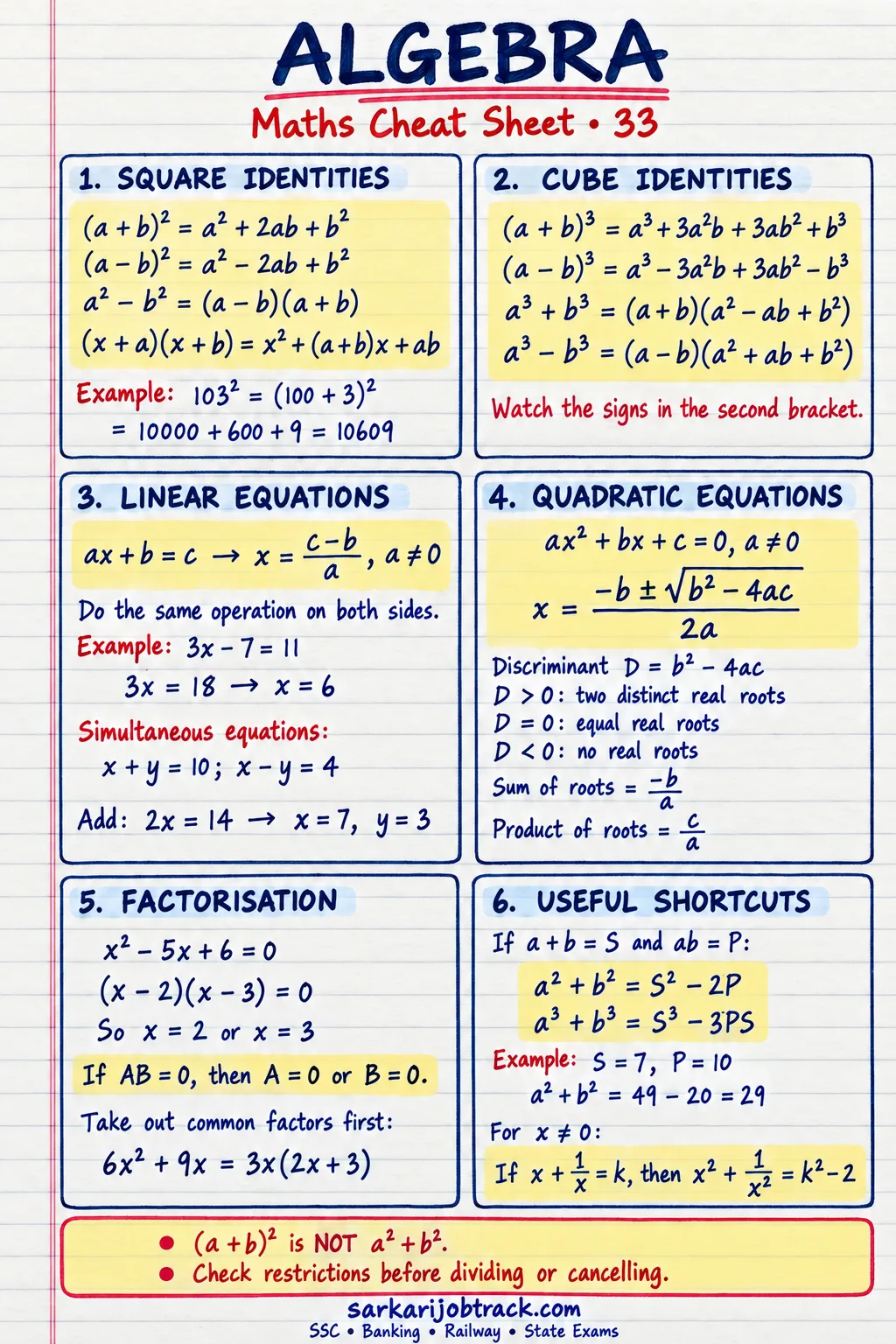
- (a + b)² = a² + 2ab + b²
- (a − b)² = a² − 2ab + b²
They are the same except for the sign of the middle term, and that middle term — the 2ab — is the one people forget. "Square the first, square the last, and twice the two multiplied together in between."
Question: (a) Expand (x + 6)². (b) Use the identity to find 103² quickly. (c) Find 97².
Part (a): straight from the identity
- Here a = x and b = 6. Square the first: x². Square the last: 6² = 36. Twice the product: 2 × x × 6 = 12x.
- Put them together: (x + 6)² = x² + 12x + 36.
Part (b): a big square made easy
- Write 103 as 100 + 3, so 103² = (100 + 3)². Now a = 100 and b = 3.
- Square the first: 100² = 10,000. Square the last: 3² = 9. Twice the product: 2 × 100 × 3 = 600.
- Add them: 10,000 + 600 + 9 = 10,609.
Part (c): the minus version
- Write 97 as 100 − 3, so 97² = (100 − 3)². Use (a − b)², which subtracts the middle term.
- 100² = 10,000; 3² = 9; twice the product = 600. Now subtract the middle term: 10,000 − 600 + 9 = 9,409.
Your turn: use (100 + 6)² to find 106² without long multiplication.
Check: 100² = 10,000, 6² = 36, and 2 × 100 × 6 = 1,200, so 106² = 10,000 + 1,200 + 36 = 11,236.
The principle: (a + b)² = a² + 2ab + b² and (a − b)² = a² − 2ab + b². The only difference is the sign of the 2ab, and the 2ab is the term never to drop. Splitting a number like 103 into 100 + 3 turns a hard square into this identity.
Example 2: From a + b and ab to a² + b², and back again
Rearrange the first identity and you get the single most-tested result in this topic. Since (a + b)² = a² + b² + 2ab, moving the 2ab across gives:
a² + b² = (a + b)² − 2ab.
So if a question gives you the sum a + b and the product ab, you can find a² + b² without ever knowing a and b on their own.
Question: (a) If a + b = 9 and ab = 14, find a² + b². (b) If a² + b² = 61 and ab = 30, and a and b are both positive, find a + b, and then find a − b.
Part (a): the sum and product given
- Use a² + b² = (a + b)² − 2ab. Here (a + b)² = 9² = 81, and 2ab = 2 × 14 = 28.
- So a² + b² = 81 − 28 = 53.
Part (b): working the identity backwards
- Turn it the other way: (a + b)² = a² + b² + 2ab = 61 + 2 × 30 = 61 + 60 = 121.
- So a + b is the number whose square is 121. Since the question says a and b are positive, a + b must be positive, so a + b = 11 (not −11).
- For a − b, use the twin identity (a − b)² = a² + b² − 2ab = 61 − 60 = 1, so a − b = 1. (Check: a + b = 11 and a − b = 1 give a = 6, b = 5, and indeed 6 × 5 = 30 and 6² + 5² = 61.)
The positive step in part (b) matters: a square root has two values, +11 and −11, and only the wording "both positive" tells you which to keep.
Your turn: if a + b = 13 and ab = 40, find a² + b².
Check: a² + b² = (a + b)² − 2ab = 13² − 2 × 40 = 169 − 80 = 89.
The principle: a² + b² = (a + b)² − 2ab, and (a + b)² = a² + b² + 2ab. The sum and the product unlock each other. When you take a square root to recover a + b, keep the sign the question's wording allows — usually the positive one.
Example 3: The difference of two squares
The third identity is short and comes up everywhere:
a² − b² = (a + b)(a − b).
A difference of two squares always splits into "the sum times the difference". Read it both ways: as a way to factorise, and as a shortcut for arithmetic.
Question: (a) Factorise x² − 16. (b) Find the value of 53² − 47² without squaring either number. (c) Simplify the fraction (p² − q²) ÷ (p − q).
Part (a): spotting the two squares
- x² is a square, and 16 = 4², so x² − 16 is a² − b² with a = x and b = 4.
- It factorises as the sum times the difference: x² − 16 = (x + 4)(x − 4).
Part (b): a difference of squares in numbers
- 53² − 47² is a² − b² with a = 53 and b = 47, so it equals (a + b)(a − b) = (53 + 47)(53 − 47).
- That is 100 × 6 = 600 — far quicker than squaring 53 and 47 and subtracting.
Part (c): cancelling with the identity
- The top p² − q² is a difference of squares, so write it as (p + q)(p − q). The fraction becomes (p + q)(p − q) ÷ (p − q).
- The (p − q) on top and bottom cancel, leaving p + q.
Your turn: factorise 9x² − 25.
Check: 9x² = (3x)² and 25 = 5², so this is (3x)² − 5² = (3x + 5)(3x − 5).
The principle: a² − b² = (a + b)(a − b). Learn to recognise two squares with a minus between them — in letters (x² − 16), in numbers (53² − 47²) and inside a fraction, where it usually cancels something.
Example 4: The a + 1/a family
A whole family of questions gives you a + 1/a (a number plus its reciprocal) and asks for a² + 1/a² or a³ + 1/a³. You never need to find a itself. The trick is to square or cube the given expression and notice what appears.
Square a + 1/a: (a + 1/a)² = a² + 2 × a × (1/a) + 1/a² = a² + 1/a² + 2, because a × (1/a) = 1. Rearranged:
a² + 1/a² = (a + 1/a)² − 2.
Question: Suppose a + 1/a = 4. (a) Find a² + 1/a². (b) Find a³ + 1/a³.
Part (a): square and subtract 2
- a² + 1/a² = (a + 1/a)² − 2 = 4² − 2 = 16 − 2 = 14.
Part (b): the cube
- There is a matching cube identity: a³ + 1/a³ = (a + 1/a)³ − 3(a + 1/a). (It comes from cubing a + 1/a, just as part (a) came from squaring it.)
- So a³ + 1/a³ = 4³ − 3 × 4 = 64 − 12 = 52.
Now the minus twin. Squaring a − 1/a gives (a − 1/a)² = a² + 1/a² − 2, so this time a² + 1/a² = (a − 1/a)² + 2 — a plus, because the cross term is now negative and subtracting it adds to the total.
Part (c): if instead a − 1/a = 6, find a² + 1/a².
- a² + 1/a² = (a − 1/a)² + 2 = 6² + 2 = 36 + 2 = 38.
Notice the pattern: from a + 1/a you subtract 2, and from a − 1/a you add 2. The value a² + 1/a² is the bridge both reach.
Your turn: if a + 1/a = 6, find a² + 1/a².
Check: a² + 1/a² = (a + 1/a)² − 2 = 6² − 2 = 36 − 2 = 34.
The principle: a² + 1/a² = (a + 1/a)² − 2 = (a − 1/a)² + 2, and a³ + 1/a³ = (a + 1/a)³ − 3(a + 1/a). Square or cube the given expression, and the a × (1/a) = 1 in the middle leaves a plain number behind. Subtract 2 for the plus case, add 2 for the minus case.
Example 5: The cubes, and the symmetric identity
The cube identities come in two shapes. First the full expansions:
- (a + b)³ = a³ + 3a²b + 3ab² + b³
- (a − b)³ = a³ − 3a²b + 3ab² − b³
Then the two that factorise a sum or difference of cubes:
- a³ + b³ = (a + b)(a² − ab + b²)
- a³ − b³ = (a − b)(a² + ab + b²)
Question: (a) Expand (x + 1)³ and (x − 1)³. (b) Find a³ + b³ when a = 4 and b = 2, and check it with the identity. (c) Find the value of x² − xy + y² when x = 4 and y = 1.
Part (a): the cube expansions
- (x + 1)³ = x³ + 3x²(1) + 3x(1²) + 1³ = x³ + 3x² + 3x + 1.
- (x − 1)³ is the same with alternating signs: x³ − 3x² + 3x − 1.
Part (b): a sum of cubes two ways
- By substitution, a³ + b³ = 4³ + 2³ = 64 + 8 = 72.
- By the identity, a³ + b³ = (a + b)(a² − ab + b²) = (4 + 2)(4² − 4×2 + 2²) = 6 × (16 − 8 + 4) = 6 × 12 = 72. The two agree, which is the point: the identity is just a faster route to the same number.
Part (c): the expression inside the cube identity
- The bracket a² − ab + b² in the sum-of-cubes identity is its own little expression. Here it is x² − xy + y² with x = 4, y = 1.
- Put the numbers in: 4² − 4×1 + 1² = 16 − 4 + 1 = 13.
There is a three-letter cousin worth knowing: a² + b² + c² − ab − bc − ca, which equals ½[(a − b)² + (b − c)² + (c − a)²] — a sum of squares, so it is never negative. For a = 6, b = 3, c = 1 it is 36 + 9 + 1 − 18 − 3 − 6 = 19, and the square-sum form ½[(3)² + (2)² + (−5)²] = ½[9 + 4 + 25] = 19 agrees. This expression is the one that appears in a³ + b³ + c³ − 3abc = (a + b + c)(a² + b² + c² − ab − bc − ca).
Your turn: find a³ − b³ when a = 5 and b = 1, by substitution and then by the identity.
Check: by substitution, 5³ − 1³ = 125 − 1 = 124. By the identity, (a − b)(a² + ab + b²) = (5 − 1)(25 + 5 + 1) = 4 × 31 = 124. They match.
The principle: (a ± b)³ = a³ ± 3a²b + 3ab² ± b³; a³ + b³ = (a + b)(a² − ab + b²) and a³ − b³ = (a − b)(a² + ab + b²). You can always evaluate a cube by substitution; the identity is the shortcut and the check.
Example 6: Solving equations
Solving is the other half of algebra. The rule is simple: do the same thing to both sides until the unknown stands alone. Whatever you add, subtract, multiply or divide, do it to the whole of each side.
Question: (a) Solve 4x + 3 = x + 21. (b) Solve 3(x − 2) = 27. (c) Solve the pair x + y = 15 and x − y = 3. (d) Solve x² − 10x + 24 = 0.
Part (a): one unknown, terms on both sides
- Gather the x terms on one side and the plain numbers on the other. Take x from both sides: 4x − x + 3 = 21, so 3x + 3 = 21.
- Take 3 from both sides: 3x = 18. Divide both sides by 3: x = 6.
- Check: 4 × 6 + 3 = 27, and 6 + 21 = 27. Both sides agree.
Part (b): a bracket first
- Divide both sides by 3 to clear the bracket: x − 2 = 27 ÷ 3 = 9.
- Add 2 to both sides: x = 11. (Check: 3 × (11 − 2) = 3 × 9 = 27.)
Part (c): two equations, two unknowns
- The unknowns appear as +y in one equation and −y in the other, so adding the two equations removes y: (x + y) + (x − y) = 15 + 3, which is 2x = 18, so x = 9.
- Put x = 9 back into x + y = 15: 9 + y = 15, so y = 6. The pair is x = 9, y = 6.
- The same idea handles "a value is given": if 3x + 2y = 24 and you are told x = 4, then 12 + 2y = 24, so 2y = 12 and y = 6 — substitute the known number and solve for the one that is left.
Part (d): a quadratic by factorising
- Find two numbers that multiply to the last term (+24) and add to the middle number (−10). They are −4 and −6, since (−4) × (−6) = 24 and (−4) + (−6) = −10.
- So x² − 10x + 24 = (x − 4)(x − 6) = 0. A product is zero only when one of its factors is zero, so x − 4 = 0 or x − 6 = 0.
- The roots are x = 4 or x = 6. (Check: 4² − 10×4 + 24 = 16 − 40 + 24 = 0, and 6² − 10×6 + 24 = 36 − 60 + 24 = 0.)
Your turn: solve 5(x − 1) = 4x + 9.
Check: multiply out the bracket: 5x − 5 = 4x + 9. Take 4x from both sides: x − 5 = 9. Add 5: x = 14.
The principle: keep an equation balanced by doing the same step to both sides. Clear brackets first; collect the unknown on one side; for a pair, add or subtract the equations to remove one unknown; for a quadratic, factorise into two brackets and set each to zero.
Common mistakes
- Dropping the middle term. (a + b)² is a² + 2ab + b², not a² + b². The 2ab is the part exams test most, and the same goes for the 3a²b and 3ab² in a cube.
- Confusing (a + b)² with a² − b². (a + b)² = a² + 2ab + b² is one squared bracket; a² − b² = (a + b)(a − b) is two squares with a minus between them. They look alike and mean different things.
- Losing a sign in the minus identities. (a − b)² keeps +b² (a square is never negative); only the middle term turns negative. In a³ − b³ the long factor is a² + ab + b², with a plus in the middle — the opposite sign to a³ + b³.
- Forgetting the two square roots. When (a + b)² = 121, a + b can be +11 or −11. Keep the value the wording allows; "a and b are positive" means take the positive one.
- In the a + 1/a family, adding when you should subtract. From a + 1/a you subtract 2 to get a² + 1/a²; from a − 1/a you add 2. Mixing these up is the commonest slip in that family.
- Treating an identity as an equation to solve. An identity like a² − b² = (a + b)(a − b) is true for every value — there is nothing to "solve". Only an equation with an equals sign and an unknown, like 3x + 3 = 21, has an answer to find.
- Not doing the same thing to both sides. When you take a number across an equals sign it changes sign, because you are really subtracting it from both sides. Skipping that step is where most wrong answers come from.
Algebra: the identities and methods in one place
Here a, b, c, x, y are any numbers, and "the sum" and "the product" mean a + b and ab.
| Identity or method | Rule | Worked numbers |
|---|---|---|
| Square of a sum | (a + b)² = a² + 2ab + b² | 103² = (100+3)² = 10,609 |
| Square of a difference | (a − b)² = a² − 2ab + b² | 97² = (100−3)² = 9,409 |
| a² + b² from sum and product | a² + b² = (a + b)² − 2ab | a+b = 9, ab = 14: 81 − 28 = 53 |
| Sum from a² + b² and product | (a + b)² = a² + b² + 2ab | a²+b² = 61, ab = 30: √121 = 11 (positive) |
| Difference of two squares | a² − b² = (a + b)(a − b) | 53² − 47² = 100 × 6 = 600 |
| a² + 1/a² from a + 1/a | (a + 1/a)² − 2 | a + 1/a = 4: 16 − 2 = 14 |
| a² + 1/a² from a − 1/a | (a − 1/a)² + 2 | a − 1/a = 6: 36 + 2 = 38 |
| a³ + 1/a³ from a + 1/a | (a + 1/a)³ − 3(a + 1/a) | a + 1/a = 4: 64 − 12 = 52 |
| Cube of a sum | (a + b)³ = a³ + 3a²b + 3ab² + b³ | (x+1)³ = x³ + 3x² + 3x + 1 |
| Sum of cubes | a³ + b³ = (a + b)(a² − ab + b²) | a = 4, b = 2: 6 × 12 = 72 |
| Difference of cubes | a³ − b³ = (a − b)(a² + ab + b²) | a = 5, b = 1: 4 × 31 = 124 |
| Symmetric three-square | a² + b² + c² − ab − bc − ca = ½[(a−b)² + (b−c)² + (c−a)²] | 6, 3, 1: 19 |
| Linear equation | do the same step to both sides | 4x + 3 = x + 21 → x = 6 |
| Pair of equations | add or subtract to remove one unknown | x + y = 15, x − y = 3 → x = 9, y = 6 |
| Quadratic by factorising | two numbers multiplying to the last term, adding to the middle | x² − 10x + 24 = (x−4)(x−6) → 4 or 6 |
Next
The natural next topic is Geometry, which puts these identities to work on lengths and angles — and after it Trigonometry, where the square identities return as the relations between sine and cosine. Both have a quiz ready: try the Geometry quiz when you want a change, and the Trigonometry quiz after that. For now, make the identities in the table above second nature — most algebra questions are one of them wearing a disguise.
Ready to test this lesson? Take the Algebra quiz
How this was made: Drafted with AI assistance; every formula and worked figure recomputed independently; spot-checked by the editor on 28 October 2026.