
Time, Speed and Distance: Trains, Average Speed and Boats in Streams
Learn the one relation speed = distance ÷ time and its three forms, change km/h to m/s and back with the ×5/18 and ×18/5 factors, use relative speed for trains and walkers, add a train's own length when it crosses a platform, find the right average speed over equal distances (not the plain mean), and handle boats going downstream and upstream, through six worked examples and a revision block.
By the end of this lesson you will be able to use the one relation speed = distance ÷ time in all three of its forms, change a speed from km/h to m/s and back, use relative speed when two bodies move together or apart, add a train's own length when it crosses a pole or a platform, find the correct average speed over two equal distances, and work out times for a boat going downstream and upstream.
Already confident? Skip to practice: Time, Speed and Distance quiz
Before this: you should be comfortable with simple fractions and with the idea of a rate — one amount for each unit of another. A speed is a rate: so many kilometres for each hour. Sharing a journey in the ratio of the speeds is a ratio idea, so if ratios feel shaky, read the Ratio and Proportion lesson first.
The one relation behind the whole topic
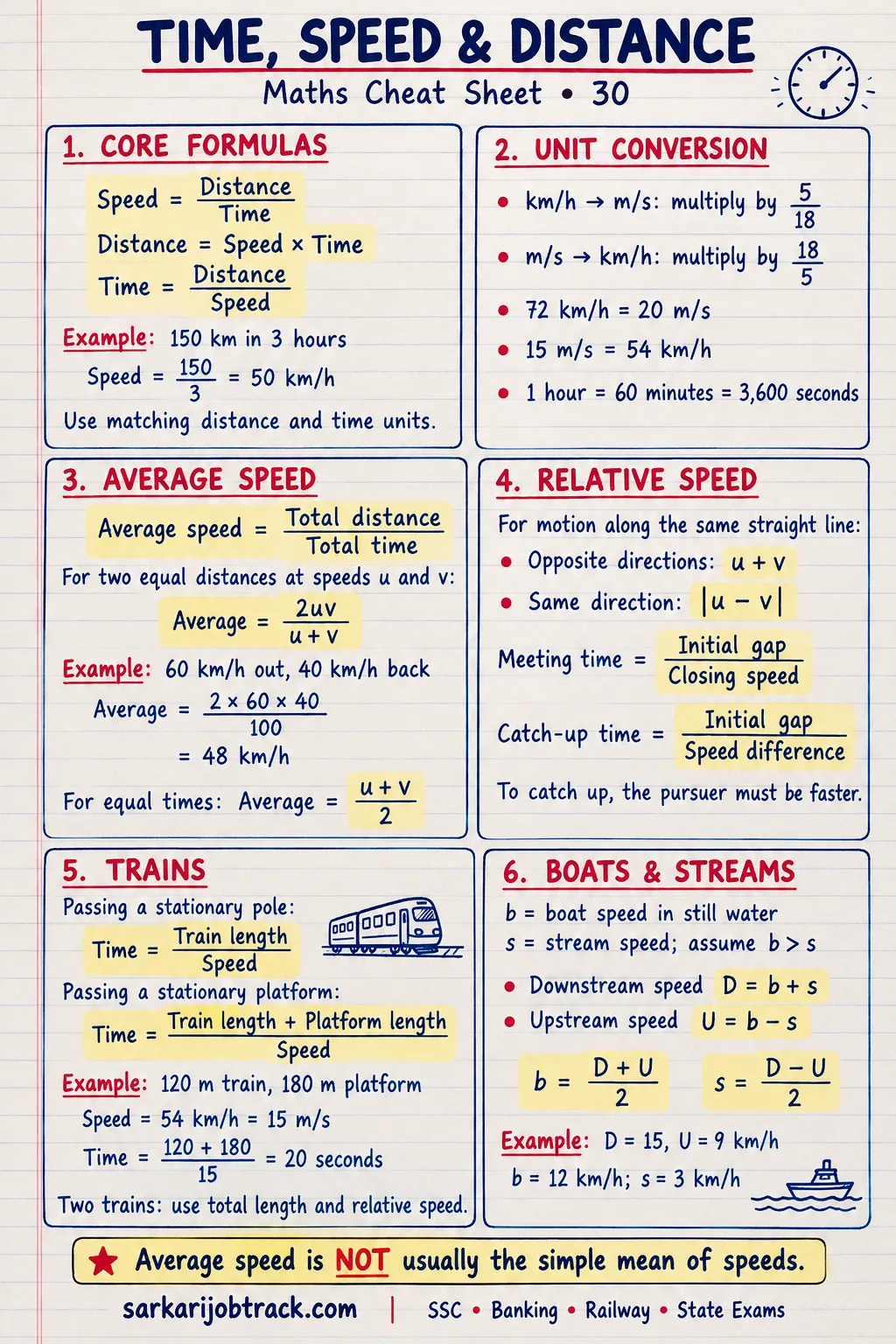
Everything in this topic comes from a single relation between three quantities:
speed = distance ÷ time.
Speed is how much distance is covered in one unit of time: 60 km in each hour is 60 km/h, 20 metres in each second is 20 m/s. From the one relation you get the other two just by rearranging it, the same way 6 = 12 ÷ 2 also tells you 12 = 6 × 2 and 2 = 12 ÷ 6:
- distance = speed × time (how far you go in a given time at a given speed);
- time = distance ÷ speed (how long a given distance takes at a given speed).
Two words used below:
- Uniform speed: unless a question says otherwise, the speed stays the same for the whole stretch, so these three forms apply directly.
- Consistent units: the three quantities must agree. Kilometres go with hours and km/h; metres go with seconds and m/s. You cannot put metres with hours, or a time in minutes into a km/h calculation, without converting first.
The single most common slip in the whole topic is mixing units — a length in metres with a speed in km/h, or a time written "1 hour 30 minutes" treated as 1.3. One hour 30 minutes is one and a half hours, 1.5 hours (30 minutes is half an hour, 30/60 = 1/2), not 1.3. Always turn minutes into a fraction of an hour before dividing.
Worked examples
Read each example slowly. The first two show every step. In the later ones, some steps are left for you, with the answer just below.
Example 1: The three forms, and a fixed distance at two speeds
Question: (a) A bus covers 275 km in 5 hours. Find its speed. (b) A car travels at 48 km/h for 3 hours 20 minutes. How far does it go? (c) A cyclist has 84 km to cover at 24 km/h. How long will it take? (d) A train covers a route in 9 hours at 40 km/h. How fast must it run to cover the same route in 8 hours?
Part (a): find the speed
- Speed = distance ÷ time = 275 ÷ 5.
- 275 ÷ 5 = 55 km/h.
Part (b): find the distance
- Distance = speed × time. First put the time in hours: 3 hours 20 minutes = 3 + 20/60 = 3 + 1/3 = 10/3 hours.
- Distance = 48 × 10/3. Divide first: 48 ÷ 3 = 16. Then 16 × 10 = 160 km.
Part (c): find the time
- Time = distance ÷ speed = 84 ÷ 24 = 3.5 hours.
- 3.5 hours is 3 hours and half an hour, so 3 hours 30 minutes. (Half an hour, not 50 minutes: 0.5 hour = 0.5 × 60 = 30 minutes.)
Part (d): the same distance at a new speed
- The route does not change, so first find it: distance = 40 × 9 = 360 km.
- To cover 360 km in 8 hours: speed = 360 ÷ 8 = 45 km/h.
There is a quicker way to see part (d). Over a fixed distance, speed and time are inversely proportional: go faster and the time falls in the same proportion. The time drops from 9 hours to 8 hours, a ratio of 9 : 8, so the speed rises in the ratio 8 : 9. New speed = 40 × 9/8 = 45 km/h. (It rises, so you multiply by the bigger-over-smaller, 9/8.)
The principle: speed = distance ÷ time, and the other two forms are just this rearranged. Convert any time in minutes to hours first. Over a fixed distance, a shorter time means a higher speed in the exact inverse ratio.
Example 2: Changing units — km/h to m/s and back
Trains are usually timed in seconds but their speed is quoted in km/h, so you must switch between the two. One kilometre is 1,000 metres and one hour is 3,600 seconds, so 1 km/h = 1,000/3,600 m/s = 5/18 m/s. That gives the two factors you will use again and again:
- km/h to m/s: multiply by 5/18.
- m/s to km/h: multiply by 18/5.
Question: (a) Write 90 km/h in m/s, and write 30 m/s in km/h. (b) A train 400 m long passes a telegraph pole in 20 seconds. Find its speed in km/h.
Part (a): the two factors
- 90 km/h to m/s: 90 × 5/18. Divide first: 90 ÷ 18 = 5, then 5 × 5 = 25 m/s.
- 30 m/s to km/h: 30 × 18/5. Divide first: 30 ÷ 5 = 6, then 6 × 18 = 108 km/h.
Part (b): a train passing a pole
- A pole (or a standing person, or any single point) has no length, so the train only has to move its own length past it: the distance is the train's length, 400 m.
- Speed = distance ÷ time = 400 ÷ 20 = 20 m/s.
- The question wants km/h, so multiply by 18/5: 20 × 18/5 = 4 × 18 = 72 km/h.
The principle: multiply by 5/18 to go from km/h to m/s, and by 18/5 to go the other way. When a train passes a pole or a standing person, the distance it covers is its own length.
Example 3: A train crossing a platform or a bridge
A pole has no length, but a platform or a bridge does. To clear a platform, the back of the train must leave it, so the train travels its own length plus the length of the platform:
distance to cross a platform = length of the train + length of the platform.
Question: A train 160 m long, running at 54 km/h, crosses a platform in 30 seconds. How long is the platform?
- The time is in seconds, so work in m/s. 54 km/h = 54 × 5/18 = 3 × 5 = 15 m/s. (54 ÷ 18 = 3, then 3 × 5 = 15.)
- In 30 seconds the train travels 15 × 30 = 450 m. That 450 m is the train's length plus the platform's length.
- Take away the train's own length: platform = 450 − 160 = 290 m.
Your turn: a train running at 90 km/h crosses a 260 m long platform in 16 seconds. Find the length of the train. (Hint: 90 km/h = 25 m/s; find the total distance first, then take away the platform.)
Check: 90 × 5/18 = 25 m/s. In 16 seconds the total distance is 25 × 16 = 400 m. That is the train plus the platform, so the train is 400 − 260 = 140 m long.
The principle: to cross a platform or a bridge, a train covers its own length plus the length of the platform. Work in m/s when the time is in seconds, find the total distance, then add or subtract the train's own length as the question needs.
Example 4: Relative speed — two bodies moving
When two bodies move, what matters is their speed relative to each other:
- Opposite directions (towards each other, or apart): the speeds add. They close, or open, the gap quickly.
- Same direction (one chasing or overtaking the other): the speeds subtract. Only the difference closes the gap.
Question: (a) Two trains, 200 m and 250 m long, run towards each other on parallel tracks at 60 km/h and 48 km/h. How long do they take to cross each other completely? (b) A train 120 m long, running at 63 km/h, overtakes a man jogging at 9 km/h in the same direction. How long does it take to pass him? (c) Two cyclists leave the same point at the same time in opposite directions at 6 km/h and 7 km/h. How far apart are they after 4 hours?
Part (a): two trains, opposite directions
- Opposite directions, so the speeds add: relative speed = 60 + 48 = 108 km/h.
- The time is in seconds, so change to m/s: 108 × 5/18 = 6 × 5 = 30 m/s. (108 ÷ 18 = 6, then 6 × 5 = 30.)
- To cross each other completely, the two trains must together cover the sum of their lengths: 200 + 250 = 450 m.
- Time = distance ÷ relative speed = 450 ÷ 30 = 15 seconds.
Part (b): same direction, overtaking
- Same direction, so the speeds subtract: relative speed = 63 − 9 = 54 km/h = 54 × 5/18 = 15 m/s.
- To pass the man (a single point), the train covers only its own length, 120 m.
- Time = 120 ÷ 15 = 8 seconds.
Part (c): moving apart
Moving in opposite directions from one point, the gap between the cyclists grows at the sum of their speeds.
- The gap opens at 6 + 7 = 13 km/h.
- Your turn: find the gap after 4 hours.
Check: distance = relative speed × time = 13 × 4 = 52 km apart.
The principle: for two bodies, use their relative speed — add the speeds for opposite directions, subtract them for the same direction. When two trains cross each other, the distance is the sum of their lengths; when a train passes a single point (a pole, a standing or walking person), the distance is just its own length.
Example 5: Average speed over two equal distances
Question: A car drives from town P to town Q at 40 km/h and returns along the same road at 60 km/h. What is its average speed for the whole trip?
The tempting answer is (40 + 60) ÷ 2 = 50 km/h. That is wrong. Average speed is never the plain average of the two speeds unless the two speeds are kept up for equal times. Here the two halves are equal in distance, and the slower half takes longer, so the slow speed counts for more of the trip. Average speed is always total distance ÷ total time.
- The real distance cancels out, so pick any convenient one for each equal half — say 120 km each way (240 km in all).
- Time out at 40 km/h: 120 ÷ 40 = 3 hours. Time back at 60 km/h: 120 ÷ 60 = 2 hours. Total time = 5 hours.
- Average speed = total distance ÷ total time = 240 ÷ 5 = 48 km/h.
Notice 48 is below 50, pulled down towards the slower speed, because the car spent longer going slowly. For two equal distances at speeds and , the average works out to 2ab ÷ (a + b) every time (this is called the harmonic mean): here 2 × 40 × 60 ÷ (40 + 60) = 4,800 ÷ 100 = 48 km/h, the same answer.
Your turn: a man walks one stretch at 20 km/h and an equal stretch back at 30 km/h. Find his average speed. (The plain average, 25, is the trap.)
Check: 2 × 20 × 30 ÷ (20 + 30) = 1,200 ÷ 50 = 24 km/h — below 25, as it must be. Or take 60 km each way: 60 ÷ 20 = 3 hours out and 60 ÷ 30 = 2 hours back, so 120 km in 5 hours = 24 km/h.
The principle: average speed = total distance ÷ total time, always. For two equal distances it is 2ab ÷ (a + b), which is less than the plain average of the two speeds. The plain average (a + b) ÷ 2 is right only when the two speeds last for equal times, not equal distances.
Example 6: Boats and streams
A boat in a moving stream (or river) has two speeds to keep apart: its speed in still water (its own engine or rowing speed) and the speed of the stream. The stream carries the boat along going downstream and holds it back going upstream:
- Downstream speed = speed in still water + speed of the stream.
- Upstream speed = speed in still water − speed of the stream.
Question: (a) A boat's speed in still water is 18 km/h and the stream flows at 2 km/h. How long does it take to go 120 km downstream? And 64 km upstream? (b) A boat covers 42 km downstream in 3 hours and the same 42 km upstream in 6 hours. Find its speed in still water and the speed of the stream.
Part (a): still-water speed and stream given
- Downstream, the stream helps: downstream speed = 18 + 2 = 20 km/h. Time for 120 km = 120 ÷ 20 = 6 hours.
- Upstream, the stream fights: upstream speed = 18 − 2 = 16 km/h. Time for 64 km = 64 ÷ 16 = 4 hours.
Part (b): working back to the two speeds
- Downstream speed = 42 ÷ 3 = 14 km/h. Upstream speed = 42 ÷ 6 = 7 km/h.
- The still-water speed is the one in the middle of these two — the average: speed in still water = (14 + 7) ÷ 2 = 10.5 km/h. (Downstream is the still-water speed plus the stream, upstream is it minus the stream, so halfway between them is the still-water speed.)
- Your turn: the stream's speed is half the difference of the downstream and upstream speeds. Find it.
Check: speed of the stream = (14 − 7) ÷ 2 = 3.5 km/h. Check: 10.5 + 3.5 = 14 (downstream) and 10.5 − 3.5 = 7 (upstream).
The principle: downstream the stream adds to the boat's still-water speed, upstream it takes away. So the still-water speed is half the sum of the downstream and upstream speeds, and the stream's speed is half their difference.
Common mistakes
- Mixing units. A length in metres must not be divided by a time to give km/h, and a time in seconds must not meet a speed in km/h. Change the speed to m/s (× 5/18) when the time is in seconds, or the time to hours when the speed is in km/h.
- Reading "1 hour 30 minutes" as 1.3 hours. It is 1.5 hours, because 30 minutes is 30/60 = half an hour. Likewise 20 minutes is 1/3 of an hour, not 0.2.
- Flipping the conversion factor. km/h to m/s is × 5/18 (the number gets smaller, because m/s is the smaller unit of speed); m/s to km/h is × 18/5 (the number gets bigger). If your answer jumps the wrong way, you have used the wrong factor.
- Forgetting the train's own length. Crossing a platform or a bridge, a train covers its length plus the platform's. Only when it passes a pole or a single standing person is the distance just the train's own length.
- Adding speeds in the same direction, or subtracting in opposite directions. Opposite directions add (the gap changes fast); the same direction subtracts (only the difference matters). Get these the wrong way round and every relative-speed answer is wrong.
- Averaging the two speeds. Over two equal distances, the average speed is 2ab ÷ (a + b), not (a + b) ÷ 2. The plain average is right only for equal times. The true average always lies nearer the slower speed.
- Muddling still-water and stream speeds. Downstream is faster (still water + stream), upstream slower (still water − stream). The still-water speed is the average of the two, the stream's speed is half their difference.
Time, Speed and Distance: the rules in one place
In this table a "unit of time" can be an hour, a minute or a second — but keep to one, and match it to the distance unit (km with hours, metres with seconds).
| To find | Rule | Worked numbers |
|---|---|---|
| Speed | distance ÷ time | 275 km in 5 h: 275 ÷ 5 = 55 km/h |
| Distance | speed × time | 48 km/h for 10/3 h: 48 × 10/3 = 160 km |
| Time | distance ÷ speed | 84 km at 24 km/h: 84 ÷ 24 = 3.5 h = 3 h 30 min |
| Minutes into hours | minutes ÷ 60 | 20 min = 20/60 = 1/3 h; 30 min = 1/2 h |
| Same distance, two speeds | speed and time are in inverse ratio | time 9 : 8 means speed 8 : 9, so 40 × 9/8 = 45 km/h |
| km/h to m/s | × 5/18 | 90 × 5/18 = 25 m/s |
| m/s to km/h | × 18/5 | 20 × 18/5 = 72 km/h |
| Train passing a pole or a person | distance = train's own length | 400 m ÷ 20 s = 20 m/s = 72 km/h |
| Train crossing a platform or bridge | distance = train length + platform length | 15 m/s × 30 s = 450 m; 450 − 160 = 290 m platform |
| Two bodies, opposite directions | relative speed = sum of the speeds | 60 + 48 = 108 km/h = 30 m/s |
| Two bodies, same direction | relative speed = difference of the speeds | 63 − 9 = 54 km/h = 15 m/s |
| Two trains crossing each other | distance = sum of the two lengths | 450 m ÷ 30 m/s = 15 s |
| Average speed | total distance ÷ total time | 240 km ÷ 5 h = 48 km/h |
| Average speed over two equal distances | 2ab ÷ (a + b), not (a + b) ÷ 2 | 2 × 40 × 60 ÷ 100 = 48 km/h |
| Downstream speed | still water + stream | 18 + 2 = 20 km/h |
| Upstream speed | still water − stream | 18 − 2 = 16 km/h |
| Still-water speed from the two | (downstream + upstream) ÷ 2 | (14 + 7) ÷ 2 = 10.5 km/h |
| Stream speed from the two | (downstream − upstream) ÷ 2 | (14 − 7) ÷ 2 = 3.5 km/h |
Next
Boats and streams, trains and relative speed, which you met here, all return in word problems that mix in time and work or ratios, so keep the three forms of speed = distance ÷ time at your fingertips. Later Maths topics build on the same rate idea in different dress: Algebra turns these word problems into equations, while Geometry and Mensuration bring in distance as length and area. When you are ready for a change of topic, try the Algebra quiz.
Ready to test this lesson? Take the Time, Speed and Distance quiz
How this was made: Drafted with AI assistance; every formula and worked figure recomputed independently; spot-checked by the editor on 25 October 2026.