
Number and Letter Series for Beginners: Finding the Next Term
Learn to find the rule behind a row of numbers or letters — constant and growing steps, multiplying, squares and cubes, two series that take turns, and letter positions — then use it to find the next term or spot the wrong one, through six worked examples, a checklist for any series and a revision list.
By the end of this lesson you will be able to find the rule behind a row of numbers or letters, use it to find the next term, and spot the one term that breaks the pattern.
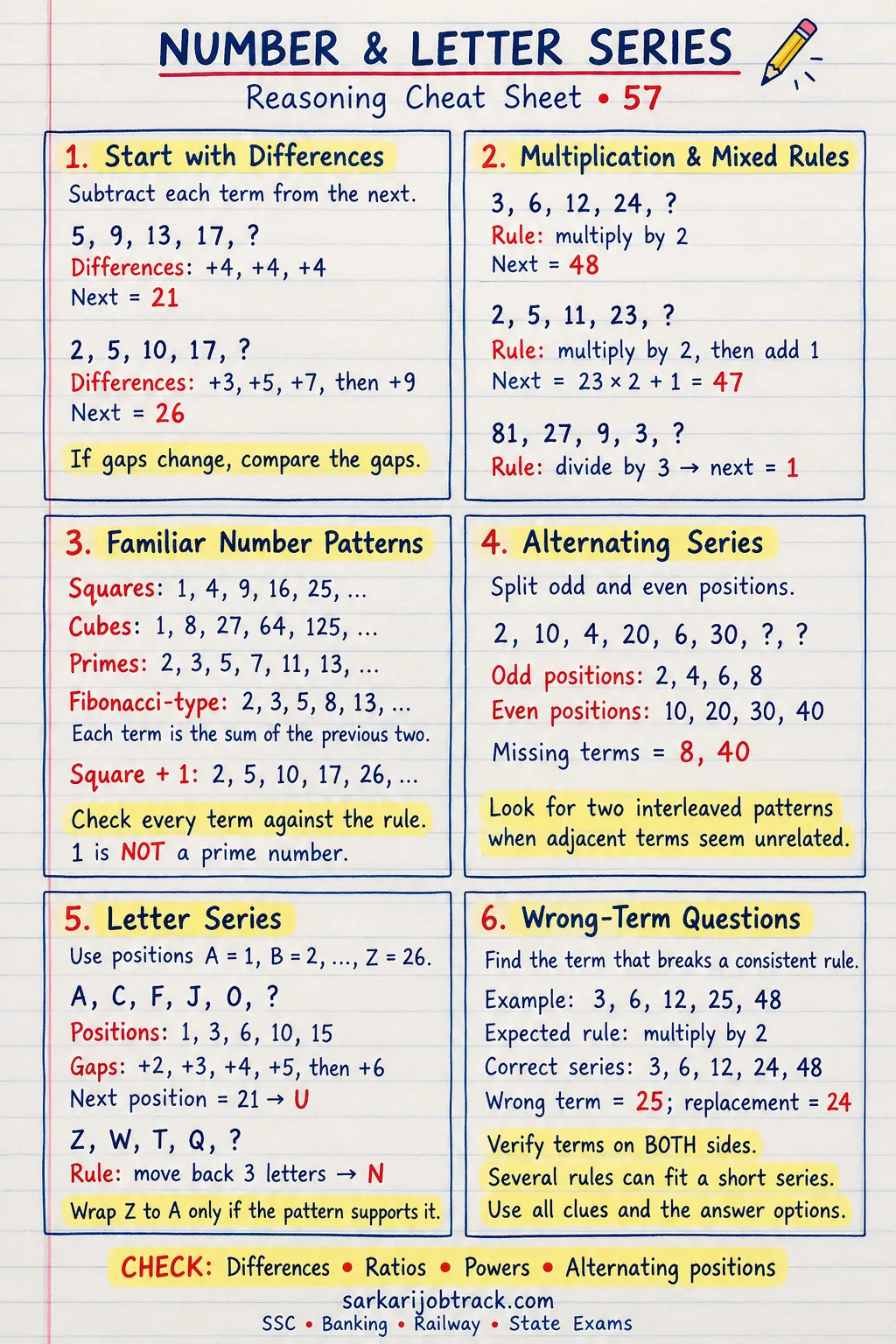
Already confident? Skip to practice: Number and Letter Series quiz
Before this: the letter questions use the alphabet positions from the Coding–Decoding lesson: A = 1, B = 2 … Z = 26, and EJOTY gives every fifth one (E = 5, J = 10, O = 15, T = 20, Y = 25). Keep its table handy, because every letter series becomes a number series once you write the positions down.
What a series question looks like
A series is a row of numbers or letters that follow one rule. You are usually asked one of two things:
- Find the next term. The row ends with a gap:
3, 7, 11, 15, ?— find the number that comes next. - Find the wrong term. One term in the row breaks the rule; find it: in
5, 11, 17, 24, 29one number does not belong.
The whole skill is finding that one rule. Picture-based series (rows of shapes or figures) are not covered in this lesson; they come later.
Start with the differences
For almost every number series, the first thing to write is the difference between each pair of terms — the amount you add to get from one to the next. The differences tell you which kind of rule you are looking at:
- The differences are all the same → the rule is "add a fixed number" (or subtract one).
- The differences grow or shrink in a pattern (1, 2, 3, 4 …) → look at the differences of the differences.
- The differences multiply (×2, ×3 …) → the terms themselves are being multiplied.
When the differences do not settle into anything, try two more ideas: the terms may be squares or cubes (or those just one away, like 9 + 1 or 27 − 1), or two series may be taking turns, one in the odd places and one in the even places. The worked examples below show each of these in turn.
For a letter series, there is one extra first step: write the position of each letter, turn the row into numbers, and then do exactly the same thing. At the end, turn the position back into a letter.
Worked examples
Read each example slowly. The first two show every step. In the later ones, some steps are left for you, with the answer just below.
Example 1: A constant difference
Question: Find the next number: 3, 7, 11, 15, 19, ?
Write the difference under each pair:
3    7    11    15    19    ?
+4 +4 +4 +4 +4- From 3 to 7 is +4. From 7 to 11 is +4. Check every pair: all of them are +4.
- The rule is "add 4", so the next number is 19 + 4 = 23.
The principle: find the difference between each pair first. If every difference is the same, the rule is to add (or subtract) that fixed number. A row that goes down works the same way: 20, 17, 14, 11, … is "subtract 3".
Example 2: The differences grow
Question: Find the next number: 2, 3, 5, 8, 12, ?
The differences are not equal this time, so write them out and then look at how they change:
2    3    5    8    12    ?
+1 +2 +3 +4 +?- The differences are 1, 2, 3, 4 — each one is a little bigger than the last.
- The differences themselves go up by 1 each time, so the next difference is 5.
- The next number is 12 + 5 = 17.
The principle: when the differences are not equal, write the differences of the differences. If those are equal, you have the pattern. Here each step grows by 1; in another series each step might grow by 2 (1, 3, 5, 7 …) or the steps might be 1, 4, 9, 16 (the squares).
Example 3: Multiplying, and squares and cubes
Part (a): Find the next number: 3, 6, 12, 24, 48, ?
- The differences here (3, 6, 12, 24) are not equal and they do not grow by a fixed amount — but each term is double the one before: 3 × 2 = 6, 6 × 2 = 12, and so on.
- Your turn: double the last term.
Check: 48 × 2 = 96.
Part (b): Find the next number: 1, 4, 9, 16, 25, ?
- These are the square numbers: 1 = 1 × 1, 4 = 2 × 2, 9 = 3 × 3, 16 = 4 × 4, 25 = 5 × 5.
- The next square is 6 × 6.
Check: 6 × 6 = 36.
Series often use squares and cubes in disguise, each one or two away from the round number. 3, 8, 15, 24, 35 is one less than a square every time (4 − 1, 9 − 1, 16 − 1, 25 − 1, 36 − 1), so the next is 49 − 1 = 48. And 1, 8, 27, 64 are the cubes (1 × 1 × 1, 2 × 2 × 2, 3 × 3 × 3, 4 × 4 × 4), so the next is 5 × 5 × 5 = 125.
The principle: if the differences lead nowhere, check whether the terms are being multiplied by a fixed number, and whether they are squares or cubes (or those plus or minus a small number). It helps to know the squares up to 15 × 15 = 225 and the cubes up to 10 × 10 × 10 = 1000.
Example 4: Two series taking turns
Question: Find the next number: 1, 3, 4, 9, 7, 27, 10, 81, ?
The numbers jump about, so try splitting the row into two series, one in the odd places and one in the even places:
- The 1st, 3rd, 5th and 7th numbers are 1, 4, 7, 10 — each is +3 on the last.
- The 2nd, 4th, 6th and 8th numbers are 3, 9, 27, 81 — each is ×3 on the last.
- The gap is the 9th place, which belongs to the first series (1, 4, 7, 10, …).
- Your turn: add 3 to the last term of that first series.
Check: 10 + 3 = 13.
The principle: if one rule will not fit the whole row and the numbers rise and fall, the row may be two series laid together, one in the odd places and one in the even places. Read every other term, find each series' own rule, and see which series the gap belongs to.
Example 5: Finding the wrong term
Question: One number breaks the pattern. Find it: 5, 11, 17, 24, 29, 35
- Write the differences: 5 (+6) 11 (+6) 17 (+7) 24 (+5) 29 (+6) 35.
- Almost every step is +6. If the rule is "add 6", the row should be 5, 11, 17, 23, 29, 35.
- The row gives 24 where 23 belongs.
- Your turn: which number is the wrong one?
Check: the wrong number is 24 (it should be 23).
The principle: for a wrong-term question, find the rule the rest of the row obeys, then read along until one term disagrees with it. The commonest trap is to "correct" the wrong term and keep going — but the numbers after it are usually right, so check them against the rule too.
Example 6: Letter series
Write the position of each letter (A = 1 … Z = 26), solve it as a number series, then turn the answer back into a letter.
Part (a) — a constant skip: D, H, L, P, ?
- Positions: D = 4, H = 8, L = 12, P = 16. The step is +4 each time.
- Your turn: add 4 to 16 and name the letter.
Check: 16 + 4 = 20, which is T.
Part (b) — a growing skip: C, D, F, I, M, ?
- Positions: C = 3, D = 4, F = 6, I = 9, M = 13. The steps are +1, +2, +3, +4.
- Your turn: the next step is +5. Add it to 13 and name the letter.
Check: 13 + 5 = 18, which is R.
Part (c) — two letters taking turns: A, Z, C, X, E, V, ?
- The 1st, 3rd and 5th letters are A (1), C (3), E (5), going up by 2. The 2nd, 4th and 6th are Z (26), X (24), V (22), going down by 2.
- The gap is the 7th place, which belongs to the rising series (1, 3, 5, …).
- Your turn: add 2 to 5 and name the letter.
Check: 5 + 2 = 7, which is G.
Part (d) — positions that follow a number pattern: A, C, F, J, O, ?
- Positions: A = 1, C = 3, F = 6, J = 10, O = 15. The steps grow 2, 3, 4, 5 — these are the triangular numbers.
- Your turn: the next step is +6. Add it to 15 and name the letter.
Check: 15 + 6 = 21, which is U.
The principle: a letter series is a number series in disguise. Write the positions, find the rule exactly as you would for numbers (a fixed skip, a growing skip, two letters taking turns, or a position rule such as a known number pattern), then convert the answer back to a letter. For a reverse row (Z, W, T, …) the positions simply go down.
How to attack any series question
- Look at the differences first. Write the amount added between each pair of terms.
- If the differences are all the same, the rule is to add (or subtract) that fixed number.
- If the differences are not the same, look at the differences of the differences, or check whether the terms are multiplied by a fixed number (look at the ratios).
- If neither settles, check for squares and cubes, and for those just one or two away from the round number.
- If the row rises and falls, check whether two series are taking turns — read every other term.
- For letters, convert to positions (A = 1 … Z = 26) and solve it as a number series, then turn the answer back into a letter.
- Test a rule against every term you are given, not just the first two. A good rule fits them all.
- For a wrong-term question, find the rule the rest of the row obeys, then read along until one term disagrees — and keep checking the terms after it.
At a glance: the rules in one place
Learn these facts by heart: the squares up to 15 × 15 = 225, the cubes up to 10 × 10 × 10 = 1000, and the alphabet positions (A = 1 … Z = 26; EJOTY = 5, 10, 15, 20, 25) from the Coding–Decoding lesson.
- Constant difference: every step is the same. Add (or subtract) that number. Example: 3, 7, 11, 15 → +4.
- Growing or shrinking difference: the steps change in a pattern. Look at the differences of the differences. Example: 2, 3, 5, 8, 12 → steps 1, 2, 3, 4.
- Multiplying: each term is the last one times a fixed number. Example: 3, 6, 12, 24 → ×2. The multiplier can itself grow larger: 7, 14, 42, 168 → ×2, ×3, ×4 (the next step is ×5).
- Squares and cubes: the terms are n × n or n × n × n, sometimes plus or minus a small number. Example: 3, 8, 15, 24 → each is one less than a square.
- Two series taking turns: one rule in the odd places, another in the even places. Read every other term.
- Letter series: write the positions, solve as a number series, convert back. Watch for a constant skip, a growing skip, two letters taking turns, or a position rule such as a known number pattern (squares or the triangular numbers).
- Wrong term: find the rule the rest obey, then read along for the term that disagrees.
Common mistakes
- Trusting a rule after two terms. 2, 4, … could be +2 or ×2. Read the whole row before deciding; a rule must fit every term.
- Stopping at the first difference. When the differences are not equal, the pattern is usually in the differences of the differences, not in the first pair.
- Missing two interleaved series. If the numbers go up and down with no single rule, read every other term.
- Forgetting to convert the answer back to a letter. In a letter series the working is in numbers, but the answer is a letter.
- "Correcting" a wrong term and reading on. The terms after the wrong one are usually right; check them against the rule, or you will find a second "mistake" that is not there.
Next
The next Reasoning topics are Mathematical Operations, Blood Relations, Direction Sense and Syllogism. Picture-based series — rows of shapes rather than numbers or letters — come with the Non-Verbal Reasoning topic later.
Ready to test this lesson? Take the Number and Letter Series quiz
How this was made: Drafted with AI assistance; every formula and worked figure recomputed independently; spot-checked by the editor on 30 October 2026.