
Venn Diagrams: Reading Overlap and Counting the Regions
Learn to pick the diagram that fits a set of classes by asking "is every X a Y?" and "can something be both?", and to read a region-count diagram described in words and answer "exactly two", "at least two" or "only one", through worked examples of each shape, a checklist for any question and a revision list.
By the end of this lesson you will be able to look at a set of classes and choose the diagram that shows how they relate, and read a Venn diagram whose region counts are given to you and answer how many items fall in "exactly two", "at least two" or "only one" of the groups.
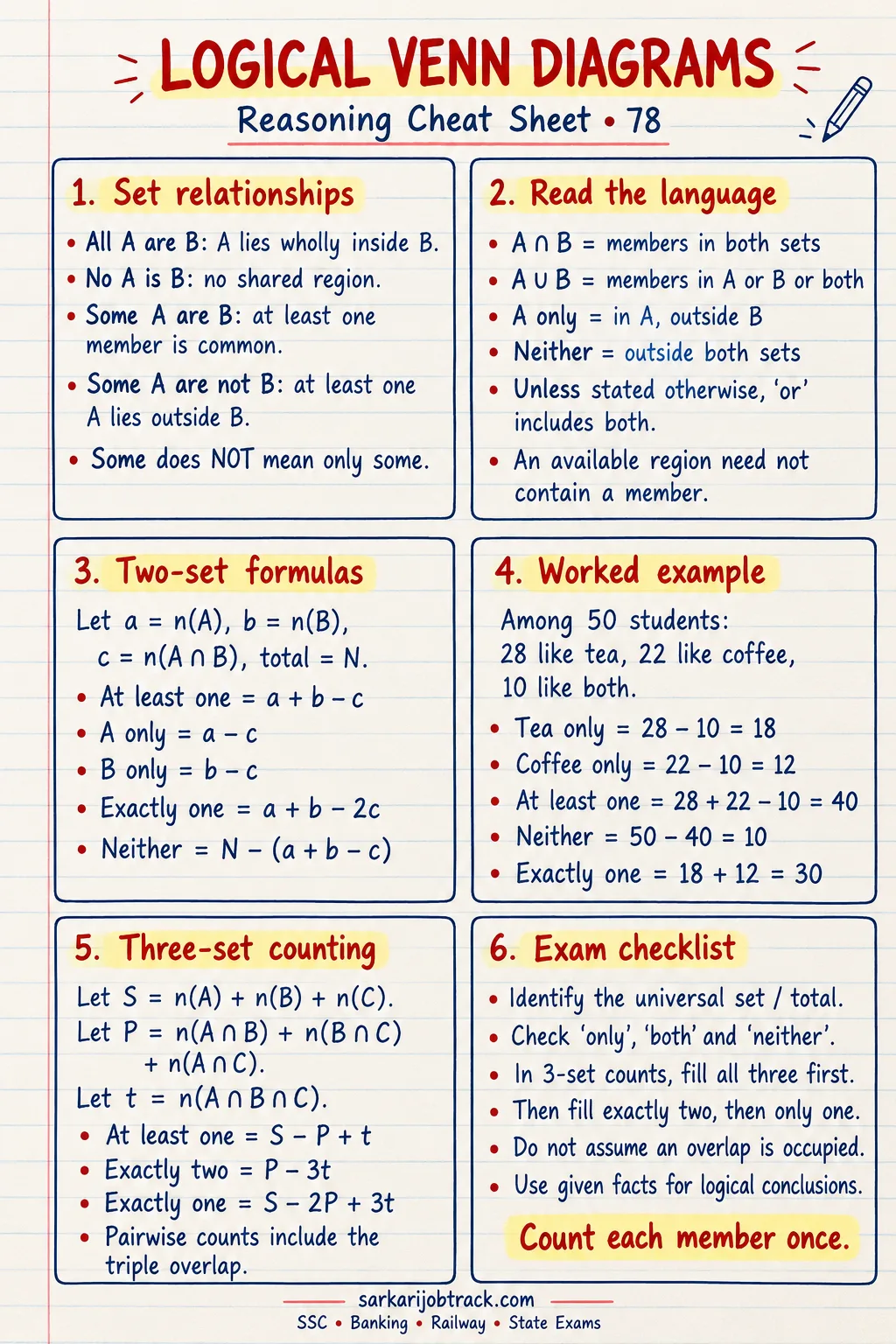
Already confident? Skip to practice: Venn Diagrams quiz
Before this: the circles here are the same circles you drew in the Syllogism and Statement-Conclusion lesson — one circle inside another for "all", two apart for "no", two overlapping for "some". Venn questions use those same three pictures, but instead of testing a conclusion you either pick the right picture for a list of classes or count the things sitting in each region. Keep that habit of asking "could something be both?" — it is the whole of the first kind of question.
Every diagram on this page is described in words, because the page shows no picture. A "which diagram" question therefore lists the options as relationships you can check in your head ("two circles apart, both inside a third"), and a counting question gives you the number in each region as plain text. Nothing here needs you to see a figure.
The two kinds of Venn question
- Which diagram fits these classes? You are given three or four classes — for example Vegetables, Potato, Onion — and asked which arrangement of circles shows how they relate. You answer it by asking, for each pair, two questions: is every one of these also one of those? and can a single thing be both?
- How many are in a region? You are given a diagram with a number written in each region, and asked something like "how many play exactly two games?" or "how many study only one subject?" You answer it by adding the right regions — and the whole skill is knowing which regions "exactly two", "at least two" and "only one" mean.
The three shapes two classes can make
Any two classes sit together in exactly one of three ways. Learn to name them:
- One inside the other. Every A is a B, so the A circle sits wholly inside the B circle. Every rose is a flower, so the rose circle is inside the flower circle. Nothing is a rose without also being a flower.
- Partly overlapping. Some A are B and some are not, so the two circles cross and share a lens-shaped middle. Some doctors are women: the doctor circle and the woman circle overlap, but neither sits inside the other.
- Completely separate. No A is a B, so the two circles do not touch at all. No dog is a cat: the two circles sit apart.
That is the entire vocabulary. A three-class question is just these shapes used twice or three times at once.
Picking the diagram for a set of classes
Take the classes two at a time and ask the two questions — is every X a Y? and can something be both? — then put the third class in.
- If every X is a Y, draw X inside Y.
- If some are and some are not (a thing can be both, but need not be), draw them overlapping.
- If nothing can be both, draw them apart.
The commonest traps are drawing an overlap the classes do not require, and getting the direction of "inside" backwards. Work through the examples below and both will become automatic.
Reading a region-count diagram
When numbers are placed in a diagram, picture three overlapping circles and name the seven regions they make. For three classes A, B and C the regions are:
- only A — inside A alone;
- only B;
- only C;
- A and B only — in both A and B but not C;
- B and C only;
- A and C only;
- all three — in the middle, inside A, B and C.
The question will give you a number for each. Then:
- "only A" or "exactly one" is the single region (or the three single regions added).
- "exactly two" means the three "... only" pair regions added — not the middle. A thing in all three is in three groups, not two.
- "at least two" means the three pair regions plus the middle (two or more).
- "the total in A" means every region that touches A: only A, the two pairs that include A, and the middle.
For two classes it is simpler: the regions are only A, only B, and both. If you are given totals instead of region counts — "30 do A, 24 do B, 10 do both" — then only A is the A total minus the both, and the number doing at least one is A + B − both (you subtract the both once because it was counted in each total).
Worked examples
Read each slowly. The first two show every step; later ones leave a step for you with the answer just below.
Example 1: One class inside another
Question: Which diagram fits Flowers, Roses, Lotuses? Options: (A) all three circles separate; (B) Roses and Lotuses overlapping, both inside Flowers; (C) Roses and Lotuses separate from each other, both inside Flowers; (D) Roses inside Lotuses, both inside Flowers.
- Every rose is a flower, and every lotus is a flower — so both the rose circle and the lotus circle sit inside the flower circle.
- Now ask the second question about roses and lotuses: can a single thing be both a rose and a lotus? No — they are different flowers. So those two circles must be apart, not overlapping.
- That is two separate circles, both inside a third.
The principle: when two kinds both belong to one bigger class but cannot be each other, draw them as two separate circles inside the big one. The answer is (C).
Example 2: Two classes overlapping
Question: Which diagram fits Human beings, Women, Doctors? Options: (A) Women and Doctors separate, both inside Human beings; (B) Women and Doctors overlapping, both inside Human beings; (C) all three separate; (D) Human beings inside Women.
- Every woman is a human being and every doctor is a human being, so both circles sit inside the human-beings circle. That rules out (C) and (D).
- The deciding question is women against doctors: can one person be both a woman and a doctor? Yes — some women are doctors. But is every woman a doctor, or every doctor a woman? No. So the two circles must overlap, not one inside the other and not apart.
- Overlapping circles, both inside the big one.
The principle: when a thing can be both but need not be, the circles overlap. The answer is (B). Contrast it with Example 1: roses and lotuses could never be both, so they stayed apart.
Example 3: Everything separate
Question: Which diagram fits Pen, Pencil, Eraser?
- Ask the two questions for each pair. Is a pen ever a pencil? No. A pencil ever an eraser? No. A pen ever an eraser? No.
- No pair can share a member, and none is inside another, so all three circles sit apart.
Answer: three completely separate circles.
The principle: when no two of the classes can share a single member, the diagram is three circles with no contact. Do not invent an overlap just because the items are "related" (all three are stationery) — relatedness is not overlap.
Example 4: Exactly two versus at least two
Question: In a group, the Venn diagram of three activities — Singing, Dancing, Painting — shows these counts: only Singing 11, only Dancing 9, only Painting 7, Singing and Dancing only 4, Dancing and Painting only 3, Singing and Painting only 5, all three activities 2. How many people do exactly two of the activities?
- "Exactly two" means in two circles and not the third — the three pair-only regions: Singing-and-Dancing-only, Dancing-and-Painting-only, Singing-and-Painting-only.
- Those are 4, 3 and 5.
- Add them: 4 + 3 + 5 = 12. The middle (all three = 2) is not included — those people do three, not two.
Answer: 12.
Now change one word. How many do at least two activities? "At least two" adds the middle: 4 + 3 + 5 + 2 = 14. The single-word change from exactly to at least brings in the all-three region.
The principle: "exactly two" is the three pair-only regions; "at least two" is those three plus the middle. Reading one as the other is the most common counting error on this topic.
Example 5: The total in one circle, and "only one"
Question (same diagram as Example 4): How many people sing in total? And how many do only one activity?
- "Sing in total" means every region inside the Singing circle: only Singing, Singing-and-Dancing-only, Singing-and-Painting-only, and all three.
- Your turn: add those four numbers (11, 4, 5, 2).
Check: 11 + 4 + 5 + 2 = 22 sing in total.
- "Only one activity" is the three single regions added: only Singing + only Dancing + only Painting = 11 + 9 + 7 = 27.
The principle: the total in a circle is every region that touches it — including the pair regions and the middle, not just the "only" region. "Only one" is the three lonely single regions and nothing else.
Example 6: A two-class count from totals
Question: In a class, 30 students play Chess, 18 play Carrom, and 8 play both. How many play only Chess, and how many play at least one of the two games?
- The 30 who play chess include the 8 who also play carrom. Those who play only chess are 30 − 8.
- Your turn: do the subtraction.
Check: 30 − 8 = 22 play only chess.
- "At least one" is chess + carrom − both, subtracting the 8 once because they were counted in both totals: 30 + 18 − 8 = 40.
The principle: with two classes given as totals, only A = A − both, and at least one = A + B − both. The subtraction of "both" is what stops you double-counting the overlap.
Example 7: A minimum-overlap question
Question: In a town, 60% of people own a car and 45% own a scooter. At least what percentage own both?
- If the two groups overlapped as little as possible, they would still have to crowd into 100% of the town. Car owners plus scooter owners come to 60 + 45 = 105%, which is 5 more than 100.
- That 5% excess cannot fit unless 5% are counted in both groups. So the overlap can be no smaller than 105 − 100 = 5%.
Answer: 5%.
The principle: the smallest possible overlap of two groups is (their sizes added) − (the whole), when that is positive. The largest possible overlap is simply the size of the smaller group (if one group could sit entirely inside the other).
How to attack any Venn question
- Decide which kind it is — pick-the-diagram, or count-the-region.
- For pick-the-diagram, take the classes two at a time. Ask is every one of these also one of those? (→ inside) and can a single thing be both? (→ overlap if it can but need not; apart if it never can).
- Do not draw an overlap the classes do not force, and do not flip the direction of "inside" — every rose is a flower, not every flower a rose.
- For counting, name the seven regions and match the words: "exactly two" is the three pair-only regions; "at least two" adds the middle; "only one" is the three single regions; "total in A" is every region touching A.
- For two classes given as totals, use only A = A − both and at least one = A + B − both.
- For a minimum overlap, add the group sizes and subtract the whole; for a maximum overlap, take the smaller group.
At a glance: the rules in one place
Three shapes for two classes: inside (every A is a B), overlapping (some can be both), apart (none can be both). Pick the diagram by asking those two questions for each pair.
- Inside: every X is a Y → X circle inside Y circle. Direction matters.
- Overlapping: a thing can be both but need not be → circles cross.
- Apart: nothing can be both → circles do not touch. Being "related" is not overlap.
- only A / exactly one: the single region(s), nothing shared.
- exactly two: the three pair-only regions added; the middle is excluded.
- at least two: the three pair-only regions plus the all-three middle.
- total in A: every region inside the A circle — only A, both pairs with A, and the middle.
- two classes from totals: only A = A − both; at least one = A + B − both.
- minimum overlap: A + B − whole (when positive). maximum overlap: the smaller group.
Common mistakes
- Reading "exactly two" as "at least two". They differ by the all-three region every time. Decide which word the question used before you add.
- Inventing an overlap. Potato and onion are both vegetables but can never be each other, so their circles stay apart. Related is not the same as overlapping.
- Flipping "inside". Every square is a rectangle; not every rectangle is a square. Put the smaller, fully-contained class inside.
- Leaving the middle out of a circle total. The people in "all three" are inside each circle, so they count towards each circle's total and towards "at least two".
- Double-counting the overlap in a two-class total. When you add two group totals, the shared members are in both, so subtract the overlap once to get "at least one".
Next
The later Reasoning topics are Mathematical Operations, Blood Relations, Direction Sense and Puzzles and Seating Arrangement. If the "which diagram" questions felt shaky, revisit the overlapping circles in the Syllogism and Statement-Conclusion lesson — the pictures are the same, and the question only changes from "which conclusion follows" to "which diagram fits".
Ready to test this lesson? Take the Venn Diagrams quiz
How this was made: Drafted with AI assistance; every formula and worked figure recomputed independently; spot-checked by the editor on 30 October 2026.